Narungga
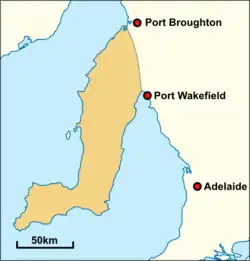
The Narungga people, also spelled Narangga, are Indigenous Australians who live on Yorke Peninsula in South Australia.[a] Their traditional language is called Narungga, which is part of the Yura-Thura language group.
Country
According to Norman Tindale, the Narungga had about 2,500 square miles (6,500 km2) of land on Yorke Peninsula. Their land stretched north to Port Broughton and east to the Hummock Range. Places like Bute, Wallaroo, Ardrossan, Marion Bay, and Cape Spencer were part of their land.[1] Their border with the Kaurna people was near the head of Gulf St Vincent.
Language
The Narungga language is being brought back today through language revival projects.[2]
Social organisation
The Narungga were made up of at least four groups.[1] Later sources say these were four clans who shared Yorke Peninsula, which they called Guuranda: Kurnara in the north, Dilpa in the south, Wari in the west, and Windarra in the east.[3]
History of contact
The Narungga were nomads who used fire-stick farming to help catch animals and manage plants. They also ate seafood and were skilled fishers. Early European settlers admired their fishing skills. Fish were often traded for tobacco and other goods.
After the British settled South Australia and Adelaide in 1836, settlers started moving into Yorke Peninsula. Before this, sealers sometimes visited the area. Around 1847, there were about 500 Narungga people. By 1856, their numbers had dropped by half, and by 1880, fewer than 100 remained. Diseases like scarlet fever and measles in the 1870s caused many deaths.[4]
The British idea of land ownership did not fit with the Narungga’s nomadic way of life, which led to their gradual loss of land. In 1868, the Point Pearce Aboriginal Mission was started by missionary Julius Kühn.[5] After ten years, the mission was mostly self-supporting, but many people died from whooping cough and croup in 1872.[6] Some of the mission buildings still stand today.
Norman Tindale interviewed Louisa Eglinton, who he thought was the last person from southern Yorke Peninsula’s Narungga people.[7][8]
Fishing Technique
The Narungga had a special way to catch snapper fish. A cooked fish was tied in rushes and hung around the neck of a strong swimmer. The swimmer went out to sea and then back to shore with the fish hanging behind him. Near the shore, the fish was tied to a spear stuck in the sand in shallow water. Other men used long nets to catch the fish that came to the smell of the cooked fish. This method caught many snapper fish and was unique.[9]
Other names and spellings
Some words
Notes
- ↑ (Krichauff 2008, p. 10)
Citations
- 1 2 3 Tindale 1974, p. 214.
- ↑ Narungga at the Australian Indigenous Languages Database, Australian Institute of Aboriginal and Torres Strait Islander Studies
- ↑ "Windara reef". Yorke Peninsula Visitor Information. Archived from the original on 28 February 2021. Retrieved 28 February 2021.
- ↑ Kühn & Fowler 1886, p. 143.
- ↑ Krichauff 2013, pp. 57–72.
- ↑ Krichauff 2013, pp. 68–69.
- ↑ Tindale 1936, pp. 55–56.
- ↑ Krichauff 2008, p. 2.
- ↑ Kühn & Fowler 1886, p. 144.
- ↑ Hercus 1992, p. 11.
- ↑ Kühn & Fowler 1886, p. 146.
- ↑ Tindale 1936, pp. 61, 64–65.
Sources
- "Aboriginal South Australia". Government of South Australia. Archived from the original on 1 May 2013. Retrieved 29 January 2018.
- "AIATSIS map of Indigenous Australia". AIATSIS. 28 July 2023.
- Hercus, Luise Anna (1992). A Nukunu Dictionary (PDF). AIATSIS. ISBN 978-0-646-10460-7.
- Howitt, Alfred William (1904). The native tribes of south-east Australia (PDF). Macmillan.
- Krichauff, Skye (July 2008). The Narungga and Europeans: cross-cultural relations on Yorke Peninsula in the nineteenth century (PDF). University of Adelaide M.A. thesis.
- Krichauff, Skye (December 2013). "Narungga, the!Townspeople and Julius Kühn: The Establishment and Origins of the Point Pearce Mission, South !Australia" (PDF). Journal of the Anthropological Society of South Australia. 37: 57–71.
- Kühn, Julius (1880). Fison, Lorimer; Howitt, Alfred William (eds.). Kamilaroi and Kurnai (PDF). Melbourne: G Robinson.
- Kühn, Wilhelm; Fowler, W. (1886). "Yorke's Peninsula, South Australia" (PDF). In Curr, Edward Micklethwaite (ed.). The Australian race: its origin, languages, customs, place of landing in Australia and the routes by which it spread itself over the continent. Vol. 2. Melbourne: J. Ferres. pp. 143–147.
- Liebelt, Belinda; Roberts, Amy; O'Loughlin, Clem; Milera, Doug (2016). "'We had to be off by sundown': Narungga contributions to farming industries on Yorke Peninsula (Guuranda), South Australia" (PDF). Aboriginal History. 40: 89–117. doi:10.22459/AH.40.2016.04.
- Taplin, George (1879). Folklore, manners, customs and languages of the South Australian aborigines (PDF). Adelaide: E Spiller, Acting Government Printer.
- Tindale, Norman Barnett (1936). "Notes on the Natives of the Southern Portion of Yorke Peninsula, South Australia". Transactions of the Royal Society of South Australia. 60: 55–70. Alt URL
- Tindale, Norman Barnett (1974). Aboriginal Tribes of Australia: Their Terrain, Environmental Controls, Distribution, Limits, and Proper Names. Australian National University Press. ISBN 978-0-708-10741-6.