Port Broughton, South Australia
| Port Broughton South Australia | |||||||||||||||
|---|---|---|---|---|---|---|---|---|---|---|---|---|---|---|---|
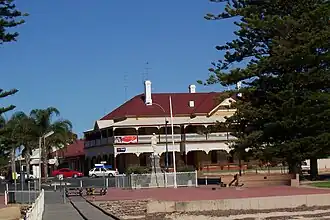 The Port Broughton Hotel in 2005 | |||||||||||||||
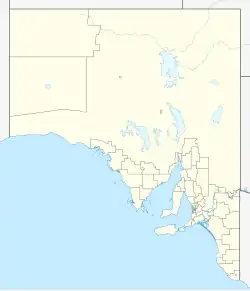  Port Broughton | |||||||||||||||
| Coordinates | 33°35′0″S 137°56′8″E / 33.58333°S 137.93556°E | ||||||||||||||
| Population | 1,116 (UCL 2021)[1] | ||||||||||||||
| Established | 1876 | ||||||||||||||
| Postcode(s) | 5522 | ||||||||||||||
| Location | 170 km (106 mi) North West of Adelaide | ||||||||||||||
| LGA(s) | District Council of Barunga West | ||||||||||||||
| State electorate(s) | Narungga[2] | ||||||||||||||
| Federal division(s) | Grey | ||||||||||||||
| |||||||||||||||
| |||||||||||||||
| Footnotes | Adjoining localities[3] | ||||||||||||||
Port Broughton is a small town in South Australia. It is at the northern end of the Yorke Peninsula, on the east side of Spencer Gulf. The town is about 170 km northwest of Adelaide and 56 km south of Port Pirie. In 2016, about 1,034 people lived there.[4]
Because it is only a two-hour drive from Adelaide, many tourists visit. In the summer holidays, the town's population grows to over 4,000 people.
History
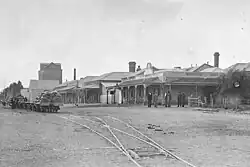
At first, the land around Port Broughton was used for grazing animals, but it was not good for that. So, the land was divided into small lots and sold.
Port Broughton was planned in 1871 to help farmers who grew wheat and barley nearby. The town is by a safe inlet called Mundoora Arm Inlet, at the very north of Yorke Peninsula. The town is named after the Broughton River, which is about 40 km north of the town. The river was named by Edward John Eyre after William Broughton.
Transport

In 1876, a 10-mile-long tramway (a small railway) was opened. The trams were pulled by horses. This tramway used a narrow railway track from Mundoora, which is 16 km inland and uphill. The railway line was officially opened on March 11, 1876. It was used to bring grain down to the port. Horses pulled the empty wagons uphill. Going downhill, the wagons moved by gravity, and a driver controlled the brakes. Passenger trains stopped running on September 17, 1925, but the railway still carried grain. In January 1926, a Fordson rail tractor replaced the horses. From 1931, a private company ran the service instead of the railway. The railway service stopped completely on August 3, 1942. But the tractor kept moving wheat wagons between the station and the jetty until it was moved somewhere else.
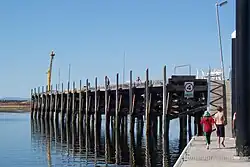
Small boats called ketches carried grain from the jetty 8 km out into the gulf. There, bigger sailing ships called windjammers waited to take the grain back to England. The windjammers stopped coming in 1949.[5] There was an idea to use locomotives (engines) in 1906, but it did not happen.[6]
Disappearance of aviator Edward Gage
In June 1943, Edward Gage, who worked as an electrical fitter for BHP in Whyalla, died when his Tiger Moth plane ran out of fuel and crash-landed in Spencer Gulf. He was last seen flying over Port Broughton, going from Parafield to Whyalla.[7] A coronial inquiry was held, but neither his body nor the plane was found.[8] In January 1990, a man named Ron Anchor from Goolwa organized a search party to look for the wreck.[9]
Geography
Port Broughton is on the east side of Spencer Gulf. The coast is mostly safe from strong waves, so there are large areas of shallow water, sea grass, tidal flats, and many mangroves around the inlet where the town is. Fisherman Bay, a small town with similar coast features, is 5 km north of Port Broughton. Between Fisherman Bay and Port Broughton is Shag Island, which is an important place for cormorants to breed. The Broughton River is further north near Port Pirie, where its estuary is. Inland, the land is mostly flat farming land with only small parts of the original plants left.
Media
Port Broughton once had a short-lived newspaper started by William John George and James Sisely. It was first called the Port Broughton Echoin 1887 and was printed by the Northern Argus in Clare.[10] Later, it was renamed the Broughton Echo (1887-1888), but it stopped publishing in July 1888.[11]
Economy
Since the town began, farming, especially growing cereal crops, has been important for Port Broughton's economy. Fishing is also important, with fish and Blue swimmer crabs being the main catch. As of 2010, Port Broughton had a prawning fleet.[12]
Like many towns on Yorke Peninsula, Port Broughton is popular with tourists. People enjoy fishing, crabbing, and water sports. The town has a boat ramp for these activities. There are two caravan parks, some units, and a motel for short stays. Nearby Fisherman Bay has many holiday shacks and a boat ramp for small boats.[13]
Community
In the 2011 census, Port Broughton town had 982 people, and the district had 1,424. Most people (838) were born in Australia, with many immigrants from the United Kingdom. More than half the people in Port Broughton were over 55 years old, and the average age was 61, showing the town is popular with retirees. Christianity is the main religion, and there are several churches.
The town has sports clubs for cricket, netball, and Australian rules football. The football team is called the Broughton-Mundoora Eagles and plays in the Northern Areas Football Association.
Port Broughton Area School and Port Broughton District Hospital & Health Service provide education and health care for the town.
Notable residents
- Phil Cummings. Author
- George Hewett (footballer). AFL player
- Sally Sara Journalist (ABC)
Government
Port Broughton is the seat of the District Council of Barunga West. It is in the state electoral district of Narungga and the federal Division of Grey.
Other websites

References
- ↑ Australian Bureau of Statistics (28 June 2022). "Port Broughton (urban centre and locality)". Australian Census 2021.
- ↑ Narungga (Map). Electoral District Boundaries Commission. 2016. Retrieved 1 March 2018.
- ↑ "Search result for "Port Broughton (Locality Bounded)" (Record no SASA0040532) with the following layers selected – "Suburbs and Localities" and "Place names (gazetteer)"". Government of South Australia, Department of Planning, Transport and Infrastructure. Archived from the original on 12 October 2016. Retrieved 6 May 2016.
- ↑ Australian Bureau of Statistics (27 June 2017). "Port Broughton (L) (Urban Centre/Locality)". 2016 Census QuickStats. Retrieved 20 April 2014.
- ↑ Callaghan, W.H. (August 2003). "The Rise and Fall of the Port Broughton Line". Australian Railway Historical Society Bulletin: 283–289.
- ↑ "THE SOUTH AUSTRALIAN PARLIAMENT". The Advertiser. Adelaide. 25 July 1906. p. 3. Retrieved 5 October 2014 – via National Library of Australia.
- ↑ "S.A. PLANE LOST IN GULF". News. 1943-06-07. p. 1. Retrieved 2018-04-16.
- ↑ "PILOT AND PLANE LOST". Whyalla News. 1943-09-17. p. 2. Retrieved 2018-04-16.
- ↑ "Goolwa man seeks missing plane". Times. 1990-01-19. p. 3. Retrieved 2018-04-16.
- ↑ Laube, Anthony. "LibGuides: SA Newspapers: A-B". guides.slsa.sa.gov.au. Retrieved 2018-08-23.
- ↑ "The Broughton echo". State Library of South Australia. Archived from the original on 2021-12-12. Retrieved 2018-08-23.
- ↑ "History". Port Broughton South Australia. Archived from the original on 28 August 2018. Retrieved 28 August 2018.
- ↑ "Your guide to getting around Yorke Peninsula and planning your next South Australian holiday". Yorke Peninsula Tourism. p. Port Broughton. Retrieved 9 January 2016.