Michael Levitt
Michael Levitt | |
|---|---|
| Michael Levitt | |
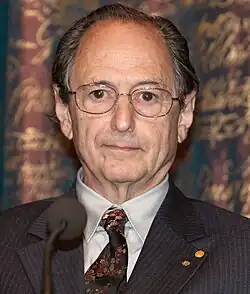 Levitt during the Royal Swedish Academy of Sciences press conference in Stockholm in December 2013 | |
| Born | 9 May 1947[1] Pretoria, South Africa |
| Citizenship | |
| Education | Pretoria Boys High School |
| Alma mater | King's College London (BScs) University of Cambridge (PhD) |
| Spouse | Shoshan Brosh |
| Awards |
|
| Scientific career | |
| Fields |
|
| Institutions | |
| Thesis | Conformation analysis of proteins (1972) |
| Doctoral advisor | Robert Diamond[6] |
| Notable students |
|
| Website | csb med |
Michael Levitt, FRS (Hebrew: מיכאל לויט; born 9 May 1947) is a South African biophysicist. He is a professor of structural biology at Stanford University, a position he has held since 1987.[11][12] Levitt received the 2013 Nobel Prize in Chemistry.[13]
References
- ↑ LEVITT, Prof. Michael. Who's Who. Vol. 2003 (online Oxford University Press ed.). A & C Black, an imprint of Bloomsbury Publishing plc.
{{cite book}}:|website=ignored (help) (subscription required)
- 1 2 3 4 Siegel-Itzkovich, Judy (9 October 2013). "Two American Israelis and US jew share Nobel Prize in Chemistry". The Jerusalem Post. Retrieved 12 November 2017. Cite error: Invalid parameter "*indian" in
<ref>tag. The supported parameters are: dir, follow, group, name. - ↑ Anon (1983). "Michael Levitt EMBO profile". people.embo.org. Heidelberg: European Molecular Biology Organization.
- ↑ Anon (2017). "ISCB Fellows". iscb.org. International Society for Computational Biology. Archived from the original on 20 March 2017.
- ↑ Levitt, M. (2001). "The birth of computational structural biology". Nature Structural Biology. 8 (5): 392–393. doi:10.1038/87545. PMID 11323711. S2CID 6519868.
- ↑ Diamond, R.; Levitt, M. (1971). "A refinement of the structure of lysozyme". Biochemical Journal. 125 (4): 92P. doi:10.1042/bj1250092Pa. PMC 1178298. PMID 5144255.
- ↑ Daggett, V.; Levitt, M. (1993). "Protein Unfolding Pathways Explored Through Molecular Dynamics Simulations". Journal of Molecular Biology. 232 (2): 600–619. doi:10.1006/jmbi.1993.1414. PMID 7688428. S2CID 2341877.
- ↑ Gerstein, M.; Levitt, M. (1997). "A structural census of the current population of protein sequences". PNAS. 94 (22): 11911–11916. Bibcode:1997PNAS...9411911G. doi:10.1073/pnas.94.22.11911. PMC 23653. PMID 9342336.
- ↑ Pethica, R. B.; Levitt, M.; Gough, J. (2012). "Evolutionarily consistent families in SCOP: Sequence, structure and function". BMC Structural Biology. 12: 27. doi:10.1186/1472-6807-12-27. PMC 3495643. PMID 23078280.
- ↑ Xia, Y.; Huang, E. S.; Levitt, M.; Samudrala, R. (2000). "Ab initio construction of protein tertiary structures using a hierarchical approach". Journal of Molecular Biology. 300 (1): 171–185. doi:10.1006/jmbi.2000.3835. PMID 10864507.
- ↑ "Levitt Lab Server | Computational Structural Biology". Csb.stanford.edu. Archived from the original on 25 March 2016. Retrieved 22 March 2017.
- ↑ "Michael Levitt". Csb.stanford.edu\accessdate=2017-03-22. Archived from the original on 15 July 2010.
- ↑ Van Noorden, Richard (2013). "Modellers react to chemistry award: Nobel Prize proves that theorists can measure up to experimenters". Nature. 502 (7471): 280. Bibcode:2013Natur.502..280V. doi:10.1038/502280a. PMID 24132265.