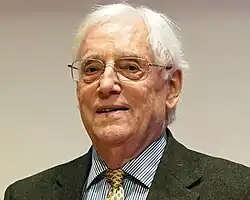
John E. Walker
John Walker FRS FMedSci | |
|---|---|
 | |
| Born | John Ernest Walker 7 January 1941[1] |
| Education | Rastrick Grammar School |
| Alma mater | University of Oxford (BA, DPhil) |
| Spouse |
Christina Westcott (m. 1963) |
| Children | Two |
| Awards |
|
| Scientific career | |
| Institutions | University of Oxford Laboratory of Molecular Biology University of Cambridge |
| Thesis | Studies on naturally occurring peptides (1970) |
| Doctoral advisor | Edward Abraham[5] |
| Influences | Fred Sanger |
| Website | www |
Sir John Ernest Walker FRS FMedSci[4] (born 7 January 1941) is a British chemist. He won the Nobel Prize in Chemistry in 1997.[6] As of 2015 Walker is Emeritus Director and Professor at the MRC Mitochondrial Biology Unit in Cambridge, and a Fellow of Sidney Sussex College, Cambridge.[7]
He was elected a member of the Academia Europaea in 1998.[8]
References
- ↑ "John E. Walker - Facts".
- ↑ "John E. Walker". people.embo.org. EMBO.
- ↑ WALKER, Prof. John Ernest. Who's Who. Vol. 1996 (online Oxford University Press ed.). A & C Black, an imprint of Bloomsbury Publishing plc.
{{cite book}}:|website=ignored (help) (subscription required)
- 1 2 Anon (1995). "Sir John Walker FMedSci FRS". royalsociety.org. London: Royal Society. Archived from the original on 2015-11-17. One or more of the preceding sentences incorporates text from the royalsociety.org website where:
“All text published under the heading 'Biography' on Fellow profile pages is available under Creative Commons Attribution 4.0 International License.” --"Royal Society Terms, conditions and policies". Archived from the original on 25 September 2015. Retrieved 2016-03-09.
{{cite web}}: CS1 maint: bot: original URL status unknown (link) - ↑ Walker, John Ernest (1969). Studies on naturally-occurring peptides. bodleian.ox.ac.uk (DPhil thesis). University of Oxford. EThOS uk.bl.ethos.711292.
- ↑ "The Nobel Prize in Chemistry 1997".
- ↑ Walker, J. E.; Saraste, M; Runswick, M. J.; Gay, N. J. (1982). "Distantly related sequences in the alpha- and beta-subunits of ATP synthase, myosin, kinases and other ATP-requiring enzymes and a common nucleotide binding fold". The EMBO Journal. 1 (8): 945–51. doi:10.1002/j.1460-2075.1982.tb01276.x. PMC 553140. PMID 6329717.
- ↑ "John Walker". Academia Europaea. Archived from the original on 28 March 2019.