Lisbon, Ohio

Lisbon is a village in Ohio in the United States. It is the county seat of Columbiana County. It used to be called New Lisbon.
New Lisbon, aka Lisbon, Ohio, is the second-oldest town in the state of Ohio, founded in 1803 by Baptist minister Lewis Kinney. [1]
History
Early Settlement and Growth
New Lisbon attracted many settlers, including Quakers and Germans from Pennsylvania. By 1820, its population outnumbered Cleveland. Initially, the town served the needs of local farmers but gradually developed into a hub for both iron and whiskey production. Throughout the 19th century, Lisbon expanded its industries, adding a variety of mills including tin, paper, saw, and grist mills as well as tanneries, iron foundries, woolen factories, and salt works.
Lisbon's prosperity slowed during the Panic of 1837, a national financial crisis that led to business closures and a decline in population. The Ohio River to Erie Canal project was halted, but the town recovered by the mid-19th century, becoming a thriving center of commerce.[2]
Iron and Whiskey Production
In the late 18th and early 19th centuries, whiskey was an everyday beverage in the United States due to concerns over the safety of drinking water.[3] In fact, whiskey was so common that soldiers in the U.S. Army received daily rations of four ounces. In 1791, Treasury Secretary Alexander Hamilton imposed a tax on whiskey to help pay off Revolutionary War debt, which led to the Whiskey Rebellion of 1791.[4] Farmers, particularly in the Midwest, opposed the tax, as they relied on whiskey production for income.
Lisbon, being a center for both whiskey and iron production, played a role in this economic shift. By the 1820s, whiskey was so abundant that it sold for just twenty-five cents a gallon.[5]
Canal and Railroad Expansion
In the late 1820s, construction of the Ohio-Erie Canal began, which was part of a larger canal system intended to connect the Ohio River to Lake Erie. The Sandy and Beaver Canal, a privately owned spur off the Ohio-Erie Canal, ran through Lisbon, utilizing the Sandy and Beaver Creeks. Completed in 1848, the canal operated until 1852, when the Cold Run Reservoir Dam failed, leaving a large section of the canal unusable. Despite this setback, Lisbon remained a center of commerce as railroads expanded into the area.[6]
Lisbon celebrates its history through events such as the Johnny Appleseed Festival, which honors John Chapman, the famous nurseryman who planted apple trees throughout Ohio, including Lisbon. The town's population was recorded as 2,586 in the 2020 U.S. Census.[7]
References
- ↑ "Lisbon Historic District - Lisbon, OH - U.S. National Register of Historic Places on Waymarking.com". www.waymarking.com. Retrieved 2025-03-16.
- ↑ "History Ohio's Canals". Ohio Department of Natural Resources. Archived from the original on 2013-12-27. Retrieved 2008-06-28.
- ↑ "The 1800s: When Americans Drank Whiskey Like it was Water". Paste Magazine. Retrieved 2025-03-16.
- ↑ "Whiskey Rebellion | Definition, History, & Significance | Britannica". www.britannica.com. 2025-02-18. Retrieved 2025-03-16.
- ↑ "When Whiskey Was the Backbone of the US Economy". HISTORY. 2019-10-10. Retrieved 2025-03-16.
- ↑ "Sandy and Beaver Canal". Ohio Historical Society. Retrieved 2007-11-06.; see also The Sandy and Beaver Canal by Gard, R. Max and Vodrey, William H., Jr. (East Liverpool, Ohio Historical Society 1952)
- ↑ "Lisbon ohio population". Archived from the original on 2024-07-18. Retrieved 2025-03-16.
Municipalities and communities of Columbiana County, Ohio, United States | ||
|---|---|---|
| Cities | 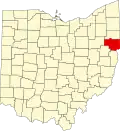 | |
| Villages |
| |
| Townships |
| |
| CDPs |
| |
| Unincorporated communities |
| |
| Ghost town |
| |
| Footnotes | ‡This populated place also has portions in an adjacent county or counties | |