Kangaroo Island dunnart
| Kangaroo Island dunnart | |
|---|---|
 | |
Scientific classification  | |
| Kingdom: | Animalia |
| Phylum: | Chordata |
| Class: | Mammalia |
| Infraclass: | Marsupialia |
| Order: | Dasyuromorphia |
| Family: | Dasyuridae |
| Genus: | Sminthopsis |
| Species: | S. aitkeni |
| Binomial name | |
| Sminthopsis aitkeni Kitchener, Stoddart and Henry 1984[2] | |
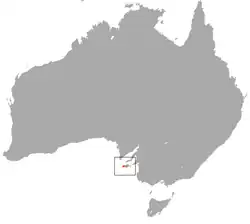 | |
| Kangaroo Island Dunnart range | |
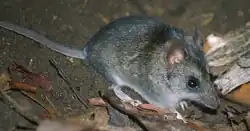
The Kangaroo Island dunnart (Sminthopsis aitkeni) is a small marsupial with dark gray fur and lighter color on its belly. It was first described in 1969. Its body length is about 170–198 mm (6.7–7.8 in), with the body (nose to anus) measuring 80–93 mm (3.1–3.7 in) and the tail 90–105 mm (3.5–4.1 in). The tail is thin, gray, lighter underneath, and longer than the body. Its back foot is about 17.5 mm (0.69 in), ears are 18 mm (0.71 in), and it weighs 20–25 grams (0.71–0.88 oz). Males are bigger than females.
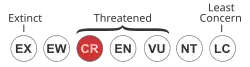
The Kangaroo Island dunnart is listed as Critically Endangered by the International Union for Conservation of Nature (IUCN). Before the 2019–2020 bushfires in Australia, there were thought to be fewer than 500 left.[3] After the fires, only about 50 are believed to remain.[4]
Habitiat
This animal lives only on the western half of Kangaroo Island in South Australia. It is the only mammal found only on this island. It lives in mallee heath with laterite soil. It used to live all over the island, but now it is found in six places, all inside Flinders Chase National Park or Ravine des Casoars Wilderness Protection Area on the west side of the island. Searches on the east side have not found any.
Diet
The Kangaroo Island dunnart is active at night. It eats small animals without backbones, mainly ants and spiders. It also eats scorpions, beetles, and grasshoppers.
Behavior and breeding
Not much is known about how these dunnarts behave. They are believed to breed twice a year. Young dunnarts have been caught in traps during mid-September to October and again in November to December. The pregnancy lasts about 12 days. Little is known about how parents care for their babies. Males probably live only for one breeding season, while females may live to breed for two seasons.
Conservation
The Kangaroo Island dunnart is listed as critically endangered on the IUCN Red List, meaning it is at very high risk of extinction. The Australian government made a plan to help the species recover in 2011.[5] Until the early 2000s, scientists were not sure if the dunnarts were really so few or if they were just hard to find.[6] Before the big bushfires in 2019–2020, it was thought that fewer than 500 dunnarts lived in the wild.
The dunnarts used to live all over Kangaroo Island, but now they are only found in six places on the western side of the island. Their numbers have gone down for several reasons. Losing their natural homes is a main cause. Although they don’t have a clear favorite type of habitat, they seem to need some low plants to live in. Much of the eastern part of the island has been changed for farming and grazing, and dunnarts are not found in these cleared areas. A disease called Phytophthora cinnamomi, which kills trees, has also hurt their homes. Feral cats may also be hunting them.
Because the dunnarts live in a small area, one bad event can harm many of them. Bushfires are a big threat. The fires in 2019–2020 destroyed much of their remaining habitat.[7] In May 2019, before the fires, a meeting was held on Kangaroo Island with government workers, scientists, and landowners to talk about the dunnarts. The meeting shared important information about how the dunnarts were doing before the fires.[8]
The bushfires caused great damage and probably killed most of the dunnarts. But some dunnarts have been seen in both burned and unburned areas after the fires, giving hope that they might recover.[4][9]
The Australian Wildlife Conservancy, local landholders and the conservation organisation, Kangaroo Island Land for Wildlife have worked together since 2020 and set up the Western River Refuge. This is a 369 ha (910 acres) block of land with habitat suitable for the dunnart and other threatened species. It is protected with an 8.8 km (5.5 mi) fence which keeps out predators like feral cats.[10]
References
- ↑ van Weenen, J. (2008). "Sminthopsis fuliginosus ssp. aitkeni". IUCN Red List of Threatened Species. 2008 e.T20294A9183297. doi:10.2305/IUCN.UK.2008.RLTS.T20294A9183297.en. Retrieved 6 August 2025.
- ↑ Kitchener, D. J.; Stoddart, J.; Henry, J. (1984). "A Taxonomic Revision of the Sminthopsis murina Complex (Marsupialia, Dasyuridae) in Australia, including Descriptions of Four New Species" (PDF). Records of the Western Australian Museum. 11 (3): 201–248. Retrieved 7 January 2020.
- ↑ "Kangaroo Island dunnart". www.naturalresources.sa.gov.au. Department for Environment and Water (DEW). 2019-06-12. Archived from the original on 10 January 2020. Retrieved 2020-01-13.
- 1 2 "Kangaroo Island wildlife group 'amazed' at post-fire find". NewsComAu. 2020-06-16. Retrieved 2020-06-22.
- ↑ Gates, Jody A. (July 2011). "Recovery plan for the Kangaroo Island Dunnart (Sminthopsis aitkeni) (30pp)" (PDF). www.environment.gov.au/. Department of Environment and Natural Resources, Government of South Australia. Retrieved 7 January 2020. (3-paragraph summary; archive)
- ↑ Gates, J. A. (5 April 2006). "Threatened Species – The Kangaroo Island Dunnart – Rare or Elusive?". www.denr.sa.gov.au. Archived from the original on 30 October 2007. Retrieved 7 January 2020.
- ↑ Readfearn, Graham (6 January 2020). "Kangaroo Island bushfires: grave fears for unique wildlife after estimated 25,000 koalas killed". www.theguardian.com/. Archived from the original on 7 January 2020. Retrieved 7 January 2020.
- ↑ "Minutes from the Kangaroo Island dunnart workshop Monday 27-May-2019 (50pp)" (PDF). www.naturalresources.sa.gov.au. May 2019. Archived (PDF) from the original on 9 January 2020. Retrieved 9 January 2020. Alt URL NOTE: The (original) link auto-downloads file to local device.
- ↑ "Rare critter find described as 'the best news all year'". www.abc.net.au. 2020-06-16. Retrieved 2020-06-22.
- ↑ "Kangaroo Island Dunnart". Australian Wildlife Conservancy. 2026. Retrieved 22 May 2026.
Other websites
- Wilson, D. E.; Reeder, D. M., eds. (2005). Mammal Species of the World (3rd ed.). Johns Hopkins University Press. ISBN 978-0-8018-8221-0. OCLC 62265494.
- Menkhorst, P.; Knight, F. (2001). A field guide to the mammals of Australia, 1st Edition. Oxford Press. p. 68. ISBN 0-19-550870-X.
- "Kangaroo Island Dunnart (Sminthopsis aitkeni)". www.australianfauna.com. 6 August 2004. Archived from the original on 31 July 2016. Retrieved 9 January 2020.
- "Kangaroo Island dunnart, ANZLIC-compliant metadata description (for wildlife data collected in the field)". www.asdd.sa.gov.au. Kingscote, South Australia: Department for Environment and Heritage. 8 October 2001. Archived from the original on 10 March 2007. Retrieved 9 January 2020.
- Gates, Jody A. (October 2001). "The distribution and ecology of the Kangaroo Island dunnart Sminthopsis aitkeni (Final Report)" (PDF). www.environment.sa.gov.au (Report). National Parks and Wildlife South Australia. Environment Australia (Endangered Species Program). Archived from the original (PDF) on 30 August 2007. Retrieved 9 January 2020.