Dunnart
| Dunnart | |
|---|---|
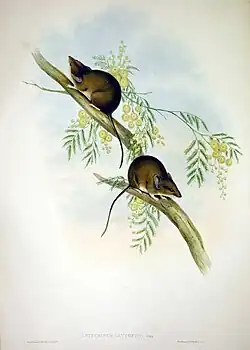 | |
| White-footed dunnart (Sminthopsis leucopus) | |
Scientific classification  | |
| Kingdom: | Animalia |
| Phylum: | Chordata |
| Class: | Mammalia |
| Infraclass: | Marsupialia |
| Order: | Dasyuromorphia |
| Family: | Dasyuridae |
| Subfamily: | Sminthopsinae |
| Tribe: | Sminthopsini |
| Genus: | Sminthopsis Thomas, 1887 |
| Type species | |
| Phascogale crassicaudata Gould, 1844 | |
| Species | |
|
23, see text | |
A dunnart is a small marsupial with narrow feet, about the size of a European mouse. It belongs to the group called Sminthopsis. Dunnarts mostly eat insects. The word comes from the Noongar (Indigneous Australian) word donat[1])
Scientific Classification
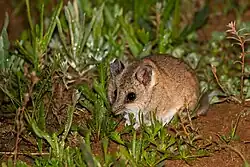
The group name Sminthopsis was given by Oldfield Thomas in 1887. Before that, the name Podabrus was used, but it was already taken by a group of beetles.[2] The type species in this group is Phascogale crassicaudata, named by John Gould in 1844.
There are 19 different species of dunnarts, and they all live in Australia or New Guinea.[note 1] all of them in Australia or New Guinea:[3]
- Genus Sminthopsis
- S. crassicaudata species-group
- Fat-tailed dunnart, Sminthopsis crassicaudata
- S. macroura species-group
- Kakadu dunnart, Sminthopsis bindi
- Carpentarian dunnart, Sminthopsis butleri
- Julia Creek dunnart, Sminthopsis douglasi
- Stripe-faced dunnart, Sminthopsis macroura
- Red-cheeked dunnart, Sminthopsis virginiae
- S. granulipes species-group
- White-tailed dunnart, Sminthopsis granulipes
- S. griseoventer species-group
- Grey-bellied dunnart, Sminthopsis griseoventer
- S. murina species-group
- Kangaroo Island dunnart, Sminthopsis aitkeni
- Chestnut dunnart, Sminthopsis archeri
- Little long-tailed dunnart, Sminthopsis dolichura
- Sooty dunnart, Sminthopsis fuliginosus
- Gilbert's dunnart, Sminthopsis gilberti
- White-footed dunnart, Sminthopsis leucopus
- Slender-tailed dunnart, Sminthopsis murina
- S. psammophila species-group
- Hairy-footed dunnart, Sminthopsis hirtipes
- Ooldea dunnart, Sminthopsis ooldea
- Sandhill dunnart, Sminthopsis psammophila
- Lesser hairy-footed dunnart, Sminthopsis youngsoni
- S. crassicaudata species-group
There are also two species are recognized by the American Society of Mammalogists:
- Froggatt's dunnart, Sminthopsis froggatti
- Stalker's dunnart, Sminthopsis stalkeri
The American Society of Mammalogists also lists S. griseoventer as a synonym of S. fuliginosa, and moved S. longicaudata to the genus Antechinomys.
Description
A male dunnart's Y chromosome is the smallest mammal Y chromosome.[4]
Notes
- ↑ The list is based on the Third edition of Wilson & Reeder's Mammal Species of the World (2005) except where both the Mammal Diversity Database and IUCN agree on the change.
References
- ↑ Abbott, Ian (2001). "Aboriginal names of mammal species in south-west Western Australia" (PDF). CALMScience. 3 (4): 450–451.
- ↑ Divljan, Anja; Ingleby, Sandy; Parnaby, Harry (6 January 2015). "Taxonomic status of Podabrus albocaudatus Krefft, 1872 and declaration of Sminthopsis granulipes Troughton, 1932 (Marsupialia: Dasyuridae) as a protected name for the White-tailed Dunnart from Western Australia". Zootaxa. 3904 (2): 283–292. doi:10.11646/zootaxa.3904.2.7. ISSN 1175-5334. PMID 25660785. S2CID 30027103.
- ↑ "Sminthopsis longicaudata". WA Museum Collections. 2017-02-14. Retrieved 2020-12-24.
- ↑ Toder R.; Wakefield M.J.; Graves J.A.M. (2000). "The minimal mammalian Y chromosome - the marsupial Y as a model system". Cytogenet Cell Genet. 91 (1–4): 285–92. doi:10.1159/000056858. PMID 11173870. S2CID 30401023.