Kangaroo Island
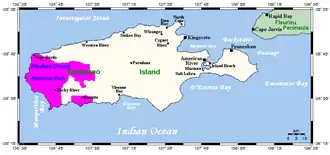
Kangaroo Island is Australia's third-largest island after Tasmania and Melville Island.
It is 112 kilometres (70 mi) southwest of Adelaide in the state of South Australia.
At its closest point to the mainland, it is 13 kilometres (8 miles) offshore from Cape Jervis.
The island is 150 km (93 mi) long and between 900 m (980 yd) and 57 km (35 mi) wide, its area covering 4,405 km2 (1,701 sq mi). Its coastline is 540 kilometres (340 mi) long and highest altitude is 307 m (1,010 ft).
Wildlife and its protection
More than half of the island has never been cleared of vegetation, and a quarter of it is conserved in National Parks, Conservation Parks, and five Wilderness Protection Areas.[1] The main protected areas are:
- Flinders Chase National Park
- Seal Bay Conservation Park
- Cape Gantheaume Conservation Park
- Cape Bouguer Wilderness Protection Area
- Ravine des Casoars Wilderness Protection Area
Because of its isolation from mainland Australia, foxes and rabbits are not there. People are forbidden to bring them into the island. Registration and microchipping of cats is compulsory.[2]
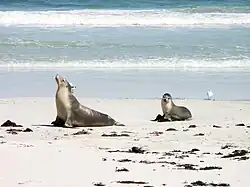
The Kangaroo Island kangaroo, Rosenberg's sand goanna, southern brown bandicoot, Tammar wallaby, common brushtail possum, short-beaked Echidna and New Zealand fur seal are native to the island, as well as six bat and frog species. The sole endemic (found nowhere else) vertebrate species is a small marsupial carnivore called the Kangaroo Island dunnart. The koala, common ringtail possum and Platypus have been introduced and still survive there. Kangaroo Island had a native species of emu, the Kangaroo Island emu which became extinct between 1802 and official European settlement in 1836. Perhaps this was caused by bushfires or hunting by sealers or whalers.
The introduced koalas have flourished so well on the island that their preferred food source, the manna gum tree, is at risk of local extinction. Koalas have recently been forced to turn to other, less tasty, plants. Park Management has been searching for a solution.
Tourism
The island is a major tourist attraction.[3]
2019-2020 bushfires
In December 2019 a number of lightning strikes started a small bushfire on the island. This quickly grew into a massive fire, which burned 200,000 ha (490,000 acres), about half of the island. Two people were killed, 900 homes burned down, thousands of farm animals killed, and the loss of native animals and their habitat.[4] One third of the island was protected area, and this was largely burnt by very hot fires. Scientists have identified 23 animal species and 31 plant species which have been threatened by the fire. Some of these species are only found on the island.[5] For example, the Kangaroo Island dunnart, a small marsupial, has had 95% of its habitat destroyed. The Australian Government will spend $8,000,000 on projects to help wildlife and plants recover from the fires.[5]
Limestone caves
There were about 130 limestone caves known on the island. These were formed two million years ago. One cave, at Kelly Hill, is open for people to visit. The 2019 bushfire cleared away much of the trees and shrubs on the island. Scientists were able to find the entrances to 150 new caves, including a large cave that has been named Phoenix. They have also discovered insects, invertebrates, and spiders that have adapted to life in total darkness. These are being studied as many of these may be new unknown species.[4]
References
- ↑ "South Australian National Parks & Reserves - Kangaroo Island Region". South Australian Government Department for Environment and Heritage. Archived from the original on 2008-07-28. Retrieved 2008-07-03.
- ↑ "Dog and Cat Management Plan" (PDF). Kangaroo Island Council. 2005. Archived from the original (PDF) on 2009-05-18. Retrieved 2008-07-03.
- ↑ Kangaroo Island Tourism Optimisation Model (2005–2006). "Visitor Exit Surveys". Archived from the original on 2007-05-21. Retrieved 2007-06-22.
- 1 2 Donnellan, Angelique (13 December 2025). "From devastation to wonder as Kangaroo Island bushfires lead to cave discoveries". ABC News. Retrieved 12 May 2025.
- 1 2 "Kangaroo Island - Impacts of the 2019–20 bushfires". Department of Climate Change, Energy, the Environment and Water. 16 February 2026. Retrieved 12 May 2026.