Southern brown bandicoot
| Southern brown bandicoot[1] | |
|---|---|
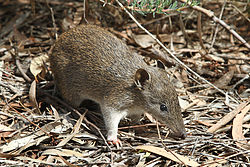 | |
| Foraging adult | |
Scientific classification  | |
| Kingdom: | Animalia |
| Phylum: | Chordata |
| Class: | Mammalia |
| Infraclass: | Marsupialia |
| Order: | Peramelemorphia |
| Family: | Peramelidae |
| Genus: | Isoodon |
| Species: | I. obesulus |
| Binomial name | |
| Isoodon obesulus (Shaw, 1797) | |
| Subspecies | |
| |
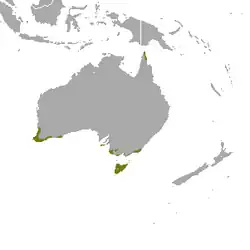 | |
| Southern brown bandicoot range | |
| Synonyms | |
The southern brown bandicoot (Isoodon obesulus) is a small marsupial with a short nose. It lives mostly in southern Australia. A type of this bandicoot in Western Australia is called the quenda, a name from the Noongar language.[6] In 2018, this type was made a separate species.[7]
Taxonomy
The southern brown bandicoot was first named Didelphis obesula by George Shaw in 1797. There are three types of this bandicoot in Australia:
- Isoodon obesulus affinus – found in Tasmania and Bass Strait Islands
- Isoodon obesulus nauticus – found only in the Nuyts Archipelago
- Isoodon obesulus obesulus – found in New South Wales, Victoria, and South Australia
The quenda and the Cape York brown bandicoot used to be seen as types of the southern brown bandicoot, but now they are separate species.[8][9]
Description
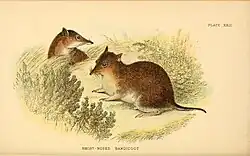
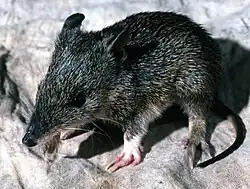
Southern brown bandicoots have strong bodies, short noses, and small round ears. Males are bigger than females. Males are about 50 cm (20 in) long and can weigh up to 1.2 kg (2.6 lb). Females are about 40 cm (16 in) long and weigh up to {1 kg (2.2 lb). Their fur is rough and mixed with dark grey and yellowish brown colors. Their belly is creamy white or light grey. Their tail is short, about 13 cm (5.1 in) long, brown on top and white underneath.[6][5]
Each foot has five toes. The second and third toes on the back feet are joined together. Most toes have strong claws, except the first toe on the front feet and the fifth toe on the back feet, which are very small. Female bandicoots have a pouch that opens to the back and has eight teats arranged in a circle.[5]
Where they live
The southern brown bandicoot used to live in many parts of coastal Australia. Now, they live in fewer places. There is a small group in the north-east of Cape York Peninsula in Queensland. Most of the others live in the southern half of Australia. In New South Wales, they are rare and mostly found in the far south-east and in two national parks north of Sydney. In Victoria, they are more common and live along the whole coast and in the mountains up to 1,000 m (3,300 ft) high in the Grampians and Dandenongs.[5]
In South Australia, they live on the Eyre and Fleurieu peninsulas, in the far southeast, and on Kangaroo Island.[10] There are small, separate groups in south-western Western Australia, but these are getting smaller.[3] The bandicoots are most common in Tasmania, where they live almost everywhere on the island. They also live on Inner Sister Island but have disappeared from many other small islands in Tasmania where they used to live.[5]
In these areas, southern brown bandicoots live in open forests, scrublands, and heathlands. They like places with lots of ground cover like shrubs or mat-rushes.[5][11] One type, Isoodon obesulus obesulus, prefers living near man-made waterways instead of dry places.[12]
Biology and Behavior
Southern brown bandicoots are active at night and eat many kinds of food, including insects, spiders, worms, plant roots, ferns, and fungi.[11] They drink very little water because they get enough from their food.[13] Their natural predators are barn owls, tiger snakes, and quolls. The bandicoots do not avoid the smell of these predators, which might make it easier for predators to catch them.[14] Bandicoots usually live alone and stay away from each other. Their home areas are abou1–5 ha (2.5–12.4 acres), depending on where they live. When two male bandicoots meet, the stronger one jumps on the other and scratches with its claws. Their skin is thick, so this usually only causes hair loss, not serious injury.[5]
Bandicoots spend most of the night looking for food. They use their sense of smell to find food by sniffing the ground and digging with their claws. If their prey tries to run away, they chase it and hold it down with their front paws to eat it. Their digging helps keep the environment healthy. One bandicoot can move about 3.9 tonnes of soil each year.[15] During the day, they sleep in hidden nests made of torn plants.[5] Both male and female bandicoots have scent glands between their ears. These glands help them communicate with each other and get bigger during the breeding season.[16]
The southern brown bandicoot can carry a parasite called Australiformis semoni in its intestines.[17]
Life History
Bandicoots have babies depending on the local rain. Many bandicoots have babies all year and can have up to four litters a year.[18] The pregnancy lasts less than 15 days, sometimes as short as 12 days. Usually, two or three babies are born, but sometimes there can be up to five.[5] Bigger mothers tend to have more babies.[19]
The babies weigh only 350 mg (5.4 gr) at birth. They stay in their mother's pouch for about 53 days and stop drinking milk at around 60 days. Bandicoots grow fast. Female bandicoots can have babies at four to five months old, and males at six to seven months old. In the wild, bandicoots usually live no longer than four years.[5]
Conservation Status
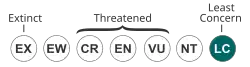
The southern brown bandicoot is listed as Least Concern by the IUCN, which means it is not in immediate danger of extinction.[2] However, its numbers have gone down a lot and its groups are now more spread out since Europeans came to Australia. In many places, the bandicoot is at risk, but it can still be common where there is enough rain and thick plants to live in. Besides losing their homes, bandicoots are also in danger from animals brought to Australia, like red foxes and feral cats.[2] People have brought bandicoots back to some dry areas where there are protections against these predators. One place like this is Wadderin Sanctuary in Western Australia, about 300 km (190 mi) east of Perth.
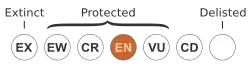
In Australia’s national reports, the southern brown bandicoot is called Endangered on the mainland and Vulnerable in South Australia.[20]
References
- ↑ Template:MSW3 Peramelemorphia
- 1 2 3 Friend, T.; Morris, K.; van Weenen, J.; Winter, J.; Menkhorst, P. (2008). "Isoodon obesulus". IUCN Red List of Threatened Species. 2008: e.T40553A10333481. doi:10.2305/IUCN.UK.2008.RLTS.T40553A10333481.en.
- 1 2 "Isoodon obesulus obesulus — Southern Brown Bandicoot (eastern), Southern Brown Bandicoot (south-eastern)". Species Profile and Threats Database. Australian Government, Department of Agriculture, Water and the Environment. Retrieved 2020-07-29.
- ↑ "Subspecies Isoodon obesulus obesulus (Shaw, 1797)". Australian Faunal Directory. Australian Government. 16 November 2022. Retrieved 19 January 2023.
- 1 2 3 4 5 6 7 8 9 10 Driessen, M.M.; Rose, R.K. (December 2015). "Isoodon obesulus (Peramelemorphia: Peramelidae)". Mammalian Species. 47 (929): 112–123. doi:10.1093/mspecies/sev012.
- 1 2 "Quenda" (PDF). Archived from the original (PDF) on 2007-09-20. Retrieved 2007-07-23.
- ↑ Jackson, S. M.; Baker, A. M.; Eldridge, M. D. B.; Fisher, D. O.; Frankham, G. J.; Lavery, T. H.; MacDonald, A. J.; Menkhorst, P. W.; Phillips, M. J.; Potter, S.; Rowe, K. C.; Travouillon, K. J.; Umbrello, L. S. (2022-10-12). "The importance of appropriate taxonomy in Australian mammalogy". Australian Mammalogy. 45 (1): 13–23. doi:10.1071/AM22016. ISSN 1836-7402. S2CID 252886788.
- ↑ "Species Isoodon fusciventer (J.E. Gray, 1841)". Australian Faunal Directory. Retrieved 28 March 2026.
- ↑ "Species Isoodon peninsulae Thomas, 1922". Australian Faunal Directory. Retrieved 28 March 2026.
- ↑ Paull, D. (1995). "The distribution of the southern brown bandicoot (Isoodon obesulus obesulus) in South Australia". Wildlife Research. 22 (5): 585–599. Bibcode:1995WildR..22..585P. doi:10.1071/WR9950585.
- 1 2 Keiper, P.; Johnson, C.N. (June 2004). "Diet and habitat preference of the Cape York short-nosed bandicoot (Isoodon obesulus peninsulae) in north-east Queensland". Wildlife Research. 31 (3): 259–265. Bibcode:2004WildR..31..259K. doi:10.1071/WR02030.
- ↑ Bruce, Matthew J.; Bryant, David B.; Kohout, Michele; Macak, Phoebe V.; Batpurev, Khorloo; Sinclair, Steve J. (26 July 2022). "Southern brown bandicoots, Isoodon obesulus obesulus, occupy the margins of artificial waterways, in preference to bushland remnants or roadside vegetation". Wildlife Research. doi:10.1071/WR21122. S2CID 251113986.
- ↑ Larcombe, A.N. (2003). "Activity rhythms of southern brown bandicoots Isoodon obesulus (Marsupialia: Peramelidae) in captivity". Australian Mammalogy. 25 (1): 81–86. doi:10.1071/AM03081.
- ↑ Mella, V.S.A.; Cooper, C.E.; Davies, S.J.J.F. (December 2010). "Predator odour does not influence trappability of southern brown bandicoots (Isoodon obesulus) and common brushtail possums (Trichosurus vulpecula)". Australian Journal of Zoology. 58 (5): 267–272. doi:10.1071/ZO10049.
- ↑ Valentine, Leonie E; Anderson, Hannah; Hardy, Giles E; Fleming, Patricia A (22 May 2013). "Foraging activity by the southern brown bandicoot (Isoodon obesulus) as a mechanism for soil turnover" (PDF). Australian Journal of Zoology. 60 (6): 419–423. doi:10.1071/ZO13030. S2CID 85392260.
- ↑ Stoddard, D.M. (1980). "Observations on the structure and function of cephalic skin glands in bandicoots (Marsupialia: Peramelidae)". Australian Journal of Zoology. 28 (1): 33–41. doi:10.1071/ZO9800033.
- ↑ Schmidt, Gerald D.; Edmonds, Stanley J. (1989). "Australiformis semoni (Linstow, 1898) n. Gen., n. Comb. (Acanthocephala: Moniliformidae) from Marsupials of Australia and New Guinea". The Journal of Parasitology. 75 (2): 215–7. doi:10.2307/3282769. JSTOR 3282769. PMID 2926590.
- ↑ Whitfield, Philip (1998). The Simon & Schuster Encyclopedia of Animals. New York: Marshall Editions Development Limited. p. 24.
- ↑ Stoddart, D.M.; Braithwaite, R.W. (1979). "A strategy for utilization of heathland habitat by the brown bandicoot (Isoodon obesulus; Marsupialia, Peramelidae)". Journal of Animal Ecology. 48 (1): 165–179. doi:10.2307/4107. JSTOR 4107.
- ↑ "Informing Biodiversity Conservation for the Adelaide and Mount Lofty Ranges Region, South Australia" (PDF). Department for Environment and Heritage, Government of South Australia.
Other websites
