Hantavirus infection
| Hantavirus infection | |
|---|---|
| Other names | Hantavirus disease |
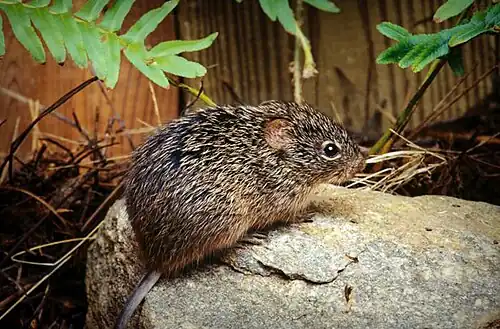 | |
| The cotton rat, Sigmodon hispidus, might have hantavirus and becomes a danger when it comes into homes in country and edge‑of‑town areas. | |
| Medical specialty | Infectious disease |
| Symptoms | HFRS: Headache, abdominal pain, fever, nausea, bleeding, kidney failure[1] HPS: Tiredness, fever, muscle pain, cough, shortness of breath[2] |
| Usual onset | 1 to 8 weeks after being near the virus[1][2] |
| Types | Hemorrhagic fever with renal syndrome (HFRS) Hantavirus pulmonary syndrome (HPS)[3] |
| Causes | orthohantaviruses spread by rodents[4] |
| Diagnostic method | Blood tests[4] |
| Prevention | Rodent control[4] |
| Treatment | Supportive care[4] |
| Frequency | HFRS 100,000 cases per year, HPS < 50 cases per year[4] |
| Deaths | HFRS 12%, HPS 40%[4] |
Hantavirus infection or hantavirus disease is an infectious disease in people. It is caused by viruses in the Orthohantavirus group. Two illnesses might be caused: hemorrhagic fever with renal syndrome (HFRS) and hantavirus pulmonary syndrome (HPS).[3] Many people with HFRS have a fever, pain in the head, pain in the stomach, nausea, bleeding, and kidney failure.[1] Many people with HPS feel very tired. They may have fever, pain in the muscles, a cough, and trouble breathing.[2] Many times it is 1 to 8 weeks after a person is near some hantavirus that they start being ill.[1][2]
HFRS comes from Old World hantaviruses, and HPS comes from New World hantaviruses.[3] More than 28 kinds of hantaviruses may make people ill.[4] Many people who got the disease breathed air with very small bits from rodent droppings.[4] Hantaviruses are dangerous because they cause thrombocytopenia (thin blood) and vascular permeability (blood tubes that let fluid out).[4] Medical doctors look for the disease with blood tests, often with serology.[4]
Treatment is mostly supportive care (looking after the person).[4] This care may give help with oxygen therapy, ventilation (breathing machine), Kidney dialysis (blood cleaning), or platelet transfusions (new blood parts).[4] Ribavirin may give some help if it is given early in HFRS.[4] The chance of death is about 12% with HFRS and about 40% with HPS.[4]
There are about 100,000 cases of HFRS each year. In 1993 HPS was first known; since that time there have been about 1,000 cases of HPS.[4] Old writings from about 1000 AD may be about illness that was probably hantavirus infection.[4] The virus that causes the disease was first seen in 1976, near the Hantan River in South Korea.[4][5]
Signs and symptoms
Early symptoms
Hantaviruses have an incubation period of 2–4 weeks. Then many times the illness starts with symptoms that are not special. These signs may give high fever, cold shakes, pain in the head, pain in the back, pain in the stomach, feeling sick, and throwing up.
Hemorrhagic fever with renal syndrome
Hemorrhagic fever with renal syndrome (HFRS) is caused most times by hantaviruses from Asia and Europe. The signs of the disease may be very light or very serious, based on the virus. After an incubation period of 2 to 4 weeks, symptoms start. First bleeding under the skin, many times with low blood pressure. More bleeding inside the body may be next. Kidney failure then starts and may lead to more problems, sometimes death.[4] A less serious form of HFRS is seen in Europe and is called "nephropathia epidemica" (NE).[6]
Hantavirus pulmonary syndrome
Hantavirus pulmonary syndrome (HPS), also called hantavirus cardiopulmonary syndrome (HCPS), is caused most times by hantaviruses in the Americas. After an incubation period of 16 to 24 days, symptoms start. First is about three days of symptoms like those in HFRS. Then there is a sudden start of strong coughing, shortness of breath, and fast heart rate. This is because of pulmonary edema (fluid in the lungs). The body also gets less work from the lymphatic system. Death from heart shock may come quickly after the most serious symptoms show.[4][7] While HCPS is usually linked with New World hantaviruses, the Puumala virus in Europe has also caused the syndrome in rare cases.[6]
Cause
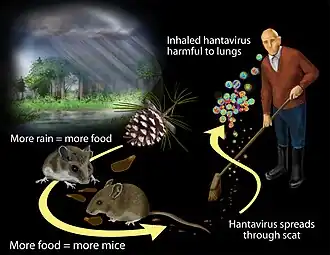
The cause is viruses in the group Orthohantavirus. These viruses are single‑stranded RNA, have a viral envelope (cover), and are negative-strand RNA viruses in the family Hantaviridae of the order Elliovirales.[8] They normally are in rodents, but they do not make the animals ill.[8] Humans may get the virus when they touch or breathe in rodent urine, rodent saliva, or rodent feces. Many hantaviruses cause one of these two diseases, but some do not cause known illness, such as the Prospect Hill virus.[7]
Transmission
Hantaviruses spread when the body fluids of rodents get to a person. Things like saliva from bites, and most times breathing in small drops of virus from urine and feces in aerosols. The way the virus gets about is the same for both diseases caused by hantaviruses. One virus that causes HCPS is the Andes virus. It is the only hantavirus that scientists now know goes from person-to-person. Person-to-person hantavirus transmission is very not normal.[4][7]
Almost all infections come from contact with rodent waste. But in 2005 and 2019, medical doctors in South America saw person‑to‑person transmission of the Andes virus.[9]
Diagnosis
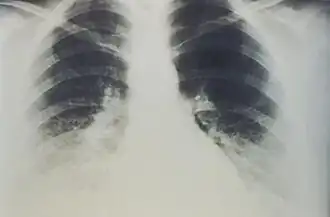
Doctors use a number of tests to find this infection:[10]
- Chest X-ray to look for pulmonary edema (fluid in the lungs)
- Blood tests to look for low platelet count ('thin blood', called thrombocytopenia)
- Immunofluorescent (light from virus) or immunoblot test (ELISA using IgM antibodies)
Prevention
The best way to not get hantavirus is to keep away from rodents in places where people live or work.[11] The virus gets about through rodent saliva, waste, and bites. It is important to control rats and mice in places where people live or work. People lower the danger by:
- taking away rat and mice nests;
- fixing cracks and holes in homes where rats or mice may get in;
- setting traps; or
- using poisons.
Some people also use natural hunters, such as cats, inside the home.[12]
How long hantaviruses are active in the environment is caused by things such as:
- how warm or cold it is;
- the rodent’s food;
- the level of water in the air; and
- whether the virus is inside or outside a building.
The viruses might be active for two to three days at normal room temperature. Sunlight with strong ultraviolet rays stops them in about three hours. Always think as being infectious any rodent droppings or urine of unknown age.[13][14][15]
Vaccine
Whole‑virus inactivated bivalent vaccines for the Hantaan virus and the Seoul virus are used in China and South Korea. In both countries, the vaccine, together with other ways to stop getting it, has meant much less hantavirus infections.
Medical researchers have also studied four other kinds of vaccines:
- DNA vaccines that work on the M genome part or the S genome part
- Subunit vaccines that use recombinant Gn, Gc, and N proteins of the virus
- Viral vector vaccines that have recombinant hantavirus proteins inside them
- Virus-like particle vaccines that have viral proteins but no genetic material
Of these, only the DNA vaccines have got to clinical trials.[16][17]
As of 2026 there was no vaccine for the Andes virus.[18]
Treatment
Ribavirin may help people with HPS and HFRS, but medical doctors still do not know how well it works. Some people get better on their own with supportive treatment to help with how ill people are feeling. Many people who may have hantavirus go to the hospital. Doctors may give them oxygen to breathe and a ventilator (machine breathing) to help them during the worst lung stage, when breathing becomes very hard.[12][19]
Epidemiology
There have been hantavirus infections on all continents except Australia and Antarctica. Places with the most hemorrhagic fever with renal syndrome are China, the Korean Peninsula, Russia (Hantaan, Puumala, and Seoul viruses), and northern and western Europe (the Puumala virus and the Dobrava virus).
Places with the most hantavirus pulmonary syndrome cases are Argentina, Chile, Brazil, the United States, Canada, and Panama.
Africa
Sangassou virus was first seen in 2010 in Africa. It causes hemorrhagic fever with renal syndrome.[20]
Asia
In China, Hong Kong, the Korean Peninsula, and Russia, hemorrhagic fever with renal syndrome is caused by the Hantaan, Puumala, and Seoul viruses.[21]
Australia
As of 2005, there were no human infections known in Australia. Rats and mice in the country have antibodies, which shows they had met the virus.[22]
Antarctica
There are not many rats or mice in this very cold place.
Europe
In Europe, people know two hantaviruses – Puumala virus and Dobrava-Belgrade viruses – which cause Hantavirus hemorrhagic fever with renal syndrome.[23] Puumala virus usually causes a not bad disease. Its name is nephropathia epidemica. People with this disease have a fever and a headache (their head hurts). They have stomach trouble. Their kidneys do not work well. They do not see clearly. Dobrava diseases are like this, but in many cases, these diseases have more hemorrhagic trouble.
The bank vole (Clethrionomys glareolus) is the Puumala virus' host. This virus is in most areas of Europe, but it is not in the Mediterranean area. There are four known Dobrava virus genotypes. A different kind of rodent carries each one. The yellow-necked mouse (Apodemus flavicollis) has genotype Dobrava. The striped field mouse (Apodemus agrarius) has genotypes Saaremaa and Kurkino. The Black Sea field mouse (Apodemus ponticus) has genotype Sochi.
In all of the year 2017, the Robert Koch Institute in Germany was told about 1,713 people with hantavirus diseases.[24]
North America
Canada
The common cause of the disease in Canada is Sin Nombre virus-infected deer mice. Between 1989 and 2014, there were a total of 109 cases, with the death rate about 29%.[25] The virus is in deer mice everywhere, but cases were generally in west Canada (British Columbia, Alberta, Saskatchewan and Manitoba) with only one case in east Canada. In Canada cases were in the country part and about 70% were linked to work in or near the home or on farms.[25]
United States
As of January 2017, a total of 728 cases of hantavirus disease had been seen in the United States since 1995. People got the disease while in 36 U.S. states. More than 96% of cases were in states west of the Mississippi River. The top 10 states by number of cases where the people was looked after were New Mexico (109), Colorado (104), Arizona (78), California (61), Washington (50), Texas (45), Montana (43), Utah (38), Idaho (21), and Oregon (21). 36% of the cases have resulted in death.[26]
Mexico
In Mexico, many rodents have been known to hold hantaviruses. Some are the Thomas's giant deer mouse (Megadontomys thomasi), the pack rat Neotoma picta, the Orizaba deer mouse (Peromyscus beatae), the Western harvest mouse (Reithrodontomys megalotis), and Sumichrast's harvest mouse (Reithrodontomys sumichrasti).[27]
South America
Agents of HPS in South America include the Andes virus (also named Oran, Castelo de Sonhos, Lechiguanas, Juquitiba, Araraquara, and Bermejo virus, among other names). It is the only hantavirus that has shown person‑to‑person spread. The Laguna Negra virus is also present. It is very close to the Rio Mamore virus.
Rodents that carry hantaviruses include Abrothrix longipilis and Oligoryzomys longicaudatus.[28]
2026 MV Hondius hantavirus outbreak
On 3 May 2026, people on the cruise ship MV Hondius in the Atlantic Ocean said they thought there was a lot of hantavirus. There were three deaths. The ship had left Argentina three weeks before. It was near Cape Verde when the outbreak got known all over the world.[29]
On the next day, the World Health Organization said that seven cases (two shown with testing and five that might be cases) have been seen, with three deaths, one very very ill person and three people who are a little ill. At that time, the ship had 147 passengers and crew on board.[30] While the ship was at anchor near Praia, Cape Verde, the authorities did not let passengers leave the ship to keep the country safe.[31]
On 6 May, there was an eighth case while the ship was sailing to the Canary Islands.[32]
History
12th‑century Chinese writings are about diseases with signs that are like Hantavirus infection.[6][33]
In late medieval England, a strange disease called sweating sickness moved across the country in 1485. Because the signs of the disease are like the signs of hantavirus pulmonary syndrome, some scientists have said that a hantavirus may have caused the sickness.[34][35]
Some experts did not like this idea. They said that sweating sickness seemed to go from person to person, while hantaviruses were not known to move in this way.[36]
Trench nephritis in World War I may have been a hantavirus infection.[37]
The first clear medical writing of hantavirus infection was in 1931 in north-east China.[6] In the 1930s medical doctors in Sweden wrote about Nephropathia epidemica.[6]
HFRS got known to western world doctors in the Korean War from 1951 to 1954, when more than 3,000 United Nations soldiers got ill in an outbreak.[33] In 1976, scientists found the first harmful hantavirus, the Hantaan virus, in rodents near the Hantan River in South Korea. Other important hantaviruses that cause HFRS, such as the Dobrava-Belgrade virus, Puumala virus, and Seoul virus, were found in the years after. These viruses are together called the Old World hantaviruses.[6][33]
The 1993 Four Corners hantavirus outbreak took place in the Four Corners area of the United States. Doctors did not know the cause at first. This outbreak led to the discovery of the Sin Nombre virus. Since then, about 43 hantavirus strains have been seen in the Americas. Twenty of these strains hurt people. They are called the New World hantaviruses. This group has the Andes virus, which is a large part of causes of HCPS in South America. Andes virus is the only hantavirus known to go from person to person.[6]
The February 2025 death of Betsy Arakawa (wife of actor Gene Hackman) was from hantavirus pulmonary syndrome.[38][39]
There were three deaths in the April 2026 MV Hondius hantavirus outbreak. The ship was sailing from Ushuaia, Argentina to Cape Verde.[40]
References
- 1 2 3 4 "CDC - Hemorrhagic Fever with Renal Syndrome (HFRS) - Hantavirus". www.cdc.gov. 22 February 2019. Archived from the original on 16 November 2019. Retrieved 29 March 2021.
- 1 2 3 4 "Signs & Symptoms | Hantavirus | DHCPP | CDC". www.cdc.gov. 22 February 2019. Archived from the original on 20 March 2021. Retrieved 28 March 2021.
- 1 2 3 "CDC - Hantavirus". www.cdc.gov. 9 September 2020. Archived from the original on 28 January 2007. Retrieved 25 March 2021.
- 1 2 3 4 5 6 7 8 9 10 11 12 13 14 15 16 17 18 19 20 Avšič-Županc T, Saksida A, Korva M (2019). "Hantavirus infections". Clin Microbiol Infect. 21S: e6 – e16. doi:10.1111/1469-0691.12291. PMID 24750436.
- ↑ "ICTV 9th Report (2011) – Negative Sense RNA Viruses – Bunyaviridae". International Committee on Taxonomy of Viruses (ICTV). Archived from the original on 11 December 2018. Retrieved 31 January 2019.
Hanta: from Hantaan, river in South Korea near where type virus was isolated.
- 1 2 3 4 5 6 7 Jiang H, Zheng X, Wang L, Du H, Wang P, Bai X (2017). "Hantavirus infection: a global zoonotic challenge". Virol Sin. 32 (1): 32–43. doi:10.1007/s12250-016-3899-x. PMC 6598904. PMID 28120221.
- 1 2 3 Gravinatti ML, Barbosa CM, Soares RM, Gregori F (2020). "Synanthropic rodents as virus reservoirs and transmitters". Rev Soc Bras Med Trop. 53 e20190486. doi:10.1590/0037-8682-0486-2019. PMC 7083353. PMID 32049206.
- 1 2 "Rodent-borne diseases". European Centre for Disease Prevention and Control. 18 May 2017. Archived from the original on 23 June 2018. Retrieved 4 June 2018.
- ↑ Martinez VP, Bellomo C, San Juan J, Pinna D, Forlenza R, Elder M, Padula PJ (2005). "Person-to-person transmission of Andes virus". Emerging Infectious Diseases. 11 (12): 1848–1853. doi:10.3201/eid1112.050501. PMC 3367635. PMID 16485469.
- ↑ Moore, Ross A.; Griffen, David (2021). "Hantavirus Syndrome". StatPearls. StatPearls Publishing. PMID 30020615. Archived from the original on 20 March 2021. Retrieved 27 November 2021.
- ↑ "Hantavirus Prevention". CDC. USA.gov. 22 February 2019. Archived from the original on 19 March 2021. Retrieved 25 March 2021.
- 1 2 "Hantavirus: Canadian Lung Association". Canadian Lung Association. 26 November 2015. Archived from the original on 2 March 2011. Retrieved 23 April 2018.
- ↑ Washington State Department of Labor & Industries (April 2010). "Hantavirus Pulmonary Syndrome (HPS) and the workplace". wisha-training.lni.wa.gov. Archived from the original on 19 February 2017. Retrieved 25 August 2017.
- ↑ Canadian Centre for Occupational Health and Safety (8 January 2016). "Hantavirus : OSH Answers". www.ccohs.ca. Archived from the original on 26 August 2017. Retrieved 25 August 2017.
- ↑ Washington State Department of Health (2017). "Hantavirus". www.doh.wa.gov. Archived from the original on 26 August 2017. Retrieved 25 August 2017.
- ↑ Liu R, Ma H, Shu J, Zhang Q, Han M, Liu Z, Jin X, Zhang F, Wu X (2020). "Vaccines and Therapeutics Against Hantaviruses". Front Microbiol. 10 2989. doi:10.3389/fmicb.2019.02989. PMC 7002362. PMID 32082263.
- ↑ Brocato RL, Hooper JW (2019). "Progress on the Prevention and Treatment of Hantavirus Disease". Viruses. 11 (7): 610. doi:10.3390/v11070610. PMC 6669544. PMID 31277410.
- ↑ Malik, Anaya (9 May 2026). "Hantavirus Risks Grow Without Licensed Vaccine - section Why Andes Virus Vaccines Remain Elusive". European Medical Journal.
- ↑ "CDC – Diagnosing and Treating Hantavirus Pulmonary Syndrome (HPS) – Hantavirus". www.cdc.gov. Archived from the original on 20 November 2016. Retrieved 9 November 2016.
- ↑ Klempa B, Witkowski PT, Popugaeva E, Auste B, Koivogui L, Fichet-Calvet E, Strecker T, Ter Meulen J, Krüger DH (2012). "Sangassou Virus, the First Hantavirus Isolate from Africa, Displays Genetic and Functional Properties Distinct from Those of Other Murinae-Associated Hantaviruses". Journal of Virology. 86 (7): 3819–3827. doi:10.1128/JVI.05879-11. PMC 3302504. PMID 22278233.
- ↑ "男生患漢坦食署Hea補鑊 住處附近僅派傳單". 30 March 2017. Archived from the original on 23 April 2020. Retrieved 25 March 2021.
- ↑ Bi, P.; Cameron, S.; Higgins, G.; Burrell, C. (2005). "Are humans infected by Hantaviruses in Australia?". Internal Medicine Journal. 35 (11): 672–674. doi:10.1111/j.1445-5994.2005.00954.x. PMID 16248862. S2CID 37603482.
- ↑ Vapalahti O, Mustonen J, Lundkvist A, Henttonen H, Plyusnin A, Vaheri A (2003). "Hantavirus infections in Europe". The Lancet Infectious Diseases. 3 (10): 653–661. Bibcode:2003LanID...3..653V. doi:10.1016/S1473-3099(03)00774-6. PMID 14522264.
- ↑ Hofmann J, Krüger DH, Loyen M (2018). "Hantavirus-Infektionen in Deutschland – ein Rückblick auf das Ausbruchsjahr 2017". Epid Bull. 15: 143–146. doi:10.17886/EpiBull-2018-018.
- 1 2 Drebot, Jones S.; Grolla, A.; Safronetz, D.; Strong, J. E.; Kobinger, G.; Lindsay, R. L. (4 June 2015). Hantavirus pulmonary syndrome in Canada: An overview of clinical features, diagnostics, epidemiology and prevention. Canada Communicable Disease Report (Report). Vector-borne diseases in Canada. Vol. 41–06. Winnipeg, MB: National Microbiology Laboratory, Public Health Agency of Canada. p. 40. ISSN 1481-8531. Archived from the original on 19 July 2017. Retrieved 25 March 2021.
- ↑ "Hantavirus Cases, by State of Reporting | Hantavirus | DHCPP". Centers for Disease Control and Prevention. 19 July 2017. Archived from the original on 26 August 2017. Retrieved 25 August 2017.
- ↑ Kariwa H, Yoshida H, Sánchez-Hernández C, Romero-Almaraz Mde L, Almazán-Catalán JA, Ramos C, Miyashita D, Seto T, Takano A, Totani M, Murata R, Saasa N, Ishizuka M, Sanada T, Yoshii K, Yoshimatsu K, Arikawa J, Takashima I (2012). "Genetic diversity of hantaviruses in Mexico: Identification of three novel hantaviruses from Neotominae rodents". Virus Research. 163 (2): 486–494. doi:10.1016/j.virusres.2011.11.013. PMID 22138671.
- ↑ Medina RA, Torres-Perez F, Galeno H, Navarrete M, Vial PA, Palma RE, Ferres M, Cook JA, Hjelle B (2008). "Ecology, Genetic Diversity, and Phylogeographic Structure of Andes Virus in Humans and Rodents in Chile". Journal of Virology. 83 (6): 2446–2459. doi:10.1128/JVI.01057-08. PMC 2648280. PMID 19116256.
- ↑ "A suspected outbreak of the rare hantavirus on a cruise ship in the Atlantic kills 3 people". AP News. 3 May 2026. Retrieved 4 May 2026.
- ↑ "Hantavirus cluster linked to cruise ship travel, Multi-country". www.who.int. Retrieved 5 May 2026.
- ↑ "Passengers stranded on cruise off Cape Verde following suspected virus deaths". Yahoo News. 4 May 2026. Retrieved 5 May 2026.
- ↑ Khan M, Chen E, Diller N (6 May 2026). "More hantavirus suspected from cruise ship. Latest on illnesses". USA TODAY. Retrieved 6 May 2026.
- 1 2 3 Conover, Michael R.; Vail, Rosanna M. (2015). "23. Hantaviruses". Human Diseases from Wildlife. Boca Ratan: CRC Press. pp. 371–384. ISBN 978-1-4665-6214-1.
- ↑ Thwaites G, Taviner M, Gant V (1997). "The English Sweating Sickness, 1485 to 1551". New England Journal of Medicine. 336 (8): 580–582. doi:10.1056/NEJM199702203360812. PMID 9023099.
- ↑ Taviner M, Thwaites G, Gant V (1998). "The English sweating sickness, 1485–1551: a viral pulmonary disease?". Medical History. 42 (1): 96–98. doi:10.1017/S0025727300063365. PMC 1043971. PMID 9536626.
- ↑ Bridson, Eric (2001). "English 'sweate' (Sudor Anglicus) and Hantavirus pulmonary syndrome, The". British Journal of Biomedical Science. 58 (1): 1–6. PMID 11284216. Archived from the original on 24 March 2006.
- ↑ Atenstaedt, R. L. (August 2006). "The medical response to trench nephritis in World War One". Kidney International. 70 (4): 635–640. doi:10.1038/sj.ki.5001618. ISSN 0085-2538. PMID 16820794.
- ↑ Lee, Morgan; Bryan, Susan Montoya; Baumann, Lisa (7 March 2025). "Gene Hackman died at home a week after wife Betsy Arakawa died from hantavirus, authorities say". AP News. Retrieved 8 May 2026.
- ↑ "Betsy Arakawa, Gene Hackman's wife, died from hantavirus, autopsy confirms". AP News. 29 April 2025. Retrieved 8 May 2026.
- ↑ Addley, Esther (9 May 2026). "Infected, at sea: how the deadly hantavirus turned a dream cruise into tragedy". The Guardian. ISSN 0261-3077. Retrieved 10 May 2026.
External links
| Classification |
|---|