Manitoba
Manitoba
| |
|---|---|
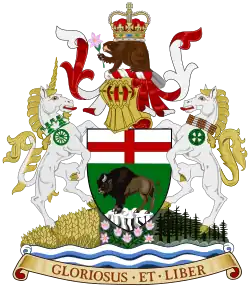 Coat of arms | |
| Motto(s): Latin: Gloriosus et Liber "Glorious and free" | |
| Coordinates: 55°N 97°W / 55°N 97°W[1] | |
| Country | Canada |
| Confederation | 15 July 1870[3] (5th, with Northwest Territories) |
| Capital | Winnipeg |
| Largest city | Winnipeg |
| Largest metro | Winnipeg Region |
| Government | |
| • Type | Parliamentary constitutional monarchy |
| • Lieutenant Governor | Anita Neville |
| • Premier | Wab Kinew (New Democrat) |
| Legislature | Legislative Assembly of Manitoba |
| Federal representation | Parliament of Canada |
| House seats | 14 of 343 (4.1%) |
| Senate seats | 6 of 105 (5.7%) |
| Area | |
| • Total | 647,797 km2 (250,116 sq mi) |
| • Land | 553,556 km2 (213,729 sq mi) |
| • Water | 94,241 km2 (36,387 sq mi) 14.5% |
| • Rank | Ranked 8th |
| 6.5% of Canada | |
| Population (2021) | |
| • Total | 1,342,153[5] |
| • Estimate (2026 Q2) | 1,503,865[6] |
| • Rank | Ranked 5th |
| Demonym | Manitoban |
| Official languages | English[7] |
| GDP | |
| • Rank | 6th |
| • Total (2015) | C$65.862 billion[8] |
| • Per capita | C$50,820 (9th) |
| Time zone | UTC−6 (Central) |
| • Summer (DST) | UTC−5 (Central DST) |
| Rankings include all provinces and territories | |
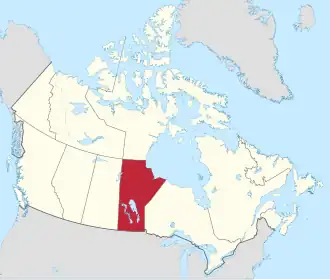
Manitoba is a province of Canada that is located roughly in the centre of the country.
Manitoba is Canada's 6th-largest province, with an area of 647,797 square kilometres (250,116 sq mi). It has the 5th-largest number of people, at 1,503,865 in 2026, and its people are called "Manitobans". Manitoba borders the Canadian provinces of Saskatchewan and Ontario, the Canadian territories of Nunavut and the Northwest Territories, and the U.S. states of North Dakota and Minnesota.
History
People have been living in Manitoba for thousands of years. Both the Hudson's Bay Company from England and many people from France moved to Manitoba during the 17th, 18th, and 19th centuries. Manitobabecame part of the Northwest Territories in 1869. The Red River Rebellion, which was started by Louis Riel, began there.
Manitoba became part of Canada on 12 May 1870. The province then included only the southern part, which is near the United States, until parts of the Northwest Territories were later added.
Government
The capital of Manitoba is Winnipeg. Other large cities in Manitoba include Brandon, Steinbach, Thompson, and Portage la Prairie.
The people of Manitoba elect a legislature. The leader of the government, who is called the premier, is the leader of the largest party in the legislature. There is also a lieutenant governor, who represents the British monarch.
The main political parties in Manitoba are the New Democratic Party, the Progressive Conservative Party, and the Liberal Party.
Provincial symbols
- Mammal - American bison
- Bird - Great grey owl
- Fish - Walleye
- Flower - Prairie crocus
- Tree - White spruce
- Fossil - Tylosaurus pembinesis
References
- ↑ "Manitoba". Geographical Names Data Base. Natural Resources Canada.
- ↑ "Manitoba". Geographical Names Data Base. Natural Resources Canada.
- ↑ Brawn, Dale (2006). The Court of Queen's Bench of Manitoba, 1870–1950: A Biographical History. University of Toronto Press. p. 22. ISBN 978-0-8020-9225-0.
- ↑ "Land and freshwater area, by province and territory". Statistics Canada. Retrieved 25 August 2023.
- ↑ "Data table, Census Profile, 2021 Census of Population – Manitoba". Statistics Canada. Archived from the original on 10 February 2022. Retrieved February 9, 2022.
- ↑ "Population estimates, quarterly". Statistics Canada. June 17, 2026. Archived from the original on June 28, 2026. Retrieved June 28, 2026.
- ↑ "The legal context of Canada's official languages". University of Ottawa. Archived from the original on 10 October 2017. Retrieved 7 March 2019.
- ↑ "Gross domestic product, expenditure-based, by province and territory (2015)". Statistics Canada. 9 November 2016. Archived from the original on 19 September 2012.
Other websites

- Manitoba at the Open Directory Project
| Provinces | |
|---|---|
| Territories | |
| Historical |
|
| Related |
|
| |


