Pack rat
| Pack rat Temporal range: Late Cenozoic - Recent | |
|---|---|
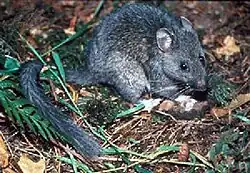 | |
| Bushy-tailed woodrat (Neotoma cinerea) | |
Scientific classification  | |
| Kingdom: | Animalia |
| Phylum: | Chordata |
| Class: | Mammalia |
| Order: | Rodentia |
| Family: | Cricetidae |
| Subfamily: | Neotominae |
| Tribe: | Neotomini |
| Genus: | Neotoma Say & Ord, 1825 |
| Type species | |
| Mus floridana Ord, 1818 | |
| Species | |
|
Neotoma albigula | |
The pack rat or packrat, also called the wood rat or trade rat, is a rodent. It is one of many species in the genus Neotoma. Very often, people mean the bushy-tailed woodrat (Neotoma cinerea). Packrats are common in the deserts and highlands of the western United States and northern Mexico. They are smaller than a usual (Old World) rat, and usually have long, sometimes bushy tails. They are also not related to the rat, other than also being a rodent.
Species
Neotoma has three subgenera. daggers (†) show extinct species.[1]
- Subgenus Neotoma
- Neotoma albigula - white-throated woodrat
- Neotoma albigula varia - Turner Island woodrat
- Neotoma angustapalata - Tamaulipan woodrat
- Neotoma bryanti - Bryant's woodrat
- †Neotoma bryanti anthonyi - Anthony's woodrat
- †Neotoma bryanti bunkeri - Bunker's woodrat
- †Neotoma bryanti martinensis - San Martín Island woodrat
- Neotoma chrysomelas - Nicaraguan woodrat
- Neotoma devia - Arizona woodrat
- Neotoma ferruginea - Guatemala woodrat
- †Neotoma findleyi - Findley's woodrat
- Neotoma floridana - eastern woodrat (Florida woodrat)
- Neotoma floridana smalli - Key Largo woodrat
- Neotoma fuscipes - dusky-footed woodrat
- Neotoma goldmani - Goldman's woodrat
- Neotoma insularis - Angel de la Guarda woodrat[2]
- Neotoma lepida - desert woodrat
- Neotoma leucodon - white-toothed woodrat
- Neotoma macrotis - big-eared woodrat
- Neotoma magister - Allegheny woodrat
- Neotoma melanura[3] - Black-tailed woodrat
- Neotoma mexicana - Mexican woodrat
- Neotoma micropus - Southern Plains woodrat
- Neotoma nelsoni - Nelson's woodrat
- Neotoma palatina - Bolaños woodrat
- Neotoma stephensi - Stephens' woodrat
- Neotoma albigula - white-throated woodrat
- Subgenus Teanopus
- Neotoma phenax - Sonoran woodrat
- Subgenus Teonoma
- Neotoma cinerea - bushy-tailed woodrat
References
- ↑ Wilson, D. E.; Reeder, D. M., eds. (2005). Mammal Species of the World (3rd ed.). Johns Hopkins University Press. ISBN 978-0-8018-8221-0. OCLC 62265494.
- ↑ Patton, J. & Álvarez-Castañeda, S.T. 2017. Neotoma insularis. The IUCN Red List of Threatened Species 2017: e.T116989038A119112253. https://dx.doi.org/10.2305/IUCN.UK.2017-3.RLTS.T116989038A119112253.en. Downloaded on 12 March 2021.
- ↑ Bradley, R.D.; Mauldin, M.R. (January 2016). "Molecular data indicate a cryptic species in Neotoma albigula (Cricetidae: Neotominae) from northwestern México". Journal of Mammalogy. 97 (1): 187–199. doi:10.1093/jmammal/gyv169.
Further reading
- Betancourt, Julio L., Thomas R. Van Devender, and Paul S. Martin, eds. Packrat Middens: The Last 40,000 Years of Biotic Change, University of Arizona Press, 1990, ISBN 0-8165-1115-2.
- Duff, A. and A. Lawson. 2004. Mammals of the World A Checklist. New Haven, Yale University Press.
- Kays, R. W., and D. E. Wilson. 2002. Mammals of North America. Princeton University Press, Princeton, 240 pp.
- Musser, G. G. and M. D. Carleton. 2005. Superfamily Muroidea. pp. 894–1531 in Mammal Species of the World a Taxonomic and Geographic Reference D. E. Wilson and D. M. Reeder eds. Johns Hopkins University Press, Baltimore.
- Ord, G., 1815. Zoology of North America, in Guthrie's Geography, 2nd American edition, pp. 291–361. [reprint Rhoads, S.N. Philadelphia, 1894], p. 292.
- Smith, F.A.; Betancourt, J.L.; Brown, J.H. (1995). "Evolution of body size in the woodrat over the past 25,000 years of climate change". Science. 270 (5244): 2012–2014. Bibcode:1995Sci...270.2012S. doi:10.1126/science.270.5244.2012. S2CID 129915445.
- Ulev, Elena 2007. Neotoma cinerea. In: Fire Effects Information System, [Online]. U.S. Department of Agriculture, Forest Service, Rocky Mountain Research Station, Fire Sciences Laboratory (Producer). Available: http://www.fs.fed.us/database/feis/ [2011, February 25].
- Zakrzewski, J. Richard (1974). "Fossil Ondatrini from Western North America". Journal of Mammalogy. 55 (2): 284–292. doi:10.2307/1378998. JSTOR 1378998.
- Linsdale, J. M., and L. P. Tevis. 1951. The dusky-footed wood rat. Records made on Hastings Natural History Reservation. Berkeley, California. pp 675 .
- Burt, W. H., and R. P. Grossenheider. 1976. A field guide to the mammals, 3d ed. Houghton Mifflin Co., Boston. pp 289.
- Schwartz, C. W., and E. R. Schwartz. 1981. The wild mammals of Missouri, rev. ed. Univ. Missouri Press, Columbia. pp 356.
- Vorhies, C. T.; Taylor, W. P. (1940). "Life history and ecology of the white-throated wood rat, Neotoma albigula Hartly, in relation to grazing in Arizona". Univ. Arizona Tech. Bull. 49: 467–587.
- Wiley, R. W. (1980). "Neotoma floridana". Mamm. Species. 139 (139): 1–7. doi:10.2307/3503989. JSTOR 3503989. S2CID 253943361.
Other websites
- "Desert Woodrats" at DesertUSA.com
- "Packrat Piles: Rodent rubbish provides ice age thermometer", Science News, 24 September 2005