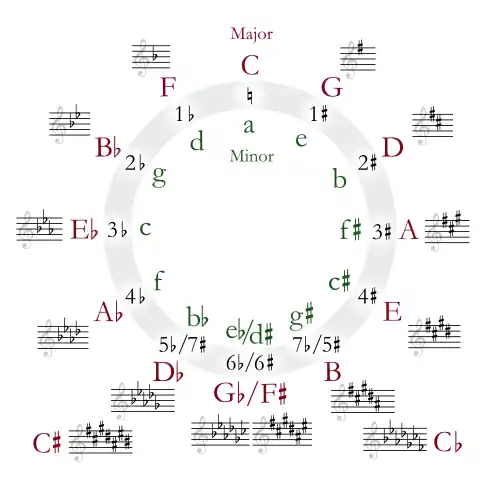
Because it has so many flats, D♭ minor is usually written as its enharmonic equivalent of C♯ minor. For example, Mahler's thematic motif "der kleine Appell" ("call to order") from his Fourth and Fifth Symphonies is written in D♭ minor in Symphony No.4, but in his Symphony No. 5 it is in C♯ minor. In the Adagio of his Symphony No. 9 a solo bassoon theme appears first in D♭ minor, but comes back two more times notated in C♯ minor. The Adagio of Bruckner's Symphony No. 8, also has phrases that are tonally in D♭ minor but written as C♯ minor.[2][3][4][5]
References
↑Thomas Busby (1840). "D Flat Minor". A dictionary of three thousand musical terms. revised by J.A. Hamilton. London: D'Almaine and Co. p.55.
↑Ernst Levy (1985). A Theory of Harmony. SUNY Press. p.62. ISBN0873959930.
↑James L. Zychowicz (2005). "Structural Considerations". Mahler's Fourth Symphony. Oxford University Press. p.28. ISBN0198162065.
↑Eero Tarasti (1996). "Music history revisited". In Eero Tarasti, Paul Forsell, and Richard Littlefield (ed.). Musical Semiotics in Growth. Indiana University Press. pp.14–15. ISBN0253329493.{{cite book}}: CS1 maint: multiple names: editors list (link)

 , C♭, D♭