Symphony No. 9 (Mahler)
| Symphony No. 9 | |
|---|---|
| by Gustav Mahler | |
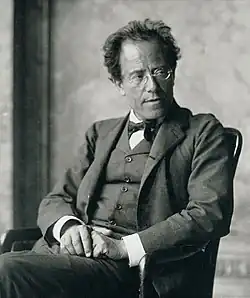 Gustav Mahler in 1907 | |
| Key | D major (– D-flat major) |
| Composed | 1909: Toblach |
| Published | 1912, Universal Edition |
| Recorded | Bruno Walter, Vienna Philharmonic Orchestra, 1938 |
| Movements | 4 |
| Premiere | |
| Date | 26 June 1912 |
| Location | Vienna, Austria-Hungary |
| Conductor | Bruno Walter |
| Performers | Vienna Philharmonic |
The Symphony No. 9 in D major is a piece of orchestral music by Gustav Mahler. The composer wrote the symphony in 1908 and 1909.[1]
The work was first played on 26 June 1912 by the Vienna Philharmonic conducted by Bruno Walter.[2] Mahler was no longer alive at this time.
Instrumentation
The symphony was written for a large orchestra with:[3]
- Woodwinds
- piccolo
- 4 flutes
- 4 oboes (4th doubling cor anglais)
- E♭ clarinet
- 3 B♭ and A clarinets
- bass clarinet
- 4 bassoons (4th doubling contrabassoon)
|
Form
The work is in four parts, also called movements. They are:[4]
- Andante comodo (D major)
- Im Tempo eines gemächlichen Ländlers. Etwas täppisch und sehr derb (C major)
- Rondo-Burleske: Allegro assai. Sehr trotzig (A minor)
- Adagio. Sehr langsam und noch zurückhaltend (D♭ major)
References
- ↑ 'Gustav Mahler', in New Grove, Macmillan, 1980
- ↑ "Mahler Symphony No. 9—Vienna Philharmonic Orchestra; Bruno Walter, conductor (1938)" (PDF). Library of Congress. Retrieved 26 December 2018.
- ↑ "Symphony No. 9, Gustav Mahler". LA Phil. Retrieved 2026-02-20.
- ↑ Agam, Tal (2025-07-31). "Mahler – Symphony No. 9 – A Beginner's Guide". Retrieved 2026-02-20.
Further reading
- Reenan, Sam (Fall 2024). "Contrapuntal Parody and Transsymphonic Narrative in Mahler's Rondo-Burleske". Music Theory Spectrum. 46 (2): 288–318. doi:10.1093/mts/mtae006. (subscription required)
- Vernon, David (2022). Beauty and Sadness: Mahler's 11 Symphonies. Edinburgh: Candle Row Press. ISBN 978-1739659905.
Other websites
- Mahler - Symphony No. 9 – A Beginner's Guide – Overview, analysis and the best recordings – The Classic Review
- Extensive history and analysis at the Wayback Machine (archived 12 June 2008)
- Score at IMSLP