Batman (1989 movie)
| Batman | |
|---|---|
 Official logo | |
| Directed by | Tim Burton |
| Screenplay by |
|
| Story by | Sam Hill |
| Based on |
|
| Produced by |
|
| Starring | |
| Cinematography | Roger Pratt |
| Edited by | Ray Lovejoy |
| Music by | Danny Elfman (score) Prince (songs) |
Production companies |
|
| Distributed by | Warner Bros.[2] |
Release dates |
|
Running time | 126 minutes |
| Countries | |
| Language | English |
| Budget | $48 million[5] |
| Box office | $411.6 million[6] |
Batman is a 1989 superhero movie directed by Tim Burton and written by Sam Hamm and Warren Skaaren. It is the first installment of Warner Bros.' initial Batman movie series based on the DC Comics character. The movie stars Jack Nicholson, Michael Keaton, Kim Basinger, Robert Wuhl, Pat Hingle, Billy Dee Williams, Michael Gough, and Jack Palance, takes place early in the war on crime of the titular character (Keaton) and depicts his confrontation with his archenemy the Joker (Nicholson). The movie's score was composed by Danny Elfman and songs were written by Prince.
After Burton was hired to direct in 1986, Steve Englehart and Julie Hickson wrote movie treatments before Hamm wrote the first screenplay. Batman wasn't greenlit until after the success of Burton's Beetlejuice (1988). The movie's tone and themes were partially influenced by Alan Moore and Brian Bolland's The Killing Joke and Frank Miller's The Dark Knight Returns. The movie primarily adapts and then diverges from the "Red Hood" origin story for the Joker, having Batman inadvertently gangster Jack Napier to fall into Axis Chemical acid, triggering his transformation into the psychotic Joker. Batman co-creator Bob Kane additionally worked as a consultant for the movie.
Numerous leading men were considered for the role of Batman before Keaton was cast. Keaton's casting was controversial since, by 1988, he'd become typecast as an comedic actor and many observers had doubt he could portray a serious role.[7] Nicholson accepted the role of the Joker under strict conditions that dictated top billing, a portion of the movie's earnings (including associated merchandise), and his own shooting schedule. Filming took place at Pinewood Studios from October 1988 to January 1989. The budget escalated from $30 million to $48 million, while the 1988 Writers Guild of America strike forced Hamm to drop out. Skaaren did provide in the rewrites, with additional uncredited drafts done in by Charles McKeown and Jonathan Gems.
Batman was both critically and financially successful, earning over $400 million in box office totals. Critics and audiences particularly praised Nicholson and Keaton's performances, Burton's direction, the production design, and composer Danny Elfman's score. It was the sixth-highest-grossing movie in history at the time of its release. The movie received several Saturn Award nominations and a Golden Globe nomination for Nicholson's performance, and the Academy Award for Best Art Direction.
The movie was followed by three sequels: Batman Returns (1992), with both Burton and Keaton returning; Batman Forever (1995), with Joel Schumacher directing and Val Kilmer in the lead role; and Batman & Robin (1997), which featured George Clooney in the role. Keaton would later reprise the role of Batman in the DC Extended Universe movie The Flash (2023). The movie also led to the development of Batman: The Animated Series (1992-1995), which in turn began the DC Animated Universe of spin-off media, and has influenced Hollywood's modern marketing and development techniques of the superhero movie genre. Two sequel novels were written by John Jackson Miller, Batman: Resurrection (2024) and Batman: Revolution (2025).
Plot
Newspaper reporter Alexander Knox and photojournalist Vicki Vale investigate sightings of "Batman", a masked vigilante who is targeting on Gotham City's criminals. They attend a fundraiser hosted by billionaire Bruce Wayne, who is secretly Batman, having chosen this path after witnessing a mugger murder his parents when he was a child. During the event, Wayne becomes attracted to Vale.
Meanwhile, mob boss Carl Grissom sends his sociopathic second-in-command Jack Napier to break into Axis Chemicals and retrieve incriminating evidence. However, this is secretly a ploy to have Napier killed for carrying on an affair with Grissom's mistress, Alicia Hunt. Corrupt Gotham City police lieutenant Max Eckhardt arranges the hit on Napier by conducting an unauthorized raid on Axis Chemicals. Unfortunately, Commissioner James Gordon learns of the raid and takes command, ordering the officers to capture Napier alive. Batman also appears, while Napier shoots Eckhardt as revenge for the betrayal. During a scuffle with Batman, Napier topples off a catwalk and falls into a vat of chemicals. Although presumed dead, Napier survives with various disfigurements including chalk white skin and emerald-green hair He undergoes surgery to repair the damage, but ends up with a rictus grin. Driven insane by his hideous appearance, Napier, calling himself "the Joker", murders Grissom, massacres Grissom's associates, and takes over his operations.
The Joker begins to terrorize Gotham by lacing various hygiene products with "Smylex" - a deadly chemical that causes its victims to die laughing. He soon becomes obsessed with Vicki and lures her to the Flugelheim Museum, which his henchmen vandalize. Batman rescues Vicki from the Joker, takes her to the Batcave, and provides her with all of his research on Smylex, which will allow Gotham's residents to escape from the toxin. Conflicted with his love for her, Wayne visits her apartment in an intend to reveal his secret identity, only for the Joker to interrupt the meeting. The Joker asks Wayne, "Have you ever danced with the devil in the pale moonlight?", which Wayne recognizes as the phrase used by the mugger who murdered his parents. He shoots Wayne, who survives by hiding a serving tray underneath his shirt.
Vicki is taken to the Batcave by Wayne's butler, Alfred Pennyworth, who had been coaxing the relationship between the pair. After Vicki learns his secret, Wayne chooses to battle the Joker for the sake of the city over their relationship. He then departs to destroy the Axis plant used to create Smylex. Meanwhile, the Joker lures Gotham's citizens to a parade honoring Gotham's bicentennial with the promise of free money. This turns out to be a trap designed to dose them with the Smylex gas held within giant parade balloons. Batman foils his plan by using his Batwing to remove the balloons, but the Joker shoots him down. The Batwing crashes in front of a cathedral, which the Joker uses to take Vicki hostage. Batman pursues the Joker, and in the ensuing fight, he identifies that Napier killed his parents and thus, indirectly created Batman. The Joker eventually pulls Batman and Vicki over the cathedral's roof, leaving them hanging while he calls for a helicopter piloted by his goons, who throw down a ladder for him to climb. Batman uses a grappling hook to attach the Joker's leg to a crumbling gargoyle that eventually falls off the roof. Unable to bear the statue's immense weight, the Joker falls to his death while Batman and Vicki make it to safety.
Sometime later, Gordon announces that the police have arrested all of the Joker's men, effectively dismantling the remains of Grissom's organizations, and unveils the Bat-Signal. Batman leaves the police a note, promising to defend Gotham if crime should strike again, and asking them to use the Bat-Signal to summon him in times of need. Alfred takes Vicki to Wayne Manor, explaining Wayne will be a little late. She responds she's not surprised, as Batman looks at the signal's projection from a rooftop, standing watch over the city.
Cast
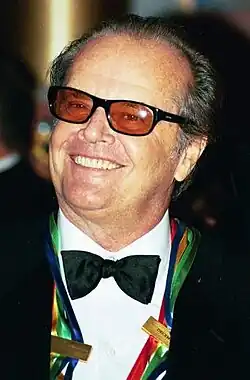
- Jack Nicholson as Jack Napier / The Joker
- Hugo E. Blick as young Jack
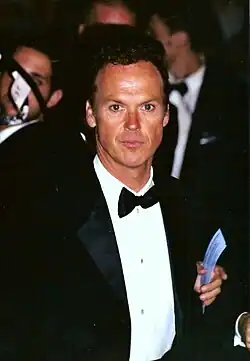
- Michael Keaton as Bruce Wayne / Batman
- Charles Roskilly as young Bruce
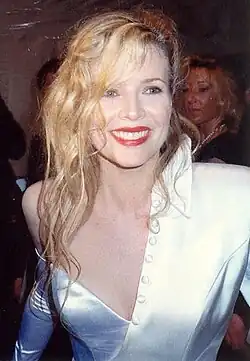
- Kim Basinger as Vicki Vale
- Robert Wuhl as Alexander Knox
- Pat Hingle as Commissioner Gordon
- Billy Dee Williams as Harvey Dent
- Michael Gough as Alfred Pennyworth
- Jack Palance as Carl Grissom
- Jerry Hall as Alicia Hunt
- Tracey Walter as Bob the Goon
- Lee Wallace as Mayor Borg
- William Hootkins as Lt. Max Eckhardt
- Liza Ross as tourist mom
- Garrick Hagon as tourist dad
- Adrian Meyers as tourist son
- David Baxt as Thomas Wayne
- Sharon Holm as Martha Wayne
Production
Development
"I was never a giant comic book fan, but I've always loved the image of Batman and the Joker. The reason I've never been a comic book fan – and I think it started when I was a child – is because I could never tell which box I was supposed to read. I don't know if it was dyslexia or whatever, but that's why I loved The Killing Joke, because for the first time I could tell which one to read. It's my favorite. It's the first comic I've ever loved. And the success of those graphic novels made our ideas more acceptable."

In the late 1970s, Batman's popularity was waning.[9] CBS was interested in producing a Batman in Outer Space movie. Producers Benjamin Melniker and Michael E. Uslan purchased the movie rights of Batman from DC Comics on October 3, 1979. It was Uslan's wish "to make the definitive, dark, serious version of Batman, the way Bob Kane and Bill Finger had envisioned him in 1939. A creature of the night; stalking criminals in the shadows."[9] Richard Maibaum was approached to write a script with Guy Hamilton to direct, but the two turned down the offer. Uslan was unsuccessful with pitching Batman to various movie studios because they wanted the movie to be similar to the campy 1960s television series. Columbia Pictures and United Artists were among those to turn down the movie.[10]
A disappointed Uslan then wrote a script titled Return of the Batman to give the movie industry a better idea of his vision for the movie. Uslan later compared its dark tone to that of the successful four-part comic book The Dark Knight Returns, to which his script predated by six years.[9] In November 1979, producers Jon Peters and Peter Guber joined the project.[5] Melniker and Uslan became executive producers. The four felt that it was best to pattern the movie's development after that of Superman (1978).[11] Uslan, Melniker and Guber pitched Batman to Universal Pictures, but the studio turned it down.[12] Though no movie studios were yet involved, the project was publicly announced with a budget of $15 million in July 1980 at the Comic Art Convention in New York. Warner Bros., the studio behind the successful Superman movie franchise, decided to also accept and produce Batman.[13]
Tom Mankiewicz completed a script titled The Batman in June 1983, focusing on Batman and Dick Grayson's origins, with the Joker and Rupert Thorne as villains and Silver St. Cloud as the romantic interest.[14] Mankiewicz took inspiration from the limited series Batman: Strange Apparitions, written by Steve Englehart.[15] Comic book artist Marshall Rogers, who worked with Englehart on Strange Apparitions, was hired for concept art.[12] The Batman was then announced in late 1983 for a mid-1985 release date on a budget of $20 million. Originally, Mankiewicz had wanted an unknown actor for Batman, William Holden for James Gordon, David Niven as Alfred Pennyworth, and Peter O'Toole as the Penguin, whom Mankiewicz wanted to portray as a mobster with low body temperature.[13] Holden died in 1981 and Niven in 1983, so this would never come to pass. A number of filmmakers were attached to Mankiewicz' script, including Ivan Reitman and Joe Dante. Reitman wanted to cast Bill Murray as Batman and Eddie Murphy as Robin.[7] Nine rewrites were performed by nine separate writers. Most of them were based on Strange Apparitions. However, Mankiewicz's script was still being used to guide the project.[16] Due to the work they did together with the film Swamp Thing (1982), Wes Craven was among the names that Melniker and Uslan considered while looking for a director.[17] Sam Raimi wanted to direct, but was unable to get the rights.[18]
After the financial success of Pee-wee's Big Adventure (1985), Warner Bros. hired Tim Burton to direct Batman. Burton had then-girlfriend Julie Hickson write a new 30-page movie treatment, feeling the previous script by Mankiewicz was campy. The success of The Dark Knight Returns and the graphic novel Batman: The Killing Joke rekindled Warner Bros.' interest in a film adaptation. Burton was initially not a comic book fan, but he was impressed by the dark and serious tone found in both The Dark Knight Returns and The Killing Joke.[7] Warner Bros. enlisted the aid of Englehart to write a new treatment in March 1986.[19] Like Mankiewicz's script, it was based on his own Strange Apparitions and included Silver St. Cloud, Dick Grayson, the Joker, and Rupert Thorne, as well as a cameo appearance by the Penguin. Warner Bros. was impressed, but Englehart felt there were too many characters. He removed the Penguin and Dick Grayson in his second treatment, finishing in May 1986.[19]
Burton approached Sam Hamm, a comic book fan, to write the screenplay.[13] Hamm decided not to use an origin story, feeling that flashbacks would be more suitable and that "unlocking the mystery" would become part of the storyline.[15] He reasoned, "You totally destroy your credibility if you show the literal process by which Bruce Wayne becomes Batman."[20] Hamm replaced Silver St. Cloud with Vicki Vale and Rupert Thorne with his own creation, Carl Grissom. He completed his script in October 1986, which demoted Dick Grayson to a cameo rather than a supporting character.[21] One scene in Hamm's script had an young James Gordon on duty the night of the murder of Bruce Wayne's parents. When Hamm's script was rewritten, the scene was deleted, reducing it to a photo in the Gotham Globe newspaper seen in the movie.[22]
Warner Bros. was less willing to move forward on development, despite their enthusiasm for Hamm's script, which Kane greeted with positive feedback.[7] Hamm's script was then bootlegged at various comic book stores in the United States.[15] Batman was finally given the greenlight to commence pre-production in April 1988, after the success of Burton's Beetlejuice the same year.[7] When comic book fans found out about Burton directing the movie with Michael Keaton starring in the lead role, controversy arose over the tone and direction Batman was going in.[23] Hamm explained, "They hear Tim Burton's name and they think of Pee-wee's Big Adventure. They hear Keaton's name, and they think of any number of Michael Keaton comedies. You think of the 1960s version of Batman, and it was the complete opposite of our film. We tried to market it with a typical dark and serious tone, but the fans didn't believe us."[15] To combat negative reports on the movie's production, Kane was hired as an creative consultant.[11] Batman's co-creator, Bill Finger, was uncredited at the time of the film's release and his name was not added to any Batman-related media until 2016.[1]
Casting
Parallel to the Superman casting, an variety of Hollywood A-listers were considered for the role of Batman, including Mel Gibson, Michael Biehn,[24] Steven Seagal,[25] Kevin Costner, Charlie Sheen, Tom Selleck, Bill Murray,[5][13] Harrison Ford and Dennis Quaid.[26] Burton was pressured by Warner Bros. to cast an obvious action movie star,[7] and had approached Pierce Brosnan, but he had no interest in playing a comic book character.[27] Gibson turned down the role in favor of Lethal Weapon 2 (1989).[28] Burton was originally interested in casting an unknown actor,[26] Willem Dafoe, who was falsely reported to be considered for the Joker, but had actually been considered for Batman early in development.[29] Producer Jon Peters suggested Michael Keaton, arguing that he had the right "edgy, tormented quality" after having seen his dramatic performance in Clean and Sober (1988).[30] Having directed Keaton in Beetlejuice, Burton agreed.[5]
The casting of Keaton caused a furor among comic book fans,[23][31] with 50,000 protest letters sent to the Warner Bros. offices.[21] Kane, Hamm, and Uslan also heavily questioned the casting.[15] "Obviously there was a negative response from the comic book people. I think they thought we were going to make it like the 1960s TV series, and make it campy, because they thought of Michael Keaton from Mr. Mom and Night Shift and stuff like that."[32] Keaton studied The Dark Knight Returns for inspiration.[33]
Tim Curry, David Bowie, John Lithgow, Brad Dourif, Ray Liotta, and James Woods were all considered for the Joker.[b] During his audition, Lithgow attempted to talk Burton out of casting him, a decision which he would later publicly regret, stating, "I didn't realize it was such a big deal."[37] Burton wanted to cast John Glover, but the studio insisted on using a movie star.[38] Robin Williams lobbied hard for the part.[21] Jack Nicholson had been the studio's top choice since 1980. Peters approached Nicholson as far back as 1986, during filming of The Witches of Eastwick;[39] Unlike Keaton, he was a popular choice for his role.[31] Nicholson had what was known as an "off-the-clock" agreement. His contract specified the number of hours he was entitled to have off each day, from the time he left the set to the time he reported back for filming,[13] as well as being off for Los Angeles Lakers home games.[40] Nicholson demanded that all of his scenes be shot in a three-week block, but the schedule lapsed into 106 days.[39] He reduced his standard $10 million fee to $6 million in exchange for a cut of the movie's earnings (including associated merchandise), which led to remuneration in excess of $50 million[41]—biographer Marc Eliot reports that Nicholson may have received as much as $90 million.[42] He also demanded top billing on promotional materials.[43]
Sean Young was originally cast as Vicki Vale, but was injured in a horse-riding accident prior to commencement of filming.[44] Young's departure necessitated an urgent search for an actress who, besides being right for the part, could commit to the movie at an very short notice. Peters suggested Kim Basinger: she was able to join the production immediately and was cast.[5][44] As a fan of Michael Gough's work in various Hammer horror movies, Burton cast Gough as Bruce Wayne's mysterious butler, Alfred.[45] Reporter Alexander Knox was portrayed by Robert Wuhl. In the original script, Knox was killed by the Joker's poison gas during the climax, but the moviemakers "liked [my] character so much," Wuhl said, "that they decided to let me live."[46] Burton chose Billy Dee Williams as Harvey Dent because he wanted to include the villain Two-Face in a future movie using the concept of an African-American Two-Face for the black and white concept,[47] but Tommy Lee Jones was later cast in the role for Batman Forever (1995), which disappointed Williams.[46] Nicholson convinced the moviemakers to cast his friend Tracey Walter as the Joker's henchman Bob.[48] Matt Damon auditioned in for the role of Dick Grayson,[49] but the role eventually went to Irish child actor Ricky Addison Reed before the character was removed by Warren Skarren for the revised shooting script.[50] The rest of the cast included Pat Hingle as Commissioner Gordon, Jerry Hall as Alicia, Lee Wallace as Mayor Borg, William Hootkins as Lt. Eckhardt, and Jack Palance as crime boss Carl Grissom.
Design
"On Batman, our vision of Gotham City was influenced by the tone of the 'Dark Knight' comics, and also Andreas Feininger's photographs of New York buildings and the work of Japanese architect Shin Takamatsu. (Blade Runner was consciously avoided as a reference; no one was allowed to watch it while we were designing the film and neon was shunned altogether!)"
Burton had been impressed with the design of Neil Jordan's The Company of Wolves (1984), but was unable to hire its production designer Anton Furst for Beetlejuice[31] as he had instead committed to Jordan's London-filmed ghost comedy High Spirits (1988), a choice he later regretted.[13] A year later Burton successfully hired Furst for Batman, and they enjoyed working with each other. "I don't think I've ever felt so naturally in tune with a director," Furst said. "Conceptually, spiritually, visually, or artistically. There was never any problem because we never fought over anything. Texture, attitude and feelings are what Burton is a master at."[11]
Furst and the art department deliberately mixed clashing architectural styles to "make Gotham City the ugliest and bleakest metropolis imaginable".[52] Furst continued, "[W]e imagined what New York City might have become without a planning commission. A city run by crime, with a riot of architectural styles. An essay in ugliness. As if hell erupted through the pavement and kept on going".[53] The 1985 movie Brazil by Terry Gilliam was also a notable influence upon the film's production design, as both Burton and Furst studied it as a reference.[11] Black and white charcoal drawings of key locations and sets were created by Furst's longtime draftsman, Nigel Phelps. Derek Meddings served as the visual effects supervisor, overseeing the miniatures and animation. Conceptual illustrator Julian Caldow designed the Batmobile, Batwing and assorted bat-gadgets that were later constructed by prop builder John Evans. Keith Short sculpted the final body of the Batmobile,[54] adding two Browning machine guns.[55] On designing the Batmobile, Furst explained, "We looked at jet aircraft components, we looked at war machines, we looked at all sorts of things. In the end, we went into pure expressionism, taking the Salt Flat Racers of the 30s and the Sting Ray macho machines of the 50s". The car was built upon a Chevrolet Impala when previous development with a Jaguar and Ford Mustang failed.[39] The car itself was later purchased by standup comedian/ventriloquist Jeff Dunham, who had it outfitted with a Corvette engine to make it street legal.[56]
Costume designer Bob Ringwood turned down the chance to work on Licence to Kill (1989) in favor of Batman. Ringwood found it difficult designing the Batsuit because "the image of Batman in the comics is this huge, big six-foot-four hunk with a dimpled chin. Michael Keaton is a guy with average build", he stated. "The problem was to make somebody who was average-sized and ordinary-looking into this bigger-than-life creature."[57] Burton commented, "Michael is a bit claustrophobic, which made it worse for him. The costume put him in a dark, Batman-like mood though, so he was able to use it to his advantage".[57] Burton's idea was to use an all-black suit, and was met with positive feedback by Bob Kane. Vin Burnham was tasked with sculpting the Batsuit, in association with Alli Eynon. Jon Peters wanted to use a Nike product placement with the Batsuit.[58][59] Ringwood studied over 200 comic book issues for inspiration. 28 sculpted latex designs were created; 25 different cape looks and 6 different heads were made, accumulating a total cost of $250,000.[60] Comic book fans initially expressed negative feedback against the Batsuit.[31] Burton opted not to use tights, spandex, or underpants as seen in the comic book, feeling it was not intimidating.[7] Prosthetic makeup designer Nick Dudman used acrylic-based makeup paint called PAX for Nicholson's chalk-white face. Part of Nicholson's contract was approval over the makeup designer.[61]
Filming
The moviemakers considered filming Batman entirely on the Warner Bros. backlot in Burbank, California, but media interest in the film made them change the location. It was shot at Pinewood Studios in England from October 10, 1988, to February 14, 1989, with 80 days of main shooting and 86 days of second unit shooting.[62] 18 sound stages were used, with seven stages occupied, including the 51 acre backlot for the Gotham City set, one of the biggest ever built at the studio.[62][11] Locations included Knebworth House and Hatfield House doubling for Wayne Manor, plus Acton Lane Power Station and Little Barford Power Station.[63][64] For the production at Acton Lane Power Station, the power plant and alien nest sets from Aliens (1986) were reused as interiors for Axis Chemicals.[65] The original production budget escalated from $30 million to $48 million.[5]
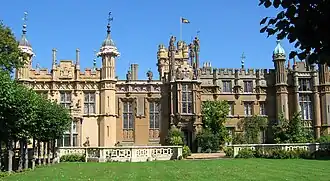
Filming was highly secretive. The unit publicist was offered and refused £10,000 for the first pictures of Nicholson as the Joker. The police were later called in when two reels of footage (about 20 minutes' worth) were stolen.[39] With various problems during filming, Burton called it "Torture. The worst period of my life!"[5]
Hamm wasn't allowed to perform rewrites during the 1988 Writers Guild of America strike.[13] Warren Skaaren, who had also worked on Burton's Beetlejuice, did in the rewrites. Jonathan Gems and Charles McKeown rewrote the script during filming.[66] Only Skaaren received screenplay credit with Hamm. Hamm criticized the rewrites, but blamed the changes on Warner Bros.[15] Burton explained, "I don't understand why that became such a problem. We started out with a script that everyone liked, although we recognized it needed a little work."[7] Dick Grayson appeared in the shooting script but was deleted because the filmmakers felt he was irrelevant to the plot;[13] Kane supported this decision.[45]
Keaton used his comedic experience for scenes such as Bruce and Vicki's Wayne Manor dinner.[31] He called himself a "logic freak" and was concerned that Batman's secret identity would in reality be fairly easy to uncover. Keaton discussed ideas with Burton to better disguise the character, including the use of contact lenses. Ultimately, Keaton decided to perform Batman's voice at an lower register than when he was portraying Bruce Wayne, which became a hallmark of the movie version of the character, with Christian Bale later using the same technique.[67]
Originally in the climax, the Joker was meant to kill Vicki Vale, sending Batman into a vengeful fury. Jon Peters reworked the climax without telling Burton and commissioned production designer Anton Furst to create a 38-foot (12 m) model of the cathedral.[68] This cost $100,000 when the movie was already well over budget. Burton disliked the idea, having no clue how the scene would end: "Here were Jack Nicholson and Kim Basinger walking up this cathedral, and halfway up Jack turns around and says, 'Why am I walking up all these stairs? Where am I going?' 'We'll talk about it when you get to the top!' I had to tell him that I didn't know."[68]
Music
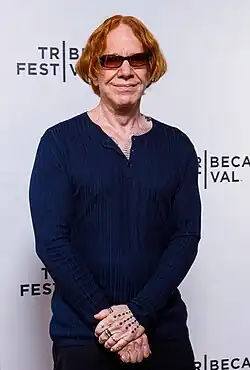
Burton hired Danny Elfman of Oingo Bongo, his collaborator on Pee-wee's Big Adventure and Beetlejuice, to compose the music score. For inspiration, Elfman was given The Dark Knight Returns. Elfman was worried, as he had never worked on a production this large in budget and scale.[69] In addition, producer Jon Peters was skeptical of hiring Elfman, but was later convinced when he heard the opening number.[70] Peters and Peter Guber wanted Prince to write music for the Joker and Michael Jackson to do the romance songs. Elfman would then combine the style of Prince and Jackson's songs together for the entire movie score.[7] At the encouragement of Prince's then-manager Albert Magnoli, it was agreed that Prince himself would write and sing the movie's songs.[71]
Burton protested the ideas, citing "my movies aren't commercial like Top Gun."[7] Elfman enlisted the help of composer Shirley Walker and Oingo Boingo lead guitarist Steve Bartek to arrange in the compositions for the orchestra.[72][73] Elfman was later displeased with the audio mixing of his movie score. "Batman was done in England by technicians who didn't care, and the non-caring showed," he stated. "I'm not putting down England because they've done gorgeous dubs there, but this particular crew elected not to."[74] Batman was one of the first films to spawn two soundtracks. One of them featured songs written by Prince while the other showcased Elfman's score. Both were successful,[75] and compilations of Elfman's opening credits were used in the title sequence theme for Batman: The Animated Series (1992–1995), also composed by Walker.[35]
Related pages
Other websites

- Batman at AllMovie
- Batman on IMDb
- Batman at Box Office Mojo
- Batman at Metacritic
- Batman at Rotten Tomatoes
Template:The President's Memorial Award
| |||||
| Films |
| ||||
| TV series |
| ||||
| Music |
| ||||
| Cast and characters |
| ||||
| Other |
| ||||
| |||||

Template:Tim Burton Template:Yearly highest-grossing US movies
- ↑ Bill Finger, co-creator of Batman, the Penguin, and Catwoman, was uncredited at the time of the film's release and his name was not added to any Batman related media until 2016.[1]
- ↑ Attributed to multiple references:[20][34][35][36]
<ref group=lower-alpha> tags or {{efn}} templates on this page, but the references will not show without a {{reflist|group=lower-alpha}} template or {{notelist}} template (see the help page).
- 1 2 "DC Will Finally Credit Bill Finger As Co-Creator Of Batman". Gizmodo. September 20, 2015. Archived from the original on August 31, 2019. Retrieved August 31, 2019.
- 1 2 3 4 "Batman (1989)". American Film Institute. Retrieved April 15, 2022.
- ↑ "Batman (1989)". Lumiere. Archived from the original on June 23, 2018. Retrieved March 14, 2018.
- ↑ "Batman (1989)". British Film Institute. Archived from the original on April 8, 2016. Retrieved April 23, 2022.
- 1 2 3 4 5 6 7 Griffin, Nancy; Masters, Kim (1997). "Hit Men". Hit & Run: How Jon Peters and Peter Guber Took Sony For A Ride In Hollywood. Simon & Schuster. pp. 158–174. ISBN 0-684-80931-1.
- ↑ "Batman (1989)". Box Office Mojo. Archived from the original on June 16, 2020. Retrieved December 29, 2020.
- 1 2 3 4 5 6 7 8 9 10 Cite error: The named reference
Elfmanwas used but no text was provided for refs named (see the help page). - ↑ Tim Burton, Burton on Burton: Revised Edition (London: Faber and Faber, 2006) 71.
- 1 2 3 Bill "Jett" Ramey (November 8, 2005). "An Interview With Michael Uslan – Part 1". Batman-on-Film. Archived from the original on September 27, 2013. Retrieved May 4, 2008.
- ↑ Bill "Jett" Ramey (November 11, 2005). "An Interview With Michael Uslan – Part 2". Batman-on-Film. Archived from the original on September 27, 2013. Retrieved May 4, 2008.
- 1 2 3 4 5 Jones, Alan (November 1989). "Batman in Production". Cinefantastique. pp. 75–88. Archived from the original on December 4, 2013. Retrieved May 13, 2008.
- 1 2 Michael Uslan, Benjamin Melniker, Peter Guber, Tom Mankiewicz, Sam Hamm, Shadows of the Bat: The Cinematic Saga of the Dark Knight—The Road to Gotham City, 2005, Warner Home Video
- 1 2 3 4 5 6 7 8 Jones, Alan (November 1989). "Batman". Cinefantastique. pp. 55–67. Archived from the original on December 5, 2013. Retrieved May 2, 2008.
- ↑ Stax (December 1, 2001). "The Stax Report Special Edition: Script Review of The Batman". IGN. Archived from the original on December 6, 2008. Retrieved October 24, 2008.
- 1 2 3 4 5 6 White, Taylor L. (July 1989). "Batman". Cinefantastique. pp. 33–40.
- ↑ Cite error: The named reference
foreverwas used but no text was provided for refs named (see the help page). - ↑ Lee Goldberg & David McDonnell (September 1986). "Wes Craven's Double Doubleheader". Fangoria. No. 57. Wes Craven (interviewed). pp. 50–53, 64. ISSN 0164-2111.
- ↑ "Sam Raimi Reveals DC Movies He Attempted to Make & Characters He Would Love to Get His Hands on".
- 1 2 "Batman". Steve Englehart.com. Archived from the original on December 14, 2007. Retrieved November 25, 2007.
- 1 2 Rebello, Stephen (November 1989). "Sam Hamm – Screenwriter". Cinefantastique. pp. 34–41.
- 1 2 3 Tim Burton, Sam Hamm, Mark Canton, Michael Keaton, Shadows of the Bat: The Cinematic Saga of the Dark Knight—The Gathering Storm, 2005, Warner Home Video
- ↑ "Archived copy". Archived from the original on February 13, 2016. Retrieved January 29, 2016.
{{cite web}}: CS1 maint: archived copy as title (link) - 1 2 Lowry, Brian (August 23, 2013). "Batman Backlash: Ben Affleck Has Nothing on Michael Keaton". Variety. Archived from the original on November 21, 2019. Retrieved August 24, 2013.
- ↑ "Michael Biehn came close to starring in Tim Burton's Batman". October 7, 2024.
- ↑ "How Tim Burton's Batman set the stage for comic books' Hollywood takeover". June 20, 2019.
- 1 2 Busch, Jenna (July 3, 2014). "Interview: Batman Producer Michael Uslan Talks the Legacy of Superhero Cinema". SuperHeroHype. Archived from the original on December 7, 2019. Retrieved July 25, 2015.
- ↑ "Pierce Brosnan: I turned down Tim Burton's Batman". The Guardian. August 21, 2014. Archived from the original on December 7, 2019. Retrieved August 22, 2014.
- ↑ "30 Things You Didn't Know About Tim Burton's Batman".
- ↑ Wigler, Josh (October 27, 2009). "Exclusive: Willem Dafoe As Batman? It Almost Happened!". MTV. Archived from the original on September 9, 2015. Retrieved May 14, 2015.
- ↑ John Peters, The Death of "Superman Lives": What Happened?, 2015
- 1 2 3 4 5 Cite error: The named reference
Joewas used but no text was provided for refs named (see the help page). - ↑ Hilary de Vries (February 5, 1989). "Batman Battles for Big Money". The New York Times. Archived from the original on December 7, 2019. Retrieved October 26, 2008.
- ↑ Daniels, Les (2000). Batman: The Complete History. Chronicle Books. p. 164. ISBN 0-8118-2470-5.
- ↑ Gilchrist, Todd (November 4, 2011). "Ray Liotta Says Tim Burton Wanted To Meet With Him For 'Batman'". Indiewire. Archived from the original on September 3, 2014. Retrieved August 29, 2014.
- 1 2 Hughes, David (2003). "Batman". Comic Book Movies. Virgin Books. pp. 33–46. ISBN 0-7535-0767-6.
- ↑ Child, Ben (October 15, 2013). "Batman's Joker was originally Brad Dourif, not Jack Nicholson, says Dourif". The Guardian. Retrieved October 27, 2021.
- ↑ Van Syckle, Katie (June 13, 2017). "John Lithgow Still Regrets Passing on Playing the Joker in Tim Burton's Batman". Vulture. Archived from the original on November 21, 2019. Retrieved June 14, 2017.
- ↑ Joe Stuber (June 18, 2019). "Episode 261: Special Guest Robert Whul!". Comic Book Central (Podcast). Joe Stuber. Archived from the original on December 30, 2019. Retrieved February 16, 2019.
- 1 2 3 4 Johnstone, Iain (August 1989). "Dark Knight in the City of Dreams". Empire. pp. 46–54.
- ↑ "Top 10 Celebrity Lakers Fans". NBA. Archived from the original on December 12, 2013. Retrieved September 6, 2007.
- ↑ Hochman, David (March 3, 2000). "The biggest movie payoffs". Entertainment Weekly. Archived from the original on December 22, 2019. Retrieved December 30, 2019.
- ↑ Carey, Matt (November 8, 2013). "You don't know Jack (Nicholson)". CNN. Archived from the original on November 14, 2013. Retrieved December 22, 2013.
- ↑ "Top ten Batman villains on screen". The Times. July 17, 2012. Archived from the original on July 12, 2019. Retrieved July 12, 2019.
Nicholson... demanded top-billing and a deal that gave him royalties on merchandise.
(subscription required) - 1 2 Shadows of the Bat: The Cinematic Saga of the Dark Knight, "Part 2: The Gathering Storm", DVD documentary, 2005
- 1 2 Tim Burton, DVD audio commentary, 2005, Warner Home Video
- 1 2 Robert Wuhl, Billy Dee Williams, Pat Hingle, Batman: The Heroes, 2005, Warner Home Video
- ↑ Batman Special Edition DVD/Blu-ray, Tim Burton Commentary
- ↑ Jack Nicholson, Tracey Walter, Batman: The Villains, 2005, Warner Home Video
- ↑ https://theplaylist.net/matt-damon-batman-and-robin-the-dark-knight-20210802/
- ↑ Comics Scene magazine, #14, August 1990, page 51
- ↑ Ettedgui, Peter (1999). Production Design and Art Direction (Screencraft Series). Focal Press. ISBN 0240804007. Published in 1999, Focal Press
- ↑ Anton Furst, Derek Meddings, Visualizing Gotham: The Production Design of Batman, 2005, Warner Home Video
- ↑ Corliss, Richard; Dutka, Elaine (June 19, 1989). "The Caped Crusader Flies Again". Time. Archived from the original on April 24, 2008. Retrieved October 26, 2008.
- ↑ "Batman". Keith Short.com. Archived from the original on February 14, 2012. Retrieved May 12, 2008.
- ↑ Keith Short, Building the Batmobile, 2005, Warner Home Video
- ↑ Walker, Rob (May 8, 2018). "How Jeff Dunham's offensive puppets became the voice of Trump's America". The Guardian. Archived from the original on May 8, 2018. Retrieved September 4, 2020.
- 1 2 Jody Duncan Shannon (February 1990). "Building the Bat-suit". Cinefex. pp. 16–24.
- ↑ Bob Ringwood, Tim Burton, Designing the Batsuit, 2005, Warner Home Video
- ↑ Robinson, Melia (March 26, 2016). "Nike designed a pretty terrible pair of boots for Tim Burton's 1989 'Batman' movie". Business Insider. Archived from the original on February 9, 2021. Retrieved August 22, 2020.
- ↑ "Reinventing the Batsuit for the Modern Era". American Movies Classic. Archived from the original on October 6, 2008. Retrieved October 17, 2008.
- ↑ Jones, Alan (November 1989). "The Joker's Make-up". Cinefantastique. pp. 69–70.
- 1 2 "Welcome to Europe Batman (Pinewood Studios advertisement)". Variety. August 9, 1989. p. 40.
- ↑ Hanke, p.87-96
- ↑ "Batman (1989) Filming Locations". Ukonscreen.com. Archived from the original on February 8, 2012. Retrieved January 2, 2011.
- ↑ Lynch, Ryan (April 24, 2017). "A Few Things You Didn't Know About James Cameron's Aliens". Sideshow.com. Archived from the original on October 23, 2020. Retrieved October 31, 2020.
- ↑ Salisbury, Burton, p.145
- ↑ Wigler, Josh. "Michael Keaton Reveals The Secret Origin Of His Batman Voice". MTV. Archived from the original on December 4, 2019. Retrieved January 14, 2015.
- 1 2 Stone, Tom (September 28, 2004). "How Hollywood had the last laugh". The Daily Telegraph.
- ↑ Danny Elfman, Tim Burton, Nocturnal Overtures: The Music of Batman, 2005, Warner Home Video
- ↑ Cite error: The named reference
rebornwas used but no text was provided for refs named (see the help page). - ↑ Gilchrist, Todd (June 24, 2019). "Prince's 'Batman' at 30: How the Film Saved His Career From 'Horrible' Financial Straits". Variety. Archived from the original on October 11, 2020. Retrieved October 8, 2020.
- ↑ Doerschuk, Robert L. (October 1989). "Danny Elfman – The Agony & The Ecstasy of Scoring Batman". Keyboard. Vol. 15, no. 10. GPI Publications. pp. 82–95. Retrieved January 12, 2018.
- ↑ Givens, Ron (February 23, 1990). "The Elfman Cometh". Entertainment Weekly. Archived from the original on January 7, 2008. Retrieved December 18, 2007.
- ↑ Sloane, Judy (August 1995). "Elfman on scoring". Film Review. p. 77.
- ↑ Holden, Stephen (July 19, 1989). "The Pop Life". The New York Times.

