Aluminium nitride
 | |
 | |
| Names | |
|---|---|
| IUPAC name
Aluminium nitride | |
| Other names
AlN | |
| Identifiers | |
3D model (JSmol) |
|
| ChEBI | |
| ChemSpider | |
| ECHA InfoCard | 100.041.931 |
| EC Number |
|
| Gmelin Reference | 13611 |
PubChem CID |
|
| RTECS number |
|
| UNII | |
CompTox Dashboard (EPA) |
|
SMILES
| |
| Properties | |
| AlN | |
| Molar mass | 40.989 g/mol[1] |
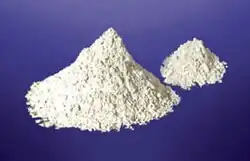
| Appearance | white to pale-yellow solid |
| Density | 3.255 g/cm3[1] |
| Melting point | 2,500 °C (4,530 °F; 2,770 K)[2] |
| hydrolyses (powder), insoluble (monocrystalline) | |
| Solubility | insoluble, subject of hydrolysis in water solutions of bases and acids [3] |
| Band gap | 6.015 eV[4][5] (300 K, direct) |
| Electron mobility | ~300 cm2/(V·s) |
| Thermal conductivity | 321 W/(m·K)[6] |
Refractive index (nD) |
2.048[7](300 k, λ = 633 nm) |
| Structure[8] | |
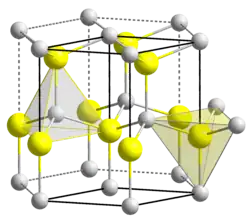
| Wurtzite (Atmospheric) | |
Space group |
C6v4-P63mc, No. 186, hP4 |
Lattice constant |
|
Formula units (Z) |
2 |
| Tetrahedral | |
| Structure[10] | |
| Rocksalt (High-pressure) | |
Space group |
, No. 225, cF8 |
Lattice constant |
a = 0.3938 nm
|
Formula units (Z) |
4 |
| Thermochemistry | |
| Std enthalpy of formation ΔfH |
−318.0 kJ/mol |
| Standard molar entropy S |
20.2 J/(mol·K) |
| Specific heat capacity, C | 30.1 J/(mol·K) |
| Hazards | |
| GHS labelling: | |
Pictograms |
   |
Signal word |
Warning |
Hazard statements |
H315, H319, H335, H373, H411 |
Precautionary statements |
P260, P264, P271, P280, P301+P330+P331, P302+P352, P303+P361+P353, P304+P340, P305+P351+P338, P310, P312, P321, P332+P313, P337+P313, P362, P363, P403+P233, P405, P501 |
| NFPA 704 (fire diamond) | |
Except where otherwise noted, data are given for materials in their standard state (at 25 °C [77 °F], 100 kPa). | |
 verify (what is  ?) | |
| Infobox references | |

Aluminium nitride is a chemical compound made of aluminium and nitride ions. The chemical formula is AlN. It is a semiconductor with a wide bandgap of 6 eV, similar to boron nitride. It has a weak piezoelectric effect that can be made stronger by adding small amounts of metals like scandium.[11]
It is used in thermal management and electronic applications if there is high thermal conductivity and electronic insulation required. It is can sometimes be an alternative to beryllium oxide because it is not a health hazard when it is machined, unlike beryllium oxide.[12]
References
- 1 2 Haynes, p. 4.45.
- ↑ Haynes, p. 12.80.
- ↑ Fukumoto, S.; Hookabe, T.; Tsubakino, H. (2010). "Hydrolysis behavior of aluminum nitride in various solutions". J. Mat. Science. 35 (11): 2743–2748. doi:10.1023/A:1004718329003. S2CID 91552821.
- ↑ Haynes, p. 12.85.
- ↑ Feneberg, M.; Leute, R. A. R.; Neuschl, B.; Thonke, K.; Bickermann, M. (2010). Phys. Rev. B. 82 (7) 075208. Bibcode:2010PhRvB..82g5208F. doi:10.1103/physrevb.82.075208.
{{cite journal}}: CS1 maint: untitled periodical (link) - ↑ Cheng, Zhe; Koh, Yee Rui; Mamun, Abdullah; Shi, Jingjing; Bai, Tingyu; Huynh, Kenny; Yates, Luke; Liu, Zeyu; Li, Ruiyang; Lee, Eungkyu; Liao, Michael E.; Wang, Yekan; Yu, Hsuan Ming; Kushimoto, Maki; Luo, Tengfei; Goorsky, Mark S.; Hopkins, Patrick E.; Amano, Hiroshi; Khan, Asif; Graham, Samuel (2020). "Experimental observation of high intrinsic thermal conductivity of AlN". Physical Review Materials. 4 (4) 044602. arXiv:1911.01595. Bibcode:2020PhRvM...4d4602C. doi:10.1103/PhysRevMaterials.4.044602. S2CID 207780348. Retrieved 2020-04-03.
- ↑ Beliaev, Leonid Yu.; Shkondin, Evgeniy; Lavrinenko, Andrei V.; Takayama, Osamu (2021). "Thickness-dependent optical properties of aluminum nitride films for mid-infrared wavelengths". Journal of Vacuum Science & Technology A. 39 (4) 043408. Bibcode:2021JVSTA..39d3408B. doi:10.1116/6.0000884.
- ↑ Vandamme, Nobuko S.; Richard, Sarah M.; Winzer, Stephen R. (1989). "Liquid-Phase Sintering of Aluminum Nitride by Europium Oxide Additives". Journal of the American Ceramic Society. 72 (8): 1409–1414. doi:10.1111/j.1151-2916.1989.tb07662.x.
- ↑ Vurgaftman, I.; Meyer, J. R. (2003). "Band parameters for nitrogen-containing semiconductors". Journal of Applied Physics. 94 (6): 3675–3696. Bibcode:2003JAP....94.3675V. doi:10.1063/1.1600519.
- ↑ Christensen, N. E.; Gorczyca, I. (1993). "Calculated structural phase transitions of aluminum nitride under pressure". Physical Review B. 47 (8): 4307–4314. Bibcode:1993PhRvB..47.4307C. doi:10.1103/PhysRevB.47.4307. PMID 10006577.
- ↑ Haider, Syed T.; Shah, Muhammad A.; Lee, Duck-Gyu; Hur, Shin (2023). "A Review of the Recent Applications of Aluminum Nitride-Based Piezoelectric Devices". IEEE Access. 11: 58779–58795. Bibcode:2023IEEEA..1158779H. doi:10.1109/ACCESS.2023.3276716.
- ↑ "Aluminum Nitride – AlN". Precision Ceramics. Retrieved 2026-04-05.