Zhuang languages
| Zhuang | |
|---|---|
| Vahcuengh ("Zhuang"), Hauqcuengh (Yongbei) Kauqnuangz (Nong), Kauqnoangz Hoedyaej (Guibian), Hauƽyəiч (Qiubei) Hauqraeuz, Gangjdoj (Yongbei, Nong, Qiubei) Kauqraeuz, Gangjtoj (Nong, Yang, Dai) | |
| Native to | China |
| Ethnicity | Zhuang people |
Native speakers | 16 million, all Northern Zhuang languages (2007)[1] |
Standard forms |
|
| Zhuang, Old Zhuang, Sawndip, Sawgoek | |
| Language codes | |
| ISO 639-1 | za |
| ISO 639-2 | zha |
| ISO 639-3 | zha – inclusive codeIndividual codes: zch – Central Hongshuihe Zhuangzhd – Dai Zhuang (Wenma)zeh – Eastern Hongshuihe Zhuangzgb – Guibei Zhuangzgn – Guibian Zhuangzln – Lianshan Zhuangzlj – Liujiang Zhuangzlq – Liuqian Zhuangzgm – Minz Zhuangzhn – Nong Zhuang (Yanguang)zqe – Qiubei Zhuangzyg – Yang Zhuang (Dejing)zyb – Yongbei Zhuangzyn – Yongnan Zhuangzyj – Youjiang Zhuangzzj – Zuojiang Zhuang |
| Glottolog | Nonedaic1237 = Daic; Zhuang is not a valid group |
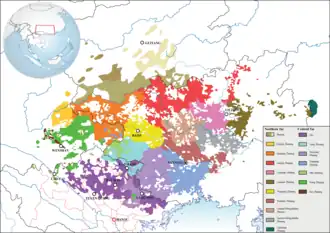 Geographic location of Zhuang dialects in Guangxi and related languages in Northern Vietnam and Guizhou | |
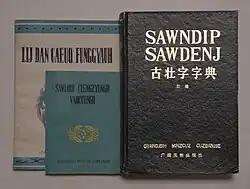
The Zhuang languages (Vahcuengh,[a] Sawndip: 話僮[b]) are made of more than a dozen Tai languages spoken by the Zhuang people of Southern China in the province of Guangxi and neighbouring parts of Yunnan and Guangdong. Northern Zhuang languages form a dialect continuum with Northern Tai varieties across the border in Guizhou, which are designated as Bouyei, while Southern Zhuang languages form another dialect continuum with Central Tai varieties such as Nung, Tay and Caolan in Vietnam.[2] Standard Zhuang is based on the Northern Zhuang dialect of Wuming.
Notes
References
- ↑ Mikael Parkvall, "Världens 100 största språk 2007" (The World's 100 Largest Languages in 2007), in Nationalencyklopedin
- ↑ Bradley, David (2007). "East and Southeast Asia". In Moseley, Christopher (ed.). Encyclopedia of the World's Engangered Languages. Routledge. pp. 349–422. ISBN 978-1-135-79640-2. p. 370.

Zhuang edition of Wikipedia, the free encyclopedia