Yttrium(III) oxide
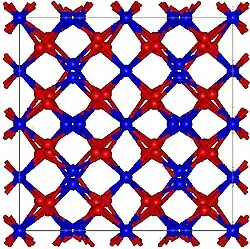 | |
| Names | |
|---|---|
| IUPAC name
Yttrium(III) oxide. | |
| Other names
Yttria, diyttrium trioxide, yttrium sesquioxide | |
| Identifiers | |
| |
3D model (JSmol) |
|
| ChemSpider | |
| ECHA InfoCard | 100.013.849 |
| EC Number |
|
PubChem CID |
|
| RTECS number |
|
| UNII | |
CompTox Dashboard (EPA) |
|
SMILES
| |
| Properties | |
| O3Y2 | |
| Molar mass | 225.81 g/mol |
| Appearance | White solid. |
| Density | 5.010 g/cm3, solid |
| Melting point | 2,425 °C (4,397 °F; 2,698 K) |
| Boiling point | 4,300 °C (7,770 °F; 4,570 K) |
| insoluble | |
| Solubility in alcohol acid |
soluble |
| Structure | |
| Cubic (bixbyite), cI80[1] | |
Space group |
Ia-3, No. 206 |
| Octahedral | |
| Thermochemistry | |
| Std enthalpy of formation ΔfH |
-1905.310 kJ/mol |
| Standard molar entropy S |
99.08 J/mol·K |
| Hazards | |
| Lethal dose or concentration (LD, LC): | |
LDLo (lowest published) |
>10,000 mg/kg (rat, oral) >6000 mg/kg (mouse, oral)[2] |
| Related compounds | |
Other cations |
Scandium(III) oxide, Lanthanum(III) oxide |
Related compounds |
Yttrium barium copper oxide |
Except where otherwise noted, data are given for materials in their standard state (at 25 °C [77 °F], 100 kPa). | |
 verify (what is  ?) | |
| Infobox references | |
Yttrium oxide is Y2O3. It is an air-stable, white solid substance. Yttrium oxide is used as a common starting material for both materials science as well as inorganic compounds.
References
- ↑ Yong-Nian Xu; Zhong-quan Gu; W. Y. Ching (1997). "Electronic, structural, and optical properties of crystalline yttria". Phys. Rev. B56 (23): 14993–15000. Bibcode:1997PhRvB..5614993X. doi:10.1103/PhysRevB.56.14993.
- ↑ "Yttrium compounds (as Y)". Immediately Dangerous to Life or Health Concentrations. National Institute for Occupational Safety and Health.
Other websites
- Yttrium oxide information at Webelements.
- External MSDS Data Sheet Archived 2006-07-18 at the Wayback Machine.