Wolfgang Benz
Wolfgang Benz | |
|---|---|
 | |
| Born | 9 June 1941 Ellwangen, Free People's State of Württemberg, Nazi Germany |
| Nationality | German |
| Education | University of Munich, (PhD, 1968) |
| Occupation(s) | Historian, researcher in antisemitism |
| Known for | Holocaust studies, antisemitism studies, German history |
| Awards | Geschwister-Scholl-Preis (1992) |
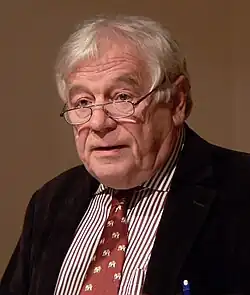
Wolfgang Benz (born June 9, 1941) is a German historian and researcher in antisemitism. He was the director of the Center for Research on Antisemitism of Technische Universität Berlin[a] between 1990 and 2011.[1] Benz is also a member of the advisory board for the Memorial to the Murdered Jews of Europe, who participated in the memorial's design.[2][3]
Overview
He has over 200 publications.[4] He is one of the most well-known German historians, and a leading expert on antisemitism studies.[5] Some call him the "doyen"[b] of antisemitism research.[1]

Research
The Holocaust
Benz is known for confirming that 5.29–6.2 million Jews were killed in the Holocaust.[6] Benz worked on data from declassified Eastern European government archives in the 1990s, contributing to the death toll's confirmation. He concluded in 1999:[7]
The goal of annihilating all of the Jews of Europe, as it was proclaimed at the conference in the villa Am Grossen Wannsee in January 1942, was not reached. Yet the six million murder victims make the Holocaust a unique crime in the history of mankind. The number of victims — and with certainty the following represent the minimum number in each case — cannot express that adequately. Numbers are just too abstract. However they must be stated in order to make clear the dimension of the genocide: 165,000 Jews from Germany, 65,000 from Austria, 32,000 from France and Belgium, more than 100,000 from the Netherlands, 60,000 from Greece, the same number from Yugoslavia, more than 140,000 from Czechoslovakia, half a million from Hungary, 2.2 million from the Soviet Union, and 2.7 million from Poland. To these numbers must be added all those killed in the pogroms and massacres in Romania and Transitrien [sic] (over 200,000) and the deported and murdered Jews from Albania and Norway, Denmark and Italy, from Luxembourg and Bulgaria.
Comparison of Islamophobia to antisemitism
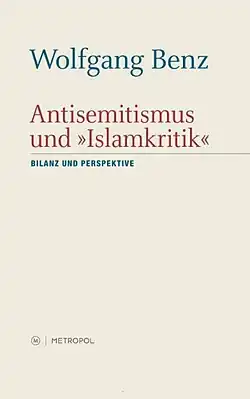
Benz claimed in 2010 that "anti-Semites [sic] of the 19th Century and some detractors of the Islam of the 21st Century work with similar methods on their concept of the enemy", warning against Islamophobia, which he saw as a "declaration of war against tolerance and democracy".[8][9] He was criticized by historian Julius H. Schoeps who considered Benz's claim "dubious – if not dangerous"[10] and by journalist Henryk M. Broder.[11]
They said that Islamophobia – unlike antisemitism – has a real basis, e.g. terrorist acts, the way dissidents are treated in Islamic countries etc. However, educator Micha Brumlik argued that as far as social-psychological aspect is concerned, Benz was right when comparing today's Islamophobia and antisemitism of the late 19th and early 20th century.[12] Historian Norbert Frei agreed with Brumlik.[13]
Opposition to Polish monument construction
Benz objected to building a monument in Berlin to honor the Polish victims of Nazi occupation (1939–45). As the director of the Center for Research on Antisemitism, Benz warned the Bundestag's president of the "danger of nationalizing memory" by building such monuments.[14]
Selected works
Monographs
| Publications | |
|---|---|
| List (year in descending order) |
|
As an editor
| Publications | |
|---|---|
| List (year in descending order) |
|
As a co-editor
| Publications | |
|---|---|
| List (year in descending order) |
|
Related pages
Footnotes
- ↑ Abbreviated as TU Berlin, also known as the Berlin Institute of Technology and Technical University of Berlin
- ↑ The most respected or prominent person in a particular field. Oxford Languages
References
- 1 2 Probst, Robert (2021-06-08). "Wolfgang Benz: Dem Historiker und Antisemitismusforscher zum 80". Süddeutsche.de (in German). Retrieved 2024-04-12.
- ↑ "Wolfgang Benz, Prof. Dr". ivkf-berlin.de. Retrieved 2024-04-13.
- ↑ Friedrich, Sarah (2021-06-02). "Wolfgang Benz wird 80 Jahre alt". Stiftung Denkmal für die ermordeten Juden Europas (in German). Retrieved 2024-04-12.
- ↑ e.V, Gegen Vergessen-für Demokratie. "Ehrung für Wolfgang Benz". www.gegen-vergessen.de (in German). Archived from the original on 2024-04-20. Retrieved 2024-04-14.
- ↑
- "Antisemitismusforscher Wolfgang Benz geht in den Ruhestand". Deutschlandfunk (in German). 2010-10-21. Retrieved 2024-04-13.
- Walter, Rüdiger. "Veranstaltung am 26. 9. 2016: Prof. Wolfgang Benz : Rassismus und Fremdenfeindschaft – Herausforderungen für die Demokratie – Attac Aalen" (in German). Retrieved 2024-04-12.
- Friedrich, Sarah (2021-06-02). "Wolfgang Benz wird 80 Jahre alt". Stiftung Denkmal für die ermordeten Juden Europas (in German). Retrieved 2024-04-12.
- "Prof. Wolfgang Benz". www.herder.de. Retrieved 2024-04-13.
- ↑ Benz, Wolfgang (1996). Dimension des Völkermords. Die Zahl der jüdischen Opfer des Nationalsozialismus. Dtv. ISBN 3-423-04690-2.
- ↑ Benz, Wolfgang (1999). The Holocaust: A German Historian Examines the Genocide. New York: Columbia University Press. pp. 152–153. ISBN 0-231-11214-9.
- ↑ Hetzer mit Parallelen, Süddeutsche Zeitung, 4. Januar 2010
- ↑ "Fakultät I Geisteswissenschaften: Aktuelles" (PDF).
- ↑ "Abwegige Parallelen". Archived from the original on 2011-07-06. Retrieved 2025-07-01.
- ↑ Sind Muslime die Juden von heute? ("Are Muslims the Jews of Today?")
- ↑ Neue Feindschaft – Alte Muster. Micha Brumlik im Gespräch mit Britta Bürger In: Deutschlandradio Kultur, 28. January 2010.
- ↑ "Antisemitismusforscher Wolfgang Benz geht in den Ruhestand".
- ↑ "German politicians block Polish WWII memorial in Berlin". rmx.news. February 21, 2020.