Treaty of Neuilly-sur-Seine
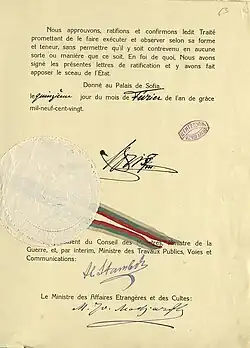 Ratification of the Treaty of Neuilly-sur-Seine, with signatures of Boris III of Bulgaria, Aleksandar Stamboliyski, and Mihail Madzharov | |
| Signed | 27 November 1919 |
|---|---|
| Location | Neuilly-sur-Seine, France |
| Condition | Ratification by Bulgaria and four Principal Allied Powers. |
| Parties | Principal Allied and Associated Powers Allied and Associated Powers
|
| Depositary | French Government |
| Languages | French (primary), English, Italian |
 Treaty of Neuilly at Wikisource | |



The Treaty of Neuilly-sur-Seine was a peace treaty signed in Neuilly-sur-Seine, France on 27 November 1919 between Bulgaria, a former Central Powers nation, and the Allied powers. The treaty was a part of series of other peace treaties signed after World War I had ended, beginning with Versailles and ended with Lausanne.
Background
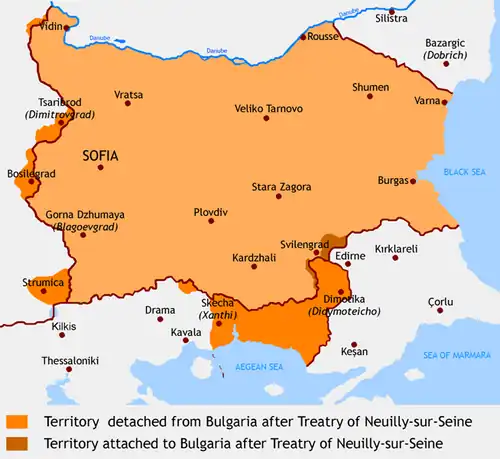
Bulgaria joined the First World War against Serbia in the west, Romania in the north and Greece in the south in order to gain influence and territories in the Balkan region. However, after the German Empire's continuous defeats in the Western Front from early 1918, several German allies including Bulgaria in the Central Powers were also severly attacked and damaged. On 29 September 1918, Bulgaria surrended unconditionally to the Allies, becoming the first Central Powers nation to do so. After World War I ended on 11 November 1918, Bulgaria, being the loser side, had to sign a treaty with the winner ones.
Contents
Territory
Bulgaria had to give up many lands to the winner sides which included Greece, Yugoslavia, Romania, etc. with a total land of over 11.000 km². However, Article 48 of the Treaty stated that Bulgaria should have access to the Aegean Sea but in reality Bulgaria had to give Greece western Thrace which meant it lost access to the Sea.
War compensation
Bulgaria had to pay 2.25 billion franc in the span of 37 years, the total payment was equal to Bulgaria's ¼ GDP before World War I. Additionally, in 6 months, Bulgaria had to give the winner nations like Greece and Romania over 70.000 livestocks and over 50.000 tons of coals in 5 years. Bulgaria also had to reduce military personnel no more than 20.000 people.
Other pages
Notes
- ↑ The United States signed the Treaty but did not ratifty it.