Toronto streetcar system
| Toronto streetcar system | |||
|---|---|---|---|
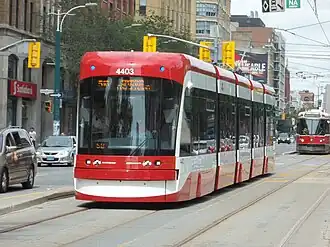 Flexity Outlook in 2014 | |||
| Overview | |||
| Locale | Toronto, Ontario, Canada | ||
| Transit type | Streetcar | ||
| Number of lines | 11[1] | ||
| Number of stations | 685 stops | ||
| Daily ridership | 223,700 (weekdays, Q4 2025) [2] | ||
| Annual ridership | 79,295,000 (2025)[3] | ||
| Operation | |||
| Began operation | 1861 (electric lines since 1892)[1] | ||
| Operator(s) | Toronto Transit Commission | ||
| Character | Street running | ||
| Technical | |||
| System length | 83 km (52 mi)[4] | ||
| Track gauge | 4 ft 10 7⁄8 in (1,495 mm) Toronto gauge | ||
| Minimum radius of curvature | 36 ft 0 in (10,973 mm)[5] | ||
| Electrification | Overhead lines, 600 V DC | ||
| |||
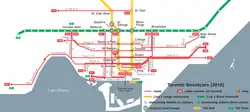
The Toronto streetcar system is a network of eleven streetcar routes in the Canadian city of Toronto, Ontario. It is by far the largest network of its kind in the Americas.[6] It operates as part of the Toronto Transit Commission's public transport network, and shares a common fare system with buses and subway services.
Unlike modern light rail systems that are becoming more commonplace in North America, streetcars runs on city streets and call at frequent bus-type stops, where the passenger waits on the sidewalk for the next streetcar and pays their fare on board the vehicle. There are 685 of these stops, eight of which are shared with and connect to the subway system. The system mainly serves the downtown and waterfront areas of the city, and acts as feeder routes to the subway.
The system, which has been one of the longest in continuous operation, was opened in 1861 as a horse tramway.[7][8] The system was bought by the Toronto Railway Company in 1891 and it was electrified in 1892.[8] Vehicles run on 82 km (51 mi) of tracks with a non-standard gauge of 1495 mm and collect power from overhead lines at 600 V DC using a pantograph or a trolley pole mounted on each streetcar.
More than 200,000 people ride the system on an average weekday, and about 79 million on an annual basis, making it among the busiest systems in the world.
References
- 1 2 "Toronto's Streetcar Network - Past to Present - History". 2013. Archived from the original on 2021-02-11. Retrieved 2013-07-26.
- ↑ {{cite web |url=https://www.apta.com/wp-content/uploads/2026/03/2025-Q4-Ridership-APTA.pdf |publisher=American Public Transportation Association (APTA) |title=Public Transportation Ridership Report Fourth Quarter 2025 |format=PDF |page=34 |date=Febuary 20, 2025 |accessdate=2025-2-20
- ↑ {{cite web |url=https://www.apta.com/wp-content/uploads/2026/03/2025-Q4-Ridership-APTA.pdf |title=Public Transportation Ridership Report Fourth Quarter 2025 |publisher=American Public Transportation Association (APTA) |format=PDF |page=31 |date=February 20, 2025 |accessdate=2025-2-20
- ↑ "UrbanRail.Net > North America > Canada > Ontario > Toronto Streetcar (Tram)". www.urbanrail.net.
- ↑ The Canadian Light Rail Vehicles - Transit Toronto
- ↑ Page, Graham (30 June 2014). "Toronto: The City that Saved its Streetcar Tracks". Rivard Report. Retrieved 20 February 2016.
- ↑ "A Brief History of Transit in Toronto - Transit Toronto - Content". transit.toronto.on.ca. 2012. Retrieved February 7, 2015.
- 1 2 Clarke, Paul (31 August 2014). "Five historical facts about Toronto's streetcar system". The Star. Archived from the original on 18 April 2016. Retrieved 20 February 2016.
City of Toronto | |||||||
|---|---|---|---|---|---|---|---|
| Features |
| ||||||
| History |
| ||||||
| Geography |
| ||||||
| Economy |
| ||||||
| Politics |
| ||||||
| Public services |
| ||||||
| Education |
| ||||||
| Culture |
| ||||||
| Transportation |
| ||||||
| |||||||

