The Uplift Mofo Party Plan
| The Uplift Mofo Party Plan | |
|---|---|
| Studio album by | |
| Released | September 29, 1987 |
| Recorded | May 1987 |
| Studio | Capitol (Hollywood), Eldorado (Hollywood) |
| Genre | |
| Length | 38:19 |
| Label | EMI Manhattan |
| Producer | Michael Beinhorn |
| Singles from The Uplift Mofo Party Plan | |
| |
The Uplift Mofo Party Plan is the third studio album by Red Hot Chili Peppers. Red Hot Chili Peppers is an American rock band. Manhattan Records released the album on September 29, 1987. Uplift is the band's only album that has the first members on every song. These people are singer Anthony Kiedis, bass guitar player Flea, guitar player Hillel Slovak and drummer Jack Irons. This is the last Red Hot Chili Peppers album with Slovak on it. He died from a drug overdose in 1988.[2] The album has one single. It is named "Fight Like a Brave". In 1992, the band released "Behind the Sun" as a single for a greatest hits album named What Hits!?.
The album was much more successful than the band's first two albums. It is the band's first album to go on the Billboard 200 music chart.[3] The RIAA gave the album a gold certification. The band went on tour to make the album more popular. Slovak died after this tour. Because of this, Irons left the band.[4]
Background
Red Hot Chili Peppers joined the record label EMI in 1983. After the band did this, Hillel Slovak and Jack Irons left the band. They left so they could focus on their other band, What Is This?. The other members of the Chili Peppers, Anthony Kiedis and Flea, hired Jack Sherman and Cliff Martinez. The band made an album in 1984 named The Red Hot Chili Peppers. Kiedis and Flea did not like how the album sounded.[5] They fired Sherman from the band. Slovak left What Is This? and joined Red Hot Chili Peppers again.[6] Slovak helped the band make their second album, Freaky Styley (1985). In early 1986, the band started working on their next album. EMI gave the Chili Peppers $5,000 to make a demo tape. The band worked with Keith Levene, one of the first members of the Clash, to make the album.[7] Levene and Slovak spent $2,000 of the money on drugs. They did not tell the rest of the band that they bought drugs. This made the other members angry. Kiedis and Flea fired Martinez. After this, they hired Irons again.[8]
Kiedis and Slovak were addicted to heroin. Their addictions got worse as the band was making Uplift. Kiedis was not helping the band make much music because of his addiction.[9] He was asked to leave the band to go to a treatment place. While he was there, the band won the LA Weekly Band of the Year Award. Because of this, Kiedis decided to stop using heroin. He visited his mother in Michigan, and she took him to another treatment place owned by the Salvation Army.[10] He lived with his mother after being treated for 20 days. It was the first time he was not using drugs since he was 11 years old.[11] After he was done, Kiedis felt much better. He wrote the lyrics to "Fight Like a Brave" while on an airplane going back to Los Angeles.[12] He joined the band again to record the album.
Recording
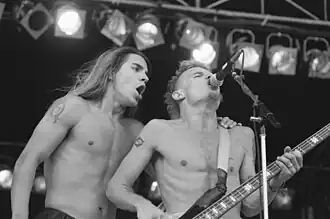
While Kiedis was getting treated, the band wanted to get a new producer. Michael Beinhorn was looking for work at EMI after he had produced other music. None of it was very successful. A man from EMI asked Beinhorn to work with the Red Hot Chili Peppers.[13] Beinhorn liked the band's music and how they acted. He wanted to meet the band. The band met him at a club in New Orleans named Tipitina's.[13] Beinhorn decided to work with the band after the meeting. Kiedis told Beinhorn he wanted to write and record the songs for the album in ten days.[14]
The album was recorded in Capitol Studios Studio B in Hollywood.[15] Kiedis had drug withdrawal while making the album and did not make as much music as he did before. He decided to take drugs for the first time in fifty days. This made him addicted to drugs again. Making the album was difficult, because Kiedis left the studio many times to buy drugs. Beinhorn said that he "really thought the record wasn't gonna get made."[16] Kiedis felt bad whenever he was not recording music with the band, so he tried to write music and buy drugs at the same time. The band was not happy that he was using drugs and not coming to the studio. However, they were impressed with how much music he wrote.[17]
The band had fun recording the album. They were inspired by Jack Irons being in the band again.[17] Beinhorn wanted the band to try new styles of music. At first, the band wanted to keep making the same music. Later, they did what Beinhorn said, and agreed that the new music sounded good. Slovak helped Kiedis record his singing on the album. In between recording songs, Slovak ran around and said "This is the most beautiful thing we've ever done."[18] During a jam session, Slovak made a guitar riff that sounded different from the band's music. Slovak almost stopped using the riff because it was very different from the music the band had already made. However, Beinhorn helped him make it into a full song. Every member of the band started making music for it. The song became one of the album's singles. It was named "Behind the Sun".[19]
Music
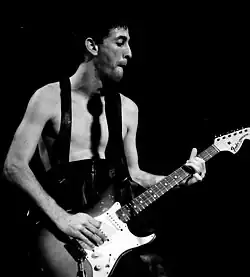
While the album was being made, Beinhorn told Kiedis to rap less and sing more. At the time, Kiedis did not like his singing voice. He also thought that too many music artists sang. On Uplift, Slovak played music that was different from funk, such as reggae and extreme metal.[19] Slovak used a talk box on the song "Funky Crime".[20] He sang into a tube to use the talk box. This let him make different sounds while playing the guitar. Flea used a different style of playing the bass guitar on the album. He slapped the strings to make different sounds. He did this on many of the band's later albums.[21] The album has a cover version of "Subterranean Homesick Blues" by Bob Dylan.
Many of the lyrics on the album are about the band members, sex, and life in Los Angeles. Kiedis, Slovak, Flea and Irons were happy that they could make music together again.[22] Kiedis was inspired by his own life when writing music. While they were making Freaky Styley, Kiedis and Slovak used cocaine a lot. When Slovak was high, he wore colorful clothes and danced in a weird way. This inspired the song "Skinny Sweaty Man".[23] Slovak also inspired the song "No Chump Love Sucker". Slovak's girlfriend left him when he was working on the album. She started dating someone who had "more money and more drugs".[24] The band made the song about this.
"Funky Crime" was inspired by a conversation between the band and George Clinton. Clinton produced Freaky Styley with the band. Kiedis said that the song was about the conversation. It is about how music is "color-blind" but separated by the media based on what it thinks about music artists.[25] Kiedis wrote "Me and My Friends" while driving home from San Francisco with his friend Joe Walters.[25] "Backwoods" is about the history of rock and roll.[25] Kiedis said that "Love Trilogy" is one of the band's favorite songs. It is about loving things that are not perfect.[19]
Release
| Professional ratings | |
|---|---|
| Review scores | |
| Source | Rating |
| AllMusic |   [26] |
| Los Angeles Times |  [27] |
| The Rolling Stone Album Guide | [28] |
EMI did not want to release the album unless the band changed the name of the song "Party on your Pussy". The band renamed the song to "Special Secret Song Inside".[29] EMI released The Uplift Mofo Party Plan on September 29, 1987. It got to number 148 on the Billboard 200. This was much more successful than the band's other albums.[30] It was the band's first album on the Billboard 200. The album has been certified gold in the United States. The band made a music video for the song "Fight Like a Brave". This is the album's main single. It did not go on any Billboard charts.[31] "Behind the Sun" was released as a single in 1992. It was released for a compilation album named What Hits!?. It got to number 7 on the Billboard Alternative Songs chart.[32]
The album also helped Red Hot Chili Peppers get more fans in Los Angeles. One of these fans was John Frusciante.[33] He later joined the band to play the guitar after Slovak died.[34] Frusciante's way of playing the guitar was inspired by Slovak.[35]
Concert tour and Slovak's death
The band went on a long concert tour for the album. They went to many different countries for it. The band noticed that there were more people at their concerts. Kiedis said that the fans had more energy as well.[36] Flea said that "We were in love with those songs and how much fun we were having playing them."[36]
The band was happy that they had more fans. However, Kiedis and Slovak were still addicted to drugs. Both of them stopped using heroin before the tour. They helped each other not use the drug.[5][37] During the tour, both of them had drug withdrawal. Slovak felt much worse than Kiedis. He could not play the guitar very well because of the withdrawal. At one concert, Slovak had a mental breakdown and did not play the guitar.[38] The band played the concert without Slovak. They did not have anyone else playing the guitar. Slovak got better, but the band did not want him to have another breakdown. They hired DeWayne McKnight to play guitar at a few concerts.[39] After a few days of playing with McKnight, the band wanted to let Slovak play again. He played with the band at many concerts in Europe. Kiedis tried to get a counselor for Slovak to help him. However, Slovak did not think his addiction was bad enough to need treatment.[40]
When the band came back to Los Angeles, Slovak stayed away from the other members of the band. When he was not getting support from his friends, Slovak had trouble avoiding drugs.[5][41] A few weeks after the band got to Los Angeles, they tried to find Slovak. They could not find him for many days. Slovak was found dead by police in his apartment on June 27, 1988.[5][2] He died because of a heroin overdose.[5] Irons left the band because of Slovak's death. He said he did not want to be in a group his friends were dying in. Kiedis and Flea did not know if they should keep making music. They decided to make more music to continue what Slovak "helped build".[42] The two hired John Frusciante. Frusciante was a fan of the Chili Peppers, and liked how Slovak played the guitar. They hired Chad Smith to play the drums.[43]
Track listing
All tracks are written by Anthony Kiedis, Flea, Hillel Slovak, and Jack Irons except "Subterranean Homesick Blues". Bob Dylan wrote this song.[26]
| No. | Title | Writer(s) | Length |
|---|---|---|---|
| 1. | "Fight Like a Brave" | 3:53 | |
| 2. | "Funky Crime" | 3:00 | |
| 3. | "Me and My Friends" | 3:09 | |
| 4. | "Backwoods" | 3:08 | |
| 5. | "Skinny Sweaty Man" | 1:16 | |
| 6. | "Behind the Sun" | Kiedis, Flea, Slovak, Irons, Michael Beinhorn | 4:40 |
| 7. | "Subterranean Homesick Blues" | Bob Dylan | 2:34 |
| 8. | "Party on Your Pussy" (This track is named "Special Secret Song Inside" on early releases) | 3:16 | |
| 9. | "No Chump Love Sucker" | 2:42 | |
| 10. | "Walkin' on Down the Road" | Kiedis, Flea, Slovak, Irons, Cliff Martinez | 3:49 |
| 11. | "Love Trilogy" | 2:42 | |
| 12. | "Organic Anti-Beat Box Band" | 4:10 | |
| Total length: | 38:19 | ||
Credits
Source:[44]
|
Red Hot Chili Peppers
Other musicians
|
Production
Design
|
Certifications
| Region | Certification | Certified units/sales |
|---|---|---|
| United States (RIAA)[45] | Gold | 500,000^ |
|
^shipments figures based on certification alone | ||
References
- ↑ Birchmeier, Jason. "Freaky Styley – Review". Allmusic. Rovi Corporation. Retrieved June 17, 2012.
- 1 2 "Hillel Slovak; Guitarist in Flamboyant Rock Band". Los Angeles Times. June 30, 1988. Retrieved January 15, 2011.
- ↑ "Red Hot Chili Peppers Albums Charting". Billboard. Nielsen Business Media, Inc. Retrieved September 12, 2007.
- ↑ Kiedis, Sloman, 2004. p. 224
- 1 2 3 4 5 (2002) "Behind the Music: Red Hot Chili Peppers episode". VH1.
- ↑ "Red Hot Chili Peppers Biography". Allmusic. Rovi Corporation. Retrieved July 22, 2007.
- ↑ Kiedis, Sloman, 2004. p. 187
- ↑ Kiedis, Sloman, 2004. p. 188
- ↑ Kiedis, Sloman, 2004. p. 191
- ↑ Kiedis, Sloman, 2004. p. 193
- ↑ Kiedis, Sloman, 2004, p. 198
- ↑ Kiedis, Sloman, 2004. p. 200
- 1 2 Mullen, 2010. p. 161
- ↑ Kiedis, Sloman, 2004. p. 201
- ↑ Keller, Daniel (July 2011). "Michael Beinhorn: Realizing It". Tape Op. Tape Op. p. 28.
- ↑ Mullen, 2010. p. 164
- 1 2 Kiedis, Sloman, 2004. p. 205
- ↑ Kiedis, Sloman, 2004. p. 206
- 1 2 3 Kiedis, Sloman, 2004. p. 204
- ↑ Kiedis, Sloman, 2004. p. 112
- ↑ Apter, 2004. pp. 70–74
- ↑ Mullen, 2010. p. 161
- ↑ Slovak, James; Slovak, Hillel (August 1999). Behind the Sun: The Diary and Art of Hillel Slovak. Slim Skinny Publications, Incorporated. ISBN 978-0-9673956-0-9.
- ↑ Kiedis, Sloman, 2004. pp. 203–204
- 1 2 3 Kiedis, Sloman, 2004. p. 203
- 1 2 Meredith, Bill. "The Uplift Mofo Party Plan Review". Allmusic. Rovi Corporation. Retrieved January 27, 2011.
- ↑ Strauss, Duncan (January 17, 1988). "Peppers: Hit-and-Miss". The Los Angeles Times. Eddy Hartenstein. Retrieved May 7, 2011.
- ↑ Kot, Greg (2004). "Red Hot Chili Peppers". In Brackett, Nathan; Hoard, Christian (eds.). The Rolling Stone Album Guide. Simon and Schuster. p. 681. ISBN 0743201698.
- ↑ Kiedis, Sloman, 2004. p. 203
- ↑ "Red Hot Chili Peppers Albums Charting". Billboard. Nielsen Business Media, Inc. Retrieved September 12, 2007.
- ↑ "Chart History – "Fight Like a Brave" – Red Hot Chili Peppers". Billboard. Nielsen Business Media, Inc. Retrieved March 5, 2011.
- ↑ "Chart History – "Behind the Sun" – Red Hot Chili Peppers". Billboard. Nielsen Business Media, Inc. Retrieved March 5, 2011.
- ↑ Mullen, 2010. p. 108
- ↑ Nelson, Artie (November 23, 1994). "Space Cadet". Raw Magazine, Issue #163.
- ↑ Apter, 2004, p. 181.
- 1 2 Mullen, 2010. p. 165
- ↑ Kiedis, Sloman, 2004. p. 208
- ↑ Kiedis, Sloman, 2004. p. 216
- ↑ Kiedis, Sloman, 2004. p. 219
- ↑ Kiedis, Sloman, 2004. p. 221
- ↑ Page, Scarlet (July 2004). "Red Hot Chili Peppers: The LA Punks Who Defied Death, Grunge And A Burning Crack Den". Mojo. Bauer Media Group.
- ↑ Kiedis, Sloman, 2004. p. 224
- ↑ "Chad Smith talks about RHCP's induction into the Hall of Fame". Stadium-arcadium.com. March 29, 2012. Archived from the original on February 20, 2016. Retrieved May 18, 2026.
- ↑ Red Hot Chili Peppers (September 1987), The Uplift Mofo Party Plan, EMI-Manhattan Records, retrieved 2026-05-20
- ↑ "American album certifications – Red Hot Chili Peppers – Uplift Mofo Party Plan". Recording Industry Association of America. Retrieved August 3, 2021.
Books
- Apter, Jeff (2004). Fornication: The Red Hot Chili Peppers Story. Omnibus Press. ISBN 1-84449-381-4.
- Kiedis, Anthony; Sloman, Larry (October 6, 2004). Scar Tissue. Hyperion. ISBN 1-4013-0101-0.
- Mullen, Brendan (October 19, 2010). An Oral/Visual History by the Red Hot Chili Peppers. Los Angeles, California: It Books. p. 256. ISBN 978-0-06-135191-4.
Other websites
- The Uplift Mofo Party Plan at Discogs (list of releases)
| |||||
| Studio albums |
| ||||
| EPs |
| ||||
| Single series |
| ||||
| Live releases |
| ||||
| Compilations |
| ||||
| Videos |
| ||||
| Tours |
| ||||
| Related articles |
| ||||
| |||||
