The Kingdom of God Is Within You
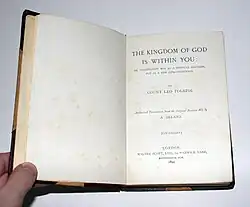 The first English edition of The Kingdom of God Is Within You | |
| Author | Leo Tolstoy |
|---|---|
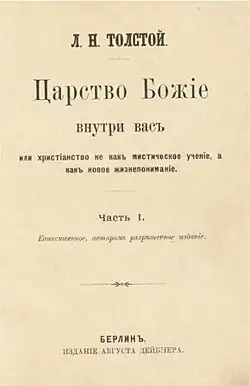
| Original title | Царство Божіе внутри васъ |
| Country | Russia (written)/Germany (first published) |
| Language | Russian |
| Subject | Christian theology, philosophy, anarchism |
| Published | 1894 |
| Media type | Hardcover, Paperback |
| Pages | 335 pages (1927 edition, hardcover) |
| ISBN | 1603863826 |
| Text | The Kingdom of God Is Within You at Wikisource |
The Kingdom of God Is Within You (pre-reform Russian: Царство Божіе внутри васъ; post-reform Russian: Царство Божие внутри vas, romanized: Tsárstvo Bózhiye vnutrí vas) is a non-fiction book by Leo Tolstoy. It is a Christian anarchist work of philosophy and theology. The book was first published in Germany in 1894, because it was banned in Russia, where Tolstoy lived.[1] Tolstoy wrote it after about 30 years of thinking on these topics. In the book he describes a new way to organize society, based on his understanding of Christianity as a religion of universal love.
The Kingdom of God Is Within You is an important text for Tolstoyan followers of nonviolence, nonviolent resistance, and the Christian anarchist movement.[2]
Background
The title of the book comes from Luke 17:21. In the book, Tolstoy explains the idea of nonviolent resistance when facing violence, which he believes was taught by Jesus Christ. When Christ says to turn the other cheek, Tolstoy argues that this is a command to end all violence, including self-defense, and to abandon revenge. He rejects the way many Roman and medieval scholars limited this teaching to certain situations.
"How can you kill people, when it is written in God's commandment: 'Thou shalt not murder'?"
Tolstoy was strongly influenced by American Christian anarchists Adin Ballou and William Lloyd Garrison. They also believed that any government that makes war goes against the New Testament and Christian ethics. Tolstoy writes at length about Ballou and Garrison in the book, including their writings and their lives. He includes a long passage from Ballou's Non-Resistance Catechism (first published in 1844). At the time, the Russian Orthodox Church was a state church closely united with the Russian government and, according to Tolstoy, fully obedient to state policy. Tolstoy tried to separate what he saw as the true gospel of Christ, especially the Sermon on the Mount, from the official teachings of the church.
Tolstoy promoted nonviolence as a way to solve nationalist conflicts and as a way to reveal what he saw as the hypocrisy of the church. In his reading of Jesus' words in the Gospels, Tolstoy argues that the modern church is a heretical creation:
Nowhere nor in anything, except in the assertion of the Church, can we find that God or Christ founded anything like what churchmen understand by the Church.
Tolstoy also quotes from magazines and newspapers that describe personal experiences related to non-resistance. He offers his view of the history of non-resistance from the early days of Christianity, saying it has always been taught by a small minority of believers. He especially criticizes those who defend the existing social order:
That this social order with its pauperism, famines, prisons, gallows, armies, and wars is necessary to society; that still greater disaster would ensue if this organization were destroyed; all this is said only by those who profit by this organization, while those who suffer from it – and they are ten times as numerous – think and say quite the contrary.
In 1894, Constance Garnett translated the book into English. In her translator's preface, she wrote:
One cannot of course anticipate that English people, slow as they are to be influenced by ideas, and instinctively distrustful of all that is logical, will take a leap in the dark and attempt to put Tolstoy's theory of life into practice. But one may at least be sure that his destructive criticism of the present social and political regime will become a powerful force in the work of disintegration and social reconstruction which is going on around us.[3]
Reception
Tolstoy's relationship with Mohandas Gandhi
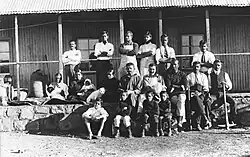
Mohandas Gandhi wrote in his autobiography, The Story of My Experiments with Truth (Part II, Chapter 15), that Tolstoy's book "overwhelmed" him and "left an abiding impression". Gandhi said that Tolstoy's book, John Ruskin's Unto This Last, and the poet Shrimad Rajchandra (Raychandbhai) were the three most important modern influences on his life.[4] Reading the book made Gandhi pay close attention to Tolstoy, who was already famous, while Gandhi was still a young political activist in South Africa.
In 1908, Tolstoy wrote A Letter to a Hindu,[5] which Gandhi later read. In it, Tolstoy argues that only love, used as a kind of weapon through passive resistance, could help the Indian people free themselves from British colonial rule. Gandhi later put this idea into practice by organizing large-scale nonviolent strikes and protests between 1918 and 1947.
In 1909, Gandhi wrote to Tolstoy to ask for advice and for permission to republish A Letter to a Hindu in Gujarati, his own language. Tolstoy replied, and the two men continued writing to each other until Tolstoy died in 1910. Their letters discuss how to apply nonviolence in practice and in religious life, and Gandhi also expresses his hope for Tolstoy's health. Tolstoy's last letter to Gandhi "was one of the last, if not the last, writings from his pen."[6][7]
With other nonviolent activists
In 1894, The Kingdom of God Is Within You led the soldier Arthur St. John to become a pacifist.[8] The book also had a strong influence on James Bevel, who became an important strategist in the 1960s civil rights movement.[9][10] While serving in the U.S. Navy, Bevel read the book and decided he could not kill another person. He asked for, and received, an honorable discharge and then went to a seminary for religious training.[11]
Importance of Jesus' words
"The Kingdom of God is Within You" is the central phrase in Luke 17:21 that supports the idea of nonviolence. Jesus says, "for, behold, the kingdom of God is within you" when the Pharisees ask him when the Kingdom of God will come. This saying has been explained in many ways, including that enlightenment is inside each person, that God is present in the heart, and that a "spark of God" has always been there. From this view, only a nonviolent and peaceful inner nature can produce nonviolent and peaceful outcomes related to the Kingdom of God.[12]
Related pages
- Leo Tolstoy bibliography
- Adin Ballou
- Divine presence
- Kingdom of God
- The Gospel in Brief
- List of books about anarchism
References
- ↑ Donna Tussing Orwin (2002). [The Cambridge Companion to Tolstoy. Cambridge University Press. ISBN 0-521-52000-2.
{{cite book}}: Check|url=value (help) - ↑ Christoyannopoulos, Alexandre (2010). Christian Anarchism: A Political Commentary on the Gospel. Exeter: Imprint Academic. p. 19.
[Tolstoy] wrote countless essays and books on the topic, but the most often cited one among anarchists is The Kingdom of God Is within You.
- ↑ Tolstoy, graf Leo (1894). "The Kingdom of God is Within You": Christianity Not as a Mystic Religion But as a New Theory of Life. Cassell Publishing Company.
- ↑ Mohandas K. Gandhi (1929). [The Story of My Experiments with Truth. Archived from [the original on ] 2010-08-01.
{{cite book}}: Check|archive-url=value (help); Check|url=value (help); Check date values in:|archive-date=(help) - ↑ Parel, Anthony J. (2002), [ "Gandhi and Tolstoy"], in M. P. Mathai; M. S. John; Siby K. Joseph (eds.), Meditations on Gandhi : a Ravindra Varma festschrift, New Delhi: Concept, pp. 96–112, retrieved 2012-09-08
{{citation}}: Check|contribution-url=value (help) - ↑ B. Srinivasa Murthy, ed. (1987). Mahatma Gandhi and Leo Tolstoy: Letters. ISBN 0-941910-03-2.
- ↑ [ ""Leo Tolstoy and Mahatma Gandhi: A Double Portrait in the Interior of the Age"- Russian documentary which captures correspondence between the two spiritual teachers of humanity"]. Press Information Bureau. Retrieved 5 December 2016.
{{cite web}}: Check|url=value (help) - ↑ Rosamund, Bartlett (2011). [ Tolstoy: A Russian Life]. Houghton Mifflin Harcourt. p. 363. ISBN 978-0151014385.
{{cite book}}: Check|url=value (help) - ↑ Randall L. Kryn, "James L. Bevel; The Strategist of the 1960s Civil Rights Movement", in David Garrow, We Shall Overcome, Volume II (1989), Carlson Publishing Company
- ↑ [(http://cfm40.middlebury.edu/node/287) Randy Kryn, "Movement Revision Research Summary Regarding James Bevel"], October 2005, Middlebury College
- ↑ [(https://books.google.com/books?id=Rv-8E76FZWkC&dq=%22James+Bevel%22+Tolstoy+%22The+Children%22+Halberstam&pg=PT806) The Children, 1999, David Halberstam]
- ↑ The Meditation Book, by Blair Abee, pages 25–26
Further reading
- Milivojevic, D. Leo Tolstoy and the Oriental Religious Heritage. (New York: Columbia University Press, 1998).
Other websites


- Standard Ebooks
 The Kingdom of God Is Within You public domain audiobook at LibriVox
- The Kingdom of God Is Within You — complete text in various formats at Internet Archive{{{name}}} at Project Gutenberg
- The Kingdom of God Is Within You — complete HTML text by Kingdom Now
- The Kingdom of God Is Within You — complete HTML version, with links to Wikipedia and to Tolstoy's source material
- Tolstoy's Legacy for Mankind- A Manifesto for Nonviolence: Part 1 Part 2
| |
| Novels |
|
| Novellas |
|
| Short stories |
|
| Plays |
|
| Non-fiction |
|
| Unfinished |
|
| Family |
|
| Life and legacy |
|
| Honors |
|
| Related |
|
| |
