Tesla (unit)
The tesla (symbol T) is the SI unit used to measure the strength of magnetic fields. Tesla can be measured in different ways; for example, one tesla is equal to one weber per square meter.
The tesla was first defined in 1960 by the General Conference on Weights and Measures (CGPM).[1] It was named in honor of the physicist, electrical engineer, and inventor, Nikola Tesla.
Definitions
Using only the seven base SI units, the definition of a tesla is:

Using other SI derived units, a tesla is also equal to:

The units used are:
A = ampere
C = coulomb
kg = kilogram
m = meter
N = newton
s = second
T = tesla
V = volt
Wb = weber
A tesla is also equal to 10,000 (104) gauss in the CGS system of units.
Example values
- 3.1×10⁻⁵–5.8-5 T – the Earth's magnetic field at its surface
- 5×10⁻³ T – the strength of a typical refrigerator magnet
- 0.3 T – the strength of solar sunspots
- 1.25T – the strength of the surface of a neodymium magnet
- 1.5−3 T – strength of medical magnetic resonance imaging systems
- 4 T – strength of the superconducting magnet built around the CMS detector at CERN[2]
- 13 T – strength of ITER fusion reactor[3]
- 16 T – magnetic field strength required to levitate a frog as part of an Ig Nobel Prize winning project.[4]
References
- ↑ International Bureau of Weights and Measures (1960), Système International d'Unités (International System of Units). 11th session, Resolution 12.
- ↑ Taylor, Lucas (23 November 2011). "Superconducting Magnet in CMS". European Laboratory for Particle Physics. Retrieved 5 April 2013.
- ↑ "ITER - the way to new energy". Retrieved 19 April 2012.
- ↑ Berry, M.V. and A.K. Geim (1997). "Of flying frogs and levitrons" (PDF). European Journal of Physics. 18 (4): 307. Bibcode:1997EJPh...18..307B. doi:10.1088/0143-0807/18/4/012. S2CID 250889203. Archived from the original (PDF) on 10 May 2017. Retrieved 5 April 2013.
Authority: International System of Units (BIPM) | ||
| Base units | 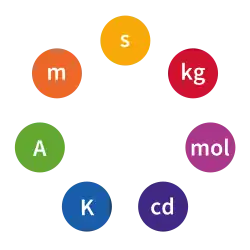 | |
| Units based on base units | ||
| Other units | ||
| See also | ||
| ||
