Svante Pääbo
Svante Pääbo ForMemRS | |
|---|---|
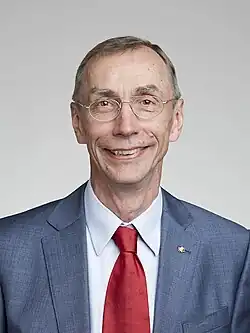 Pääbo in 2016 | |
| Born | 20 April 1955 Stockholm, Sweden |
| Education | Uppsala University (PhD) |
| Known for | Paleogenetics |
| Spouse |
Linda Vigilant (m. 2008) |
| Children | 2 |
| Awards |
|
| Scientific career | |
| Fields |
|
| Institutions |
|
| Thesis | How the E19 Protein of Adenoviruses Modulates the Immune System (1986) |
Svante Pääbo ForMemRS (Swedish: [ˈsvânːtɛ̂ ˈpʰɛ̌ːbʊ̂];[3] born 20 April 1955) is a Swedish geneticist. His works focused on evolutionary genetics. He is one of the founders of paleogenetics. He has worked on the Neanderthal genome.[4] He is also an adjunct professor at Okinawa Institute of Science and Technology, Japan.[5]
In 1998, he was elected a member of the Academia Europaea.[6]
In 2022, he won the Nobel Prize in Physiology or Medicine for his works about genomes of extinct hominins and human evolution.[7][8][9]
Svante Pääbo is bisexual.[10]
References
- ↑ "Professor Svante PÄÄBO | Jeantet". 1 October 2017. Archived from the original on 16 May 2021. Retrieved 16 October 2021.
- ↑ "Svante Paabo". London: Royal Society. 2016. Archived from the original on 29 April 2016. One or more of the preceding sentences incorporates text from the royalsociety.org website where:
"All text published under the heading 'Biography' on Fellow profile pages is available under Creative Commons Attribution 4.0 International License." --"Royal Society Terms, conditions and policies". Archived from the original on September 25, 2015. Retrieved 2016-03-09.
- ↑ Lena Nordlund, Annlouise Martin (Producers) (14 August 2014). Svante Pääbo (MP3) (Radio). Sveriges Radio. Event occurs at 1:15. Archived from the original on 3 October 2022. Retrieved 2 May 2018.
- ↑ Kolbert, Elizabeth. "Sleeping with the Enemy: What happened between the Neanderthals and us?". The New Yorker. No. 15 & 22 August 2011. pp. 64–75. Archived from the original on 11 July 2022. Retrieved 23 November 2021.
- ↑ "Svante Pääbo". OIST Groups. 29 April 2020. Archived from the original on 24 October 2021. Retrieved 3 October 2022.
- ↑ "Svante Pääbo". Academia Europaea. Archived from the original on 28 March 2019.
- ↑ "Press release: The Nobel Prize in Physiology or Medicine 2022". Archived from the original on 3 October 2022. Retrieved 3 October 2022.
- ↑ Grover, Natalie; Pollard, Niklas; Ahlander, Johan (3 October 2022). "Swedish geneticist wins Nobel medicine prize for decoding ancient DNA". Reuters. Archived from the original on 3 October 2022. Retrieved 3 October 2022.
- ↑ "Nobel laureate Svante Paabo's ancient DNA discoveries shed light on what makes us human". Onmanorama. 6 October 2022. Archived from the original on 6 October 2022. Retrieved 6 October 2022.
- ↑ ‘Neanderthal Man’ — Nobel Prize winner Svante Pääbo revolutionized anthropology. Here is a look back at his groundbreaking 2014 memoir