Stygimoloch
| Stygimoloch Temporal range: Upper Cretaceous 67–66 mya | |
|---|---|
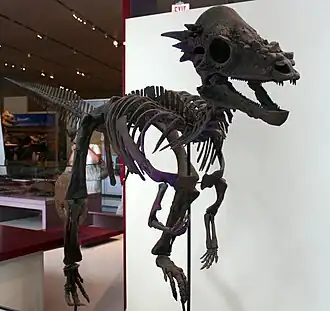 | |
| Stygimoloch spinifer "Sandy" replica specimen, Royal Ontario Museum | |
Scientific classification  | |
| Kingdom: | Animalia |
| Phylum: | Chordata |
| Clade: | Dinosauria |
| Order: | †Ornithischia |
| Suborder: | †Pachycephalosauria |
| Family: | †Pachycephalosauridae |
| Genus: | †Stygimoloch Galton & Sues, 1983 |
| Species: | †S. spinifer |
| Binomial name | |
| Stygimoloch spinifer Galton & Sues, 1983 | |
| Synonyms | |
| |
Stygimoloch is a dubious genus of herbivorous dinosaur. It is known from fossil remains dating to the late Cretaceous period, about 67 to 66 million years ago. Like other pachycephalosaurids, Stygimoloch was a bipedal herbivore with short forelimbs and a thick, domed skull, likely used in intraspecific head-butting. It includes a single species, S. spinifer, know from partial elements of the skull and a possible undescrebried skeletal specimen, "Sandy". The skull of Stygimoloch is notable for the elongated spikes that surround the dome.
22% of all domes examined had lesions suggesting osteomyelitis, a bone infection resulting from trauma, suggesting the animals engaged in intraspecific combat, akin to extant bighorn sheep.[1]
Stygimoloch fossils were first discovered in North America, in Montana and Wisconsin. The first was discovered in Hell Creek, Montana and was named in 1983 by Peter M. Galton, a British paleontologist and Hans-Dieter Sues, a German paleontologist.
Taxonomy
The classification of Stygimoloch is debated, but the most paleontologists today places the S. spinifer as a own genus of Pachycephalosaurid or species of Pachycephalosaurus.[2]
Here is a diagram classification of the Stygimoloch by Evans in 2013:[2]
| Pachycephalosauria |
| ||||||||||||||||||||||||||||||||||||||||||||||||||||||||||||||||||||||||||||||||||||||||||||||||||||||
Synonym of Pachycephalosaurus proposed
Today, many scientists believe that Stygimoloch and the smaller Dracorex represent immature specimens of Pachycephalosaurus rather than distinct genera. This theory was first put forth by paleontologist Jack Horner in 2009. It has been supported by studies involving the animals' skulls.[3] Dracorex and Stygimoloch both display higher amounts of porus bone than Pachycephalosaurus, indicative of immature individuals.[4]
Others paleontologists thinks that Stygimoloch is a distinct genus or species of Pachycephalosaurus and Dracorex is a juvenile or a female of S. spinifer because of similar anatomy.[5]
References
- ↑ Peterson, JE; Dischler, C; Longrich, NR (2013). "Distributions of cranial pathologies provide evidence for head-butting in dome-headed dinosaurs (Pachycephalosauridae)". PLOS ONE. 8 (7): e68620. Bibcode:2013PLoSO...868620P. doi:10.1371/journal.pone.0068620. PMC 3712952. PMID 23874691.
{{cite journal}}: CS1 maint: article number as page number (link) - 1 2 Evans, David C.; Schott, Ryan K.; Larson, Derek W.; Brown, Caleb M.; Ryan, Michael J. (2013-05-07). "The oldest North American pachycephalosaurid and the hidden diversity of small-bodied ornithischian dinosaurs". Nature Communications. 4 (1). doi:10.1038/ncomms2749. ISSN 2041-1723.
- ↑ Horner, John R.; Goodwin, Mark B. (2009-10-27). "Extreme Cranial Ontogeny in the Upper Cretaceous Dinosaur Pachycephalosaurus". PLOS ONE. 4 (10): e7626. doi:10.1371/journal.pone.0007626. ISSN 1932-6203. PMC 2762616. PMID 19859556.
{{cite journal}}: CS1 maint: article number as page number (link) - ↑ "Three dino types may be just three dino ages". 2009-10-27. Retrieved 2025-07-04.
- ↑ Evans, David C.; Schott, Ryan K.; Larson, Derek W.; Brown, Caleb M.; Ryan, Michael J. (2013-05-07). "The oldest North American pachycephalosaurid and the hidden diversity of small-bodied ornithischian dinosaurs". Nature Communications. 4 (1). doi:10.1038/ncomms2749. ISSN 2041-1723.