Stanley Baldwin
Stanley Baldwin | |
|---|---|
 1920 | |
| Prime Minister of the United Kingdom | |
| In office 7 June 1935 – 28 May 1937 | |
| Monarch | |
| Preceded by | Ramsay MacDonald |
| Succeeded by | Neville Chamberlain |
| In office 4 November 1924 – 4 June 1929 | |
| Monarch | George V |
| Preceded by | Ramsay MacDonald |
| Succeeded by | Ramsay MacDonald |
| In office 22 May 1923 – 22 January 1924 | |
| Monarch | George V |
| Preceded by | Bonar Law |
| Succeeded by | Ramsay MacDonald |
| Personal details | |
| Born | 3 August 1867 Bewdley, Worcestershire, England |
| Died | 14 December 1947 (aged 80) Stourport-on-Severn, Worcestershire, England |
| Resting place | Worcester Cathedral |
| Political party | Conservative |
| Spouse(s) |
Lucy Ridsdale
(m. 1892; died 1945) |
| Children | 7, including Oliver and Arthur |
| Parents | Alfred Baldwin (father) |
| Education |
|
| Occupation | Industrialist |
| Signature |  |
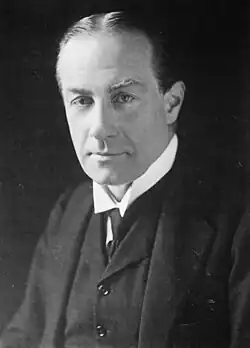
Stanley Baldwin, 1st Earl Baldwin of Bewdley, KG, PC, PC (Can), JP, FRS (3 August 1867 – 14 December 1947) was a Prime Minister of the United Kingdom three times. He presided over the economic crisis of the 1930s and abdication of King Edward VIII of the United Kingdom.[1][2]
He also believed in being soft on Germany since many people in nearby countries were German and wanted to become part of it, the country stopped the Soviet Union from spreading its communism and most British people did not want another world war.
References
- ↑ "The greatness of Stanley Baldwin". Lord Lexden OBE. 29 September 2023. Retrieved 29 April 2024.
- ↑ Strangio, Paul; et al. (2013). Understanding Prime-Ministerial Performance: Comparative Perspectives. Oxford University Press. pp. 224, 226. ISBN 978-0-1996-6642-3.
 | Walpole | Wilmington | Pelham | Newcastle | Devonshire | Newcastle | Bute | G Grenville | Rockingham | Chatham | Grafton | North | Rockingham | Shelburne | Portland | Pitt the Younger | |  | |
Pitt the Younger | Addington | W Grenville | Portland | Perceval | Liverpool | Canning | Goderich | Wellington | Grey | Melbourne | Peel | Melbourne | Peel | Russell | Derby | Aberdeen | Palmerston | Derby | Palmerston | Russell | Derby | Disraeli | Gladstone | Disraeli | Gladstone | Salisbury | Gladstone | Salisbury | Gladstone | Rosebery | Salisbury | Balfour | Campbell-Bannerman | Asquith | Lloyd George | Bonar Law | Baldwin | MacDonald | Baldwin | MacDonald | Baldwin | Chamberlain | Churchill | Attlee | Churchill | Eden | Macmillan | Douglas-Home | Wilson | Heath | Wilson | Callaghan | Thatcher | Major | Blair | Brown | Cameron | May | Johnson | Truss | Sunak | Starmer | |||