Soviet deportation of Poles during World War II
| Soviet deportation of Poles during World War II | |
|---|---|
| Part of Genocides by the Soviet Union and Soviet persecution of Poles during World War II | |
| Date | February 1940–June 1941[1][2] |
| Target | Poles[1][2] |
Attack type | Ethnic cleansing[1][2] |
| Victims | 1,200,000 Poles[1][2] |
| Perpetrators | Soviet Union[1][2] |
| Motive | Ethnic cleansing and Russification[1][2] |
The Soviet deportation of Poles during World War II refers to the mass deportation of around 1,200,000 Poles from Soviet-occupied eastern Poland to mainland Russia between February 10, 1940 and June 1941.[1]
Overview
The deportation happened while Polish and Jewish property across the occupied zone was taken over by the Soviets.[3] Polish Jews made up 30% of the Poles deported to Siberia,[4][5] making them statistically the most targeted group among the deportees.[4][5]
Events
Deportations
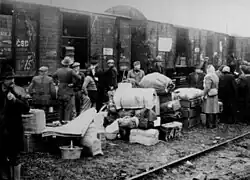
The Soviets conducted the deportation in four waves.[2] The first wave of deportation in February 1940 saw 220,000 Poles sent to northern European Russia.[2] The second wave of deportation in April 1940 saw as many as 330,000 Poles sent to Soviet-occupied Kazakhstan.[2] The third and fourth wave saw as many as 400,000 and 200,000 Poles sent to forced settlements across the Soviet Union respectively.[2]
Forced conscription
As many as 210,000 young Polish men were forced to fight for the Soviet Union following the annexation of the Kresy macroregion.[2]
Academic views
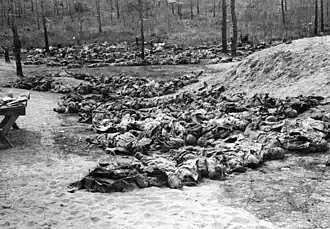
Some historians saw the Soviet deportation of Poles as the worst part of the Soviet persecution of Poles during World War II,[1] followed by the Katyn massacre in which around 22,000 Poles were mass-murdered by the Soviets.[7] Some historians saw it as a genocide as well, despite not comparable to the Holocaust.[1]
Related pages
Footnotes
References
- 1 2 3 4 5 6 7 8 9
- "The first deportation of Poles to Russia". European Network Remembrance and Solidarity (ENRS). Retrieved March 11, 2025.
- Rummel, R.J. "Statistics Of Poland's Democide: Addenda". University of Hawaii System. Retrieved March 11, 2025.
- Karski, Karol (2012). "The Crime of Genocide Committed against the Poles by the USSR before and during World War II: An International Legal Study". Case Western Reserve Journal of International Law. 45 (3). Retrieved March 11, 2025.
- Ludwika, Zofia; Ptasnik, Malachowska. "A Polish Woman's Daily Struggle to Survive: Her Diary of Deportation, Forced Labor, and Death in Kazakhstan: April 13, 1940-May 26, 1941". Rice University. Retrieved March 11, 2025.
- 1 2 3 4 5 6 7 8 9 10 11
- Pogonowski, Iwo (1993). Jews in Poland. Hippocrene. ISBN 9780781801164.
Reprint by Hippocrene 1998, ISBN 0781806046.
- Malcher, George C. (1993). Blank Pages: Soviet Genocide Against the Polish People. Woking: Pyrford. ISBN 1897984006.
- Hope, Michael (2005) [2000]. Polish Deportees in the Soviet Union. London: Veritas Foundation. ISBN 0-948202-76-9. Foreword by Dr. Tomasz Piesakowski 1998 Archived 2009-04-08 at the Wayback Machine reprint with excerpts by Waldemar Wajszczuk. Book review with excerpts by Derek Crowe.
- Ferguson, Niall (2006). The War of the World: History's Age of Hatred (Hardcover, Google Books no preview). London: Allen Lane. ISBN 0713997087.
- Pogonowski, Iwo (1993). Jews in Poland. Hippocrene. ISBN 9780781801164.
- ↑ (in Polish) Represje 1939-41 Aresztowani na Kresach Wschodnich Archived 2006-10-21 at the Wayback Machine (Repressions 1939–41. Arrested on the Eastern Borderlands.) Ośrodek Karta. Retrieved 15 November 2006.
- 1 2 Grabowski, Jan; Klein, Shira (February 9, 2023). "Wikipedia's Intentional Distortion of the History of the Holocaust". The Journal of Holocaust Research. 37 (2): 133–190. doi:10.1080/25785648.2023.2168939. Retrieved January 20, 2025.
The Polish government's resolve to control the past culminated with [...] the Amendment to the Act on the Institute of National Remembrance [...] penalizes those who 'slander the good name of the Polish nation' and who 'blame the Polish society for crimes committed by the Nazi Third Reich.'
[... s]tatistically, Polish Jews were the most targeted group among the former Polish citizens deported by the Soviets to Siberia during the 1939–1941 period. Furthermore, the alleged massive scale of Jewish participation in Soviet militias was based on perceptions, rather than facts; in the eyes of Polish observers, the shock at seeing Jews in police uniforms, practically impossible in prewar Poland, created a false impression of a massive scale of the phenomenon. - 1 2
- Jan Tomasz Gross, Revolution from Abroad (Princeton: Princeton University Press, 2003), pp. 196–98. The three major Soviet deportations (1940–1941) encompassed varying numbers of Jews, along with some Ukrainians and Byelorussians. The ethnic distribution for all deportations has been estimated at 52 percent Poles, 30 percent Jews (while the Jews made up 10 percent of the total population), and 18 percent others.
- The estimated number of Polish citizens deported from Poland’s eastern borderlands is between 300,000 and 330,000, including some 80,000 Jews; Alina Skibińska, “Żydzi polscy ocaleni na wschodzie (1939– 1946),” in Narody i polityka. Studia ofiarowane profesorowi Jerzemu Tomaszewskiemu, ed. August Grabski and Artur Markowski (Warsaw: ŻIH and Instytut Historyczny UW, 2010). The Index of the Repressed (https://indeksrepresjonowanych.pl) contains incomplete information on Jews deported from the individual county’s localities. The Central Card File of the Jews Who Survived the Holocaust mentions as many as 113 persons who survived in the USSR territory out of 220 from Bielsk County registered by the Central Committee of the Jews in Poland.
- Dora Galperin, “Tragedia i zniszczenie Kamieńca,” in Księga pamięci: Kamieniec Litewski, Zastawie i okolice, http://www.jewishgen.org/yizkor/Kamenets/Kamenets.html.
- ↑ Polish: Cztery masowe deportacje obywateli polskich w głąb ZSRS przeprowadzone w latach 1940–1941. Pierwsza deportacja dotknęła rodziny osadników wojskowych i cywilnych. Miała miejsce w nocy z 9 na 10 II 1940 r. Druga deportacja odbyła się 13 IV 1940 r. i w jej wyniku wysiedlono głównie rodziny osób przetrzymywanych w obozach jenieckich oraz więzionych i aresztowanych. Trzecia tura wywózek odbyła się 29 VI 1940 r. i dotknęła głównie uciekinierów spod okupacji niemieckiej tzw. „bieżeńców”. Czwarta deportacja miała miejsce w maju i czerwcu 1941 r. Wysiedleniu podlegali przede wszystkim członkowie konspiracji, ich bliscy, i rodziny osób rozstrzelanych. W ciągu dwudziestu miesięcy okupacji, w czterech masowych deportacjach, wywieziono co najmniej 1 600 000 obywateli Polskich.
- ↑
- "The Katyń Massacres of 1940". SciencePo. July 23, 2011. Retrieved March 11, 2025.
- "Documents: US, UK hushed up Soviet massacre of 22,000 Poles in WWII". NBC News. September 11, 2012. Retrieved March 11, 2025.
- Brzozowska-Pasieka, Monika. "The Secret Soviet Genocide of WWII". Victims of Communism Memorial Foundation. Retrieved March 11, 2025.
- "Putin blames Poland for WWII and says Soviet occupation "saved lives"". Notes from Poland. December 23, 2019. Retrieved March 11, 2025.
- "War crimes are a common thing for the Kremlin. We recall the mass murders and genocide during World War II, for which Russia (so far) has not been punished — a story in archival photos". Бабель. April 25, 2022. Retrieved March 11, 2025.
- Cuesta, Javier G. (April 28, 2023). "Russia rewrites the history of 22,000 Poles murdered by Soviet forces during World War II". EL PAÍS English. Retrieved March 11, 2025.