Soviet persecution of Poles during World War II
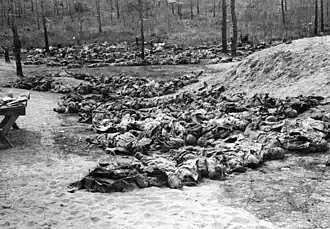 Bodies of Polish prisoners-of-war by the mass graves of the Katyn massacre, awaiting forensic examination, April 30, 1943. | |
| Soviet invasion of Poland | |
|---|---|
The Soviet persecution of Poles during World War II refers to the mass murder and deportations of Poles in territories occupied by the Soviet Union during World War II.[6]
Overview
Following the invasion of Poland, Poland was divided between Nazi Germany and the Soviet Union.[6] Nazi Germany occupied western Poland, while the Soviet Union occupied eastern Poland until late June 1941, when the Axis powers invaded the Soviet Union.[6] By June 1941, the Soviet Union had already arrested 500,000 Poles.[5] At least 150,000 Poles were killed by the Soviets on Polish soil throughout WWII.[5]
Soviet-occupied Poland (1939‒41)
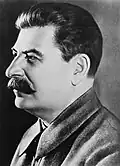
The Soviet Union occupied 52.1% of pre-war Poland (c. 200,000 km2), with over 13,700,000 citizens.[7] Among minority citizens, 37% were Ukrainians, 14.5% Belarusians, 8.4% Jews, 0.9% Russians and 0.6% Germans.[7] Joseph Stalin's occupation of eastern Poland is said to be motivated by his baseless perception that pre-war Poland was a "crime against revolution [...] counter-revolutionary activity".[8]
Katyn massacre
On March 5, 1940, Lavrentiy Beria asked Joseph Stalin to order the killing of 25,700 Polish "nationalists and counterrevolutionaries" in the Soviet-occupied zone.[9] Six members of the Soviet Politburo – Stalin, Vyacheslav Molotov, Lazar Kaganovich, Kliment Voroshilov, Anastas Mikoyan, and Mikhail Kalinin – approved the killing.[9] American historian Gerhard Weinberg said that the Soviets killed the captured Poles as they considered them the "avowed enemies of Soviet authority".[10] Weinberg further noted:[10]
Stalin could be certain that any revived Poland would be unfriendly [. ...] depriving it of a large proportion of its military and technical elite would make it weaker.
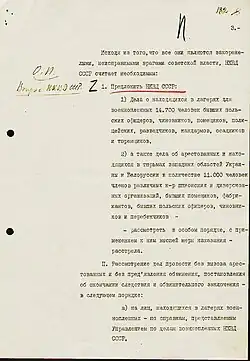
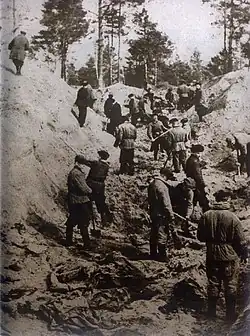
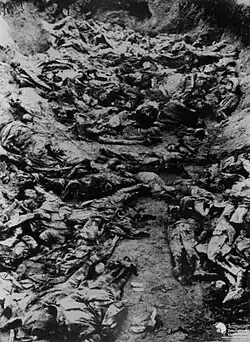
Between April and May 1940, around 22,000 Poles were executed by the Soviets in the Katyn forest (now in Smolensk, Russia).[2][11] The victims were mainly captured Polish soldiers, police, doctors, teachers, scientists, engineers and journalists.[2][11] They were executed as part of the Soviet campaign to prevent Poland from having a functional society again.[2][11] Before that, 111,091 persons associated with Poland had already been killed by the Soviets during the Stalinist purges between August 25, 1937 and November 15, 1938.[12]
Genocide question
Over the past decades, it has been debated whether the Katyn massacre could be seen as a genocide. Many Polish academics, including historian Adam Basak,[13][14] jurist Cezary Mik,[14][15] Karolina Kosińska,[14][16] and prosecutor Małgorzata Kuźniar-Plota,[14][17] who investigated the massacre,[14][17] believed that the Katyn massacre qualified as a genocide.[14]
Historian Adam Basak noted:[13][14]
[The Soviet Politburo's] intent was to destroy a part of the Polish national group [...] twenty-six thousand representatives of the intellectual elite, selected because of their social status and social function.
Jurist Cezary Mik called the massacre "genocidal murder of the Polish elite in Katyn and other places",[14][15] while Karolina Kosińska said:[14][16]
If we talk about a specific plan to destroy a group, we can undoubtedly point to the USSR's policy [. ...] various genocidal acts against the Polish nation, acts the most spectacular of which was the Katyn Massacre.
More importantly, prosecutor Małgorzata Kuźniar-Plota,[14][17] who investigated the massacre,[14][17] ruled that:[14][17]
[The Katyn massacre] had all the characteristics of the crime of genocide specified in Article 2 of the Convention on the Prevention and Punishment of the Crime of Genocide.[18]

Mass deportation
Between February 10, 1940 and June 1941, as many as 1,200,000 Poles were deported to mainland Russia.[14] The deportation happened while Polish and Jewish property across the occupied zone was taken over by the Soviets.[19] Polish Jews made up 30% of the Poles deported to Siberia,[20][21] making them statistically the most targeted group among the deportees.[20][21]
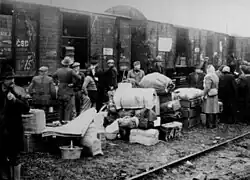
The Soviets conducted the deportation in four waves.[22] The first wave of deportation in February 1940 saw 220,000 Poles sent to northern European Russia.[22] The second wave of deportation in April 1940 saw as many as 330,000 Poles sent to Soviet-occupied Kazakhstan.[22] The third and fourth wave saw as many as 400,000 and 200,000 Poles sent to forced settlements across the Soviet Union.[22]
Destruction of Polish society
In both the Nazi- and Soviet-occupied zone, the oppression of Poles was motivated by anti-Polish racism[5][23] (also called anti-Polonism[24] or Polonophobia[25]), which predated the Soviet Union.[23][26] In the Soviet-occupied zone, Russian culture was also imposed on the Poles by reorganizing Polish universities in line with the Statute Books for Soviet Higher Schools, and prioritizing Russian studies while suppressing Polish studies.[7] Traces of Polish history were systematically erased by the Soviets.[7] All Polish parties and organizations were dissolved,[7] while the Polish currency was made invalid,[7] causing the whole population to lose their life savings overnight.[27]
NKVD prisoner massacres

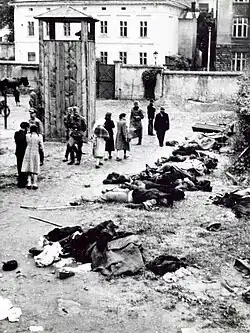
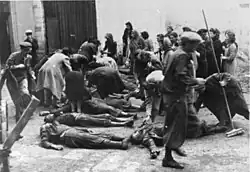
Before Nazi Germany invaded the Soviet Union in June 1941, the Soviets were holding hundreds of thousands of political prisoners in NKVD prisons across their occupied Eastern European territories,[28] many of whom were Polish.[28] Right after the invasion began, the NKVD was ordered to kill or evacuate 140,000 prisoners from Soviet-occupied eastern Poland.[28]
Two-thirds of the said prisoners were killed by the NKVD.[28] Among the prisoners killed, at least 9,800 were reportedly executed in prisons and 1,443 executed during evacuation.[28] Geographically, 20,000–30,000 of them died in Soviet-occupied eastern Poland, and 9,000 in the Ukrainian SSR,[28] which had just gone through the Holodomor[29][30] and Great Purge-related massacres in the 1930s.[31][32] They were targeted for mass murder over their Polish or Ukrainian identity.[28][32]
Medical students who came across the victim bodies of one of such massacres in Lviv described the scene:[33]
From the courtyard, doors led to a large space, filled from top to bottom with corpses [...] Among them were many women. On the left wall, three men were crucified, barely covered by clothing from their shoulders, with severed male organs. Underneath them on the floor in half-sitting, leaning positions – two nuns with those organs in their mouths [...] most were stabbed in the stomach with a bayonet. Some were naked or almost naked, others in decent street clothes. One man was in a tie, mostly likely just arrested.
Historian Yury Boshyk wrote:[31]
It was not only the numbers of the executed, but also the manner in which they died that shocked the populace. When the families of the arrested rushed to the prisons after the Soviet evacuation, they were aghast to find bodies so badly mutilated that many could not be identified. It was evident that many of the prisoners had also been tortured before death; others were killed en masse.
Formation of Soviet puppet state in Poland
After Nazi Germany was defeated, the Soviet Union set up a puppet state in Poland,[34] subjecting Poland to communist totalitarianism until 1989,[35][36] while Soviet troops did not leave Poland until 1993.[37] The puppet state's founding came with the arrest of 25,000 Polish Home Army soldiers,[38] who were deported to Gulags in mainland Russia.[38] As many as 100,000 Polish women were also raped by Soviet soldiers right after the war.[4]
Polish resistance
Armed resistance
Some anti-communist Poles took up arms against the Soviets.[39] However, the armed resistance failed due to the lack of foreign support.[39] Tens of thousands of them were deported to Gulags in mainland Russia,[39] with a few to no confirmed survivors.[39] Among them consisted of 6,000 Poles who had been jailed in Borowicze (now Borovichi, Russia) and 6,300 in Stalinogorsk (now Novomoskovsk, Russia).[39]
The exact number is unknown as nobody has access to all of the Soviet documents.[39] Most Polish deportees were jailed in Gulags in Workutstroj,[40] Pieczorłag and Uchtiżemłag, located in the Komi Autonomous Soviet Socialist Republic in northwestern Russia.[40]
Civil disobedience
Throughout the Cold War, the Poles resisted the Soviet puppet regime peacefully. Instances of peaceful Polish resistance included the June 1956 Poznań protests (c. 100 killed and 600 wounded),[41] March 1968 protests,[36] December 1970 protests (44 killed, 1,000+ wounded and 3,000+ arrested),[42] June 1976 protests,[43] 1971 Łódź strikes,[44] 1980 Lublin strikes,[45] 1981 warning strike,[46] 1981 Polish hunger demonstrations,[47] 1982 demonstrations in Poland[48] and 1988 Polish strikes,[49] which contributed to the fall of the puppet regime in 1989.[49]
Denial
Since the fall of communism, individuals on the political left have occasionally denied the Soviet persecution of Poles during WWII – including the Katyn massacre.[50][51]
Examples
Poland
In December 2019, members of the Democratic Left Alliance (SLD) said that "the Soviets liberated Poland from German occupation".[50] The party was a successor to the communist party that ruled Poland between 1947 and 1989.[50]
The said members were criticized for "falsifying Polish history" and "promoting a [communist] totalitarian system".[50] British historian Norman Davies also commented that the Red Army soldiers did not know what freedom was but fought for their leaders to "bring all conquered countries under Bolshevik dictatorship".[50]
Czechia
In December 2024, the Czech Constitutional Court rejected an appeal from Josef Skála,[51] a former Communist Party deputy leader,[51] who had previously been convicted for denying that the Soviets committed the Katyn massacre.[51] The Court stated in its ruling,[51]
Freedom of speech is not absolute and cannot justify denying established historical facts.
Conspiracy theories
Though the Soviets were fully responsible for the Soviet persecution of Poles, many antisemites spread conspiracy theories that Jews coordinated the Soviet persecution of Poles.[21]
For instance, the Naliboki massacre, where 127‒128[52] Poles were killed by Soviet partisans in Naliboki in Nazi-occupied Poland, has been wrongfully blamed on Jews by antisemites.[20] The allegations of Jewish guilt have been disproven repeatedly,[20] particularly by Poland's official Institute of National Remembrance.[c][20][53] The conspiracy theory is seen by mainstream historians as a form of Holocaust distortion.[20]
Related pages
Footnotes
- ↑ Finnish: Tadeusz Tchórzewskin suunnittelema Katynin joukkomurhan muistomerkki (2000) Puolan Wroclawissa.
- ↑ Polish: Cztery masowe deportacje obywateli polskich w głąb ZSRS przeprowadzone w latach 1940–1941. Pierwsza deportacja dotknęła rodziny osadników wojskowych i cywilnych. Miała miejsce w nocy z 9 na 10 II 1940 r. Druga deportacja odbyła się 13 IV 1940 r. i w jej wyniku wysiedlono głównie rodziny osób przetrzymywanych w obozach jenieckich oraz więzionych i aresztowanych. Trzecia tura wywózek odbyła się 29 VI 1940 r. i dotknęła głównie uciekinierów spod okupacji niemieckiej tzw. „bieżeńców”. Czwarta deportacja miała miejsce w maju i czerwcu 1941 r. Wysiedleniu podlegali przede wszystkim członkowie konspiracji, ich bliscy, i rodziny osób rozstrzelanych. W ciągu dwudziestu miesięcy okupacji, w czterech masowych deportacjach, wywieziono co najmniej 1 600 000 obywateli Polskich.
- ↑ Polish: Instytut Pamieci Narodowej (IPN)
References
- ↑ Gross 1997, chpt. Sovietisation of Poland's Eastern Territories. From Peace to War, p. 77. ISBN 1571818820.
- 1 2 3 4 Sanford, George (2005). Katyn and the Soviet Massacre of 1940. Routledge. pp. 20–24. ISBN 0415338735.
- ↑ AFP / Expatica (30 August 2009), Polish experts lower nation's WWII death toll Archived 2012-04-06 at the Wayback Machine, Expatica Communications BV.
- 1 2 Joanna Ostrowska, Marcin Zaremba, "Kobieca gehenna" (The women's ordeal) Archived 2019-03-23 at the Wayback Machine, Polityka - No 10 (2695), 2009-03-07; pp. 64-66. (in Polish)
Dr. Marcin Zaremba Archived 2011-10-07 at the Wayback Machine of Polish Academy of Sciences, the co-author of the article cited above – is a historian from Warsaw University Department of History Institute of 20th Century History (cited 196 times in Google scholar). Zaremba published a number of scholarly monographs, among them: Komunizm, legitymizacja, nacjonalizm (426 pages), Marzec 1968 (274 pages), Dzień po dniu w raportach SB (274 pages), Immobilienwirtschaft (German, 359 pages), see inauthor:"Marcin Zaremba" in Google Books.
Joanna Ostrowska Archived 2016-03-14 at the Wayback Machine of Warsaw, Poland, is a lecturer at Departments of Gender Studies at two universities: the Jagiellonian University of Kraków, the University of Warsaw as well as, at the Polish Academy of Sciences. She is the author of scholarly works on the subject of mass rape and forced prostitution in Poland in the Second World War (i.e. "Prostytucja jako praca przymusowa w czasie II Wojny Światowej. Próba odtabuizowania zjawiska," "Wielkie przemilczanie. Prostytucja w obozach koncentracyjnych," etc.), a recipient of Socrates-Erasmus research grant from Humboldt Universitat zu Berlin, and a historian associated with Krytyka Polityczna. - 1 2 3 4
- DAVID ENGEL, FACING A HOLOCAUST: THE POLISH GOVERNMENT-IN-EXILE AND THE JEWS, 1943–1945, at 71 (1993) (“The German broadcast [announcing the discovery of the Katyn graves] charged that these officers had been shot by the Soviets in March 1940 . . . .”).
- "In the 1939-1941 period alone, Soviet-inflicted suffering on all citizens in Poland exceeded that of Nazi-inflicted suffering on all citizens. (...) The Soviet-imposed myth about "Communist heroes of resistance" enabled them for decades to avoid the painful questions faced long ago by other Western countries." Johanna Granville, H-Net Review of Jan T. Gross. Revolution from Abroad.
- Tomasz Szarota & Wojciech Materski (2009), Polska 1939–1945. Straty osobowe i ofiary represji pod dwiema okupacjami, Warsaw: Institute of National Remembrance, ISBN 978-83-7629-067-6 (Excerpt reproduced in digital form).
- Sterio, Milena (2012). "Katyn Forest Massacre: Of Genocide, State Lies, and Secrecy". Case Western Reserve Journal of International Law. 44 (3). Retrieved March 11, 2025.
- 1 2 3 Telegrams sent by Friedrich Werner von der Schulenburg, German ambassador to the Soviet Union, from Moscow to the German Foreign Office: No. 317 Archived 2009-11-07 at the Wayback Machine of 10 September 1939, No. 371 Archived 2007-04-30 at the Wayback Machine of 16 September 1939, No. 372 Archived 2007-04-30 at the Wayback Machine of 17 September 1939. The Avalon Project, Yale Law School. Retrieved 14 November 2006.
- 1 2 3 4 5 6 Trela-Mazur, Elżbieta (1998) [1997]. Włodzimierz Bonusiak; Stanisław Jan Ciesielski; Zygmunt Mańkowski; Mikołaj Iwanow (eds.). Sovietization of educational system in the eastern part of Lesser Poland under the Soviet occupation, 1939-1941 [Sowietyzacja oświaty w Małopolsce Wschodniej pod radziecką okupacją 1939-1941]. Kielce: Wyższa Szkoła Pedagogiczna im. Jana Kochanowskiego. pp. 43, 294. ISBN 83-7133-100-2.. Also in: Trela-Mazur 1997, Wrocławskie Studia Wschodnie, Wrocław.
- ↑ Władysław Anders (1995). Bez ostatniego rozdziału (in Polish). Lublin: Test. p. 540. ISBN 83-7038-168-5.
- 1 2 Brown, Archie (2009). The Rise and Fall of Communism. HarperCollins. p. 140. ISBN 978-0061138799. Archived from the original on 18 June 2013. Retrieved 7 May 2011.
- 1 2 Weinberg, Gerhard (2005). A World at Arms. Cambridge University Press. p. 107. ISBN 978-0521618267.
- 1 2 3
- "The Katyń Massacres of 1940". SciencePo. July 23, 2011. Retrieved March 11, 2025.
- Brzozowska-Pasieka, Monika. "The Secret Soviet Genocide of WWII". Victims of Communism Memorial Foundation. Retrieved March 11, 2025.
- "War crimes are a common thing for the Kremlin. We recall the mass murders and genocide during World War II, for which Russia (so far) has not been punished — a story in archival photos". Бабель. April 25, 2022. Retrieved March 11, 2025.
- Cuesta, Javier G. (April 28, 2023). "Russia rewrites the history of 22,000 Poles murdered by Soviet forces during World War II". EL PAÍS English. Retrieved March 11, 2025.
- Webber, Alex (April 13, 2025). "The search for truth and justice 85 years after Katyn massacre". TVP World. Retrieved April 14, 2025.
- ↑ McLoughlin, Barry, and McDermott, Kevin (eds). Stalin's Terror: High Politics and Mass Repression in the Soviet Union. Palgrave Macmillan, December 2002. ISBN 1-4039-0119-8, p. 164
- 1 2 See Adam Basak, Katyń: Problem odpowiedziałności karnej sprawców w świetle Norymbergi, in 21 Studia na Faszyzmem i Zbrodniami Hitlerowskimi 325, 325–60 (Karol Jonca ed., 1998).
- 1 2 3 4 5 6 7 8 9 10 11 12 13
- "The first deportation of Poles to Russia". European Network Remembrance and Solidarity (ENRS). Retrieved March 11, 2025.
- Rummel, R.J. "Statistics Of Poland's Democide: Addenda". University of Hawaii System. Retrieved March 11, 2025.
- Karski, Karol (2012). "The Crime of Genocide Committed against the Poles by the USSR before and during World War II: An International Legal Study". Case Western Reserve Journal of International Law. 45 (3). Retrieved March 11, 2025.
- Ludwika, Zofia; Ptasnik, Malachowska. "A Polish Woman's Daily Struggle to Survive: Her Diary of Deportation, Forced Labor, and Death in Kazakhstan: April 13, 1940-May 26, 1941". Rice University. Retrieved March 11, 2025.
- 1 2 See Cezary Mik, Lech Aleksander Kaczyński (18.6.1949-10.4.2010), 1/2 Kwartalnik Prawa Publicznego 5, 10 (2010) (describing the life as well as public and academic work of the late Lech Kaczyński, President of Poland, who, while heading a Polish delegation for the celebrations of the seventieth anniversary of the Katyn Massacre, died along with the ninety-five people accompanying him on April 10, 2010 in a plane crash in Smolensk).
- 1 2 Karolina Kosińska, Zbrodnia ludobójstwa w prawie międzynarodowym 34 (2009).
- 1 2 3 4 5 See Małgorzata Kuźniar-Plota, Kwalifikacja prawna Zbrodni Katyńskiej—Wybrane zagadnienia, in Zbrodnia Katyńska: W kRęgu Prawdy i Kłamstwa 46 (Sławomir Kalbarczyk ed., 2010).
- ↑ "Convention on the Prevention and Punishment of the Crime of Genocide". Welcome to the United Nations. Retrieved March 12, 2025.
- ↑ (in Polish) Represje 1939-41 Aresztowani na Kresach Wschodnich Archived 2006-10-21 at the Wayback Machine (Repressions 1939–41. Arrested on the Eastern Borderlands.) Ośrodek Karta. Retrieved 15 November 2006.
- 1 2 3 4 5 6 Grabowski, Jan; Klein, Shira (February 9, 2023). "Wikipedia's Intentional Distortion of the History of the Holocaust". The Journal of Holocaust Research. 37 (2): 133–190. doi:10.1080/25785648.2023.2168939. Retrieved January 20, 2025.
[s]tatistically, Polish Jews were the most targeted group among the former Polish citizens deported by the Soviets to Siberia during the 1939–1941 period. Furthermore, the alleged massive scale of Jewish participation in Soviet militias was based on perceptions, rather than facts; in the eyes of Polish observers, the shock at seeing Jews in police uniforms, practically impossible in prewar Poland, created a false impression of a massive scale of the phenomenon.
- 1 2 3 Jan Tomasz Gross, Revolution from Abroad (Princeton: Princeton University Press, 2003), pp. 196–98. The three major Soviet deportations (1940–1941) encompassed varying numbers of Jews, along with some Ukrainians and Byelorussians. The ethnic distribution for all deportations has been estimated at 52 percent Poles, 30 percent Jews (while the Jews made up 10 percent of the total population), and 18 percent others.
- 1 2 3 4
- Pogonowski, Iwo (1993). Jews in Poland. Hippocrene. ISBN 9780781801164.
Reprint by Hippocrene 1998, ISBN 0781806046.
- Malcher, George C. (1993). Blank Pages: Soviet Genocide Against the Polish People. Woking: Pyrford. ISBN 1897984006.
- Hope, Michael (2005) [2000]. Polish Deportees in the Soviet Union. London: Veritas Foundation. ISBN 0-948202-76-9. Foreword by Dr. Tomasz Piesakowski 1998 Archived 2009-04-08 at the Wayback Machine reprint with excerpts by Waldemar Wajszczuk. Book review with excerpts by Derek Crowe.
- Ferguson, Niall (2006). The War of the World: History's Age of Hatred (Hardcover, Google Books no preview). London: Allen Lane. ISBN 0713997087.
- Pogonowski, Iwo (1993). Jews in Poland. Hippocrene. ISBN 9780781801164.
- 1 2 Myron Weiner, Sharon Stanton Russell, ed. (2001). "Stalinist Forced Relocation Policies". Demography and National Security. Berghahn Books. pp. 308–315. ISBN 1-57181-339-X.
- ↑ Thaddeus C. Radzilowski, Anti-Polonism Archived 15 June 2016 at the Wayback Machine
- ↑ Ilya Prizel (13 August 1998). National Identity and Foreign Policy: Nationalism and Leadership in Poland, Russia and Ukraine. Cambridge University Press. p. 171. ISBN 978-0-521-57697-0.
- ↑ Myroslav Shkandrij, Russia and Ukraine: literature and the discourse of empire from Napoleonic to postcolonial times, McGill-Queen's Press - MQUP, 2001, 354 pages. ISBN 0-7735-2234-4 Page 69.
- ↑ Karolina Lanckorońska (2001). "I - Lwów". Wspomnienia wojenne; 22 IX 1939 - 5 IV 1945 (in Polish). Kraków: ZNAK. p. 364. ISBN 83-240-0077-1.
- 1 2 3 4 5 6 7 Berkhoff, Karel Cornelis (2004). Harvest of Despair. p. 14. ISBN 0674020782. Retrieved 2013-12-30.
- ↑
- Applebaum, Anne (September 16, 2024). "Holodomor | Facts, Definition, & Death Toll". Britannica. Retrieved October 30, 2024.
Holodomor, man-made famine that convulsed the Soviet republic of Ukraine from 1932 to 1933, peaking in the late spring of 1933.
- "Holodomor (Ukrainian Genocide)". The Genocide Education Project. Retrieved October 30, 2024.
- "Common Lies about the Holodomor". Ukraïner. November 1, 2020. Retrieved October 30, 2024.
- "Why Did So Many Ukrainians Die in the Soviet Great Famine?". Kellogg Insight. October 1, 2022. Retrieved October 30, 2024.
- "Ukraine: This 96-year-old survived Soviet Holodomor famine". DW News. November 24, 2023. Retrieved October 30, 2024.
- Applebaum, Anne (September 16, 2024). "Holodomor | Facts, Definition, & Death Toll". Britannica. Retrieved October 30, 2024.
- ↑
- "Worldwide Recognition of the Holodomor as Genocide". Holodomor Museum. November 24, 2007. Retrieved October 30, 2024.
- Boriak (2008). Hennadii. Vol. 30. Harvard Ukrainian Research Institute. pp. 199–215. JSTOR stable/23611473. Retrieved October 30, 2024.
- Bezo, Brent; Maggi, Stefania (April 15, 2015). "Living in "survival mode:" Intergenerational transmission of trauma from the Holodomor genocide of 1932–1933 in Ukraine". Social Science & Medicine. 134. doi:10.1016/j.socscimed.2015.04.009. Retrieved October 30, 2024.
- Andriewsky, Olga (2015). "Towards a decentred history: The study of the Holodomor and Ukrainian historiography". East/West: Journal of Ukrainian Studies. 2 (1). doi:10.21226/T2301N. ISSN 2292-7956. Retrieved October 30, 2024.
- Mills, Claire; Walker, Nigel (March 3, 2023). "Ukrainian Holodomor and the war in Ukraine". House of Commons Library. Retrieved October 30, 2024.
- "Holodomor | Holocaust and Genocide Studies | College of Liberal Arts". University of Minnesota Twin Cities. Retrieved October 30, 2024.
- 1 2 Richard Rhodes (2002). Masters of Death: The SS-Einsatzgruppen and the Invention of the Holocaust. New York: Alfred A. Knopf. ISBN 0-375-40900-9. Rather than releasing their prisoners as they hurriedly retreated during the first week of the war, the Soviet secret police killed most of them. In the first week of the invasion, the NKVD prisoner executions totaled some 10,000 in western Ukraine and more than 9,000 in Vinnytsia, eastward toward Kyiv. Comparable numbers of prisoners were executed in eastern Poland, Byelorussia, Lithuania, Latvia, and Estonia. The Soviet areas had already sustained hundreds of thousands of executions during the 1937–1938 Great Purge.
- 1 2 Valery Vasiliev, Yuriy Shapoval, "Stages of «Great Terror»: The Vinnytsia Tragedy", Zerkalo Nedeli, No. 31 (406), August 17–23, 2002, (in Russian Archived 2007-11-28 at the Wayback Machine, in Ukrainian Archived 2009-05-18 at the Wayback Machine)
- ↑ "Lviv museum recounts Soviet massacres" Archived 2019-01-15 at the Wayback Machine, Natalia A. Feduschak. CDVR. 2010. Retrieved 6 feb 2017
- ↑ The Great Globe Itself: A Preface to World Affairs By William Bullitt, Francis P. Sempa
- ↑ "Fall of Communism in Eastern Europe, 1989". Office of the Historian (US Government). Retrieved March 11, 2025.
- 1 2
- Lappin, Shalom (2006), ‘How Class Disappeared from Western Politics’, Dissent, Vol. 51, No. 1, pp. 73-78.
- Nirenberg, David (2013). Anti-Judaism: The Western Tradition. Retrieved February 9, 2025.
- Tabarovsky, Izabella (2022). "Demonization Blueprints: Soviet Conspiracist Antizionism in Contemporary Left-Wing Discourse". Journal of Contemporary Antisemitism. Academic Studies Press. doi:10.26613/jca/5.1.97. Retrieved February 9, 2025.
- Troy, Gil (February 1, 2024). "How Palestine Hijacked the U.S. Civil Rights Movement". Tablet magazine. Retrieved February 9, 2025.
- Kirsch, Adam (2024), On Settler Colonialism: Ideology, Violence, and Justice, W.W. Norton and Company, New York and London.
- Lappin, Shalom (2025). "The Nazification of the Postmodernist Left". Fathom Journal. Retrieved February 9, 2025.
When Jews insisted on highlighting antisemitism [...] they were accused of reactionary particularism [. ...] much of the left resisted attempts to present the Nazi genocide as a Jewish cataclysm [. ...] It did not see the oppression of Soviet Jewry, or the desperate flight of Ethiopian Jews, as issues [. ...] Stalinist purges [...] Jews [...] as cosmopolitans and Zionist agents. In 1968-69 the Polish Communist Party conducted an anti-Zionist attack on [...] its Jewish population of 35,000, resulting in the forced emigration of approximately 25,000 of them.
- ↑
- Murphy, Dean E. (September 19, 1993). "Last Russian Troops Depart From Poland : Military: The Red Army arrived to battle Nazis 54 years ago. Its successors' exit leaves the nation free of foreign interveners for the first time since then". Los Angeles Times. Retrieved March 11, 2025.
- Kornat, Marek (September 16, 2023). "Why did Russian troops leave Poland as late as in 1993, not in 1989?". Wszystko co najważniejsze. Retrieved March 11, 2025.
- Sieradzka, Monika (September 17, 2018). "The day Soviet troops left Poland". DW News. Retrieved March 11, 2025.
- 1 2 Paczkowski, Andrzej (1999). "Enemy Nation". Black Book of Communism. Crimes, Terror, Repression. London: Harvard University Press. pp. 372‒375. Archived from the original on January 31, 2023. Retrieved March 11, 2025.
- 1 2 3 4 5 6 The establishment of communist regimes in Eastern Europe, 1944-1949 By Norman Naimark
- 1 2 "Poles and Polish citizens in the Gulag". Gulag Online. Retrieved March 11, 2025.
- ↑ (in Polish) "Z perspektywy historyka i w świetle dokumentów…" – interview with dr Łukasz Jastrząb
- ↑ "Piotr Brzeziński z IPN: "Czarny czwartek" mógł być prowokacją wymierzoną w Gomułkę". dzieje.pl (in Polish). Archived from the original on 2 August 2021. Retrieved 2 January 2021.
- ↑ The origins of democratization in Poland By Michael H. Bernhard, page 45
- ↑ Jarska, Natalia (12 April 2011). "Bunt miasta kobiet". Tygodnik Powszechny (in Polish). Retrieved 8 February 2025.
- ↑ Warsaw Voice, Solidarity 1980-81
- ↑
- The biggest strike in history of Poland, J. Polonus Archived 2008-05-01 at the Wayback Machine
- "Bydgoszcz March". Archived from the original on 2008-12-11. Retrieved 2009-01-02.
- Kalendarium 1980–1981, Jaroslaw Szarek Archived 2011-07-18 at the Wayback Machine
- ↑
- "Anger Over Food Spreads in Poland". By James M. Markham, The New York Times
- The Polish Revolution By Timothy Garton Ash, p. 191
- "Jerzy Kropiwnicki, the president of Łódź". Archived from the original on 2008-12-22. Retrieved 2009-01-02.
- ↑
- (in Polish) Encyclopedia of Solidarity – Lubin Crime. Article written by Lukasz Kaminski, historian of Wroclaw University. Encyklopedia-solidarnosci.pl. Retrieved on August 31, 2011.
- Rzeczpospolita daily, KAZIMIERZ GROBLEWSKI "Winni sa niewinni" Archived May 3, 2009, at the Wayback Machine. Rzeczpospolita.pl (December 13, 2001). Retrieved on August 31, 2011.
- Poland under Martial Law, by Roman Stefanowski, Blinken Open Society Archives
- August 1982 demonstration, Portal of the Polish Press Agency. 11listopada1918.pl. Retrieved on August 31, 2011.
- 1 2
- Turning the tables? by Andy Zebrowski “The second massive wave of strikes this year has shaken the Polish regime to such an extent that it doesn't know which way to turn”
- Pushing back the curtain. BBC News, Poland 1984 - 1988
- Second August, by Andrzej Grajewski
- 1 2 3 4 5 ""The Soviets liberated Poland" – Polish left-wing leaders criticised for WWII remarks". Notes from Poland. December 2, 2019. Retrieved March 11, 2025.
- 1 2 3 4 5 "Czech Constitutional Court rejects appeal over denial of Soviet responsibility for Katyn massacre". Radio Prague International. December 16, 2024. Archived from the original on March 12, 2025. Retrieved March 11, 2025.
- ↑
- Snyder, Timothy (2012-10-02). Bloodlands: Europe Between Hitler and Stalin. Basic Books. p. 247. ISBN 978-0-465-03297-6.
- "Komunikat dot. śledztwa w sprawie zbrodni popełnionych przez partyzantów sowieckich w latach 1942–1944 na terenie byłego województwa nowogródzkiego" [Announcement regarding the investigation into the crimes committed by Soviet partisans in the years 1942–1944 in the former Nowogródek Voivodeship]. Institute of National Remembrance (Poland) (in Polish). 19 June 2008. Retrieved 2023-02-28.
- "Polish Investigators Tie Partisans to Massacre". The Forward. 2008-08-08. Retrieved 2023-03-02.
- ↑ IPN (November 2013). "Śledztwo w sprawie zbrodni popełnionych przez partyzantów radzieckich na żołnierzach Armii Krajowej i ludności cywilnej na terenie powiatów Stołpce i Wołożyn woj. nowogródzkie (S 17/01/Zk)". Śledztwa w biegu - Zbrodnie komunistyczne (in Polish). Instytut Pamieci Narodowej. Archived from the original on 3 December 2013. Retrieved 25 January 2014.
18 December 1878 — 5 March 1953 | ||
| History and politics |
|  |
| Concepts |
| |
| Controversies |
| |
| Works by Stalin |
| |
| De-Stalinization |
| |
| Criticism of Stalin |
| |
| Remembrances |
| |
| Family of Stalin |
| |
| ||