Shitateru-hime
| Shitateruhime | |
|---|---|
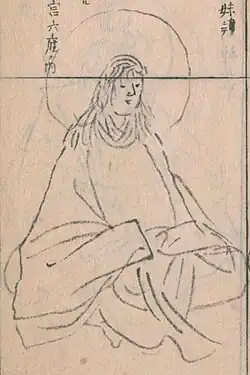 Drawing in Shinbutsu zue | |
| Major cult centre | Shitori Shrine, Kifune Shrine |
| Personal information | |
| Spouse | Ame no Wakahiko[1] or takehazuchi |
| Parents |
|
| Siblings | Ajisukitakahikone |
Shitateru-hime is a Japanese goddess. She is the daughter of Tagori-hime, one of the three sisters worshipped at Munakata Taisha. Some stories say Shitateru-hime is the same as Takehazuchi-no-mikoto, while others say she is his wife.
Shitori Shrine
Shitori Shrine is an ancient shrine. People think it was first the family shrine of the Shitori clan (倭文氏), Kofun-period weavers who called Takehazuchi-no-mikoto their ancestor. However, shrine legends all focus on Shitateru-hime. They say she came by boat from Izumo. She lived on the mountain behind the shrine. After she died, her relatives buried her in a Kofun in the Shrine.[2]
Marriage
The gods once sent Ame no Hohi down to earth, but he sent no news for three years. So they chose Ame no Wakahiko to rule the land.[3][4]
Some tales say he is Ame no Hohi’s son, sent to look for his father.[5]
Ame no Wakahiko met and married Shitateru-hime when he came to discuss the Kuni-yuzuri (handover of the land).[1]
Death of Ame no Wakahiko
Eight years passed with no report. The gods sent a bird called Nakime to check on him. On a wise woman’s advice, Ame no Wakahiko shot the bird with his bow.[6]
The arrow flew up to heaven, where Takamimusubi threw it back.
It struck Ame no Wakahiko while he was lying in bed and killed him.[3][4][7]
Other versions state that Amaterasu was the one who shot the arrow back at him.[7]
Shitateru-hime’s grief was so loud it reached the Plain of High Heaven. During the funeral she sang a song to honor her husband.[1]
Related page
References
- 1 2 3 "Encyclopedia of Shinto詳細". 國學院大學デジタルミュージアム (in Japanese). Retrieved 2024-03-24.
- ↑ Yoshiki, Emi (2007). Zenkoku 'Ichinomiya' tettei gaido (in Japanese). PHP Institute. ISBN 978-4569669304.
- 1 2 "Encyclopedia of Shinto - Home: Kami in Classic Texts: Ame no Wakahiko". eos.kokugakuin.ac.jp. Retrieved 2020-09-29.
- 1 2 Roberts, Jeremy (2009). Japanese Mythology A to Z. Infobase Publishing. ISBN 978-1-4381-2802-3.
- ↑ Japanese Mythology a to Z. Infobase. 2009. ISBN 9781438128023.
- ↑ Ashkenazi, Michael (2008). Handbook of Japanese mythology. Handbooks of world mythology. Oxford: Oxford University Press. p. 114. ISBN 978-0-19-533262-9.
- 1 2 Abe, C. (2003). Impurity and Death: A Japanese Perspective. Universal Publishers. p. 38. ISBN 978-1-58112-195-7. Retrieved 2020-09-29.
Further reading
- Jugon, Jean-Claude. "La romance du sentiment et de la pensée dans les légendes de Tanabata (Japon) et d’Éros-Psyché (Grèce), une interprétation transculturelle: «Oni» soit qui mal y pense! Archived 2024-06-21 at the Wayback Machine". In: 論叢現代語・現代文化 2015 Vol.14 pp. 1-92. (in French)
- Nüffer, Laura. “Humans and Non-Humans: Animal Bridegrooms and Brides in Japanese Otogizōshi.” In: A Cultural History of Fairy Tales in the Age of the Marvelous. Edited by Suzanne Magnanini. London: Bloomsbury Academic Press, 2021. pp. 95-118.
- ITO, Yuko. "Origins and development of the two versions of "Ame no Wakahiko Soshi": a comparative study". In: 都留文科大学研究紀要 [The Tsuru University Review], Mar/2007, volume 65, pp. 258–241. https://ci.nii.ac.jp/naid/110007055993/en/; ISSN 0286-3774. DOI: info:doi/10.34356/00000195 (in Japanese)
- Yasufuku, Junko. "The Tale of Ame no Wakahiko and the Psychic Development of the Feminine". In: Memoirs of Osaka Kyoiku University. IV, Education, pshychology, special education and physical culture, Osaka Kyoiku University, Feb/1995, volume 43, no. 2, pp. 251–258. ISSN 0389-3472. URL: https://ci.nii.ac.jp/naid/110000119291/en/ (in Japanese)