Shia Islam
| This article is part of a series on: |
| Islam |
|---|
 |
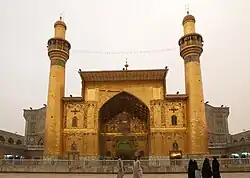 Ali's Tomb is one of the most important places for Shi'a Muslims | |
| Founder | |
|---|---|
| Followers of Ali ibn Abi Talib |
Shia Islam (Arabic: شِيعَةٌ, Persian: شعِهٌّ) is a sect of Islam which believes that Prophet Muhammad was commanded by Allah to choose Ali as caliph, his successor, Muhammad's cousin and son-in-law, and his descendants, and that Muhammad publicly declared it during his last sermon after the Hajj at Ghadir Khumm.[1] The belief is seen as supported by the Qur'an and Islamic history, with Shia scholars citing verses that highlight the special status of the family of certain prophets, including Ali.[1]
Shi'a Muslims believe in the teachings of the Qur'an and of Muhammad's family, whom they call the Ahl al-Bayt. They consider the first three ruling caliphs to have little importance in their faith. The Arabic singular/adjective form is Shī'ī (شِيعِيٌّ) and means a follower. The term "Shia" comes from the Arabic phrase "Shīʿat ʿAlī," meaning "followers of Ali."[2][3]
The 1979 Iranian Revolution led by Ruhollah Khomeini propelled Shia Islam from a marginalized sect to a powerful geopolitical and ideological force worldwide.[4][5]
Sources
- Shia Code, the Shia Islamic Guide Archived 2019-08-25 at the Wayback Machine
- List of Shi'a websites Archived 2009-02-11 at the Wayback Machine
- Ahlul Bayt Digital Islamic Library Project
- Al-Shia Website
- Archived 2021-03-17 at the Wayback Machine
References
- 1 2 Vaezi, Ahmad (2004). Shia political thought. London: Islamic Centre of England. pp. 56.
- ↑ academic.oup.com https://academic.oup.com/jaar/article/83/3/599/725097. Retrieved 2024-11-27.
{{cite web}}: Missing or empty|title=(help) - ↑ Ferguson, Duncan S. (2010-08-24). Exploring the Spirituality of the World Religions: The Quest for Personal, Spiritual and Social Transformation. Bloomsbury Academic. p. 192. ISBN 978-1-4411-4645-8.
- ↑ https://www.npr.org/2007/02/13/7371280/shia-rise-amid-century-of-mideast-turmoil
- ↑ https://www.cfr.org/event/emerging-shia-crescent-symposium-implications-us-policy-middle-east-0