Scheenstia
| Scheenstia Temporal range: Late Jurassic–Early Cretaceous, | |
|---|---|
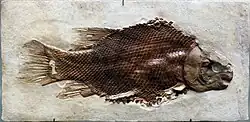 | |
| Fossil specimen of S. maximus | |
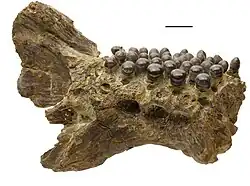 | |
| Lower jaw with teeth of Scheenstia sp. scale bar = 1 cm | |
Scientific classification  | |
| Kingdom: | Animalia |
| Phylum: | Chordata |
| Class: | Actinopterygii |
| Order: | Lepisosteiformes |
| Family: | †Lepidotidae |
| Genus: | †Scheenstia López-Arbarello & Sferco, 2011 |
| Type species | |
| Scheenstia zappi López-Arbarello & Sferco, 2011 | |
| Species[1] | |
| |
Scheenstia is an extinct genus of freshwater and marine ray-finned fish from the Upper Jurassic–Lower Cretaceous of Europe. The teeth of this genus are called "toadstones" and were believed to be found in the head of a toad. It is part of a family called the Lepidotidae in the order Lepisosteiformes. It is related to the much better-known Lepidotes.
Appearance
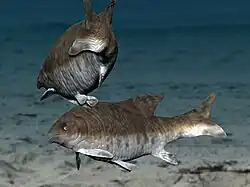
A large fish, Scheenstia, could exceed one meter. It had a robust body and rounded teeth, perfect for squashing hard-bodied animals. It was probably a relatively slow swimmer. The body shape resembles the famous Lepidotes.
Image gallery
Related pages
References
- ↑ López-Arbarello 2012, p. e39370.
Sources
- López-Arbarello, Adriana (2012-07-11). "Phylogenetic Interrelationships of Ginglymodian Fishes (Actinopterygii: Neopterygii)". PLoS ONE. 7 (7): e39370. doi:10.1371/journal.pone.0039370. ISSN 1932-6203. PMC 3394768. PMID 22808031.
{{cite journal}}: CS1 maint: article number as page number (link) - Cavin, Lionel; Deesri, Uthumporn; Olive, Sébastien (2020-03-18). "Scheenstia bernissartensis (Actinopterygii: Ginglymodi) from the Early Cretaceous of Bernissart, Belgium, with an appraisal of ginglymodian evolutionary history". Journal of Systematic Palaeontology. 18 (6): 513–527. doi:10.1080/14772019.2019.1634649. ISSN 1477-2019.