Sarinda
 | |
| Classification | |
|---|---|
| Related instruments | |
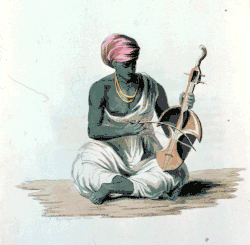
The sarinda is an Indian folk musical instrument. It is like lutes and fiddles. It is played with a bow. It has between ten and thirty strings. The bottom part of the front of its hollow wooden soundbox is covered with animal skin. It is played while sitting on the ground. The musician holds the sarinda straight up.[1][2][3]
Origin
The tribal fiddle instrument "Dhodro Banam" is the origin of the stringed instrument "Sarinda". Dhodro Banam was found throughout in central, north-western and eastern India. It is an important instrument in the culture and religion of the tribal Santhals of West Bengal, Bihar and Odisha.
The Sarangi and Nepali sarangi are similar to the Sarinda. The Sarinda was introduced to and popularized in Sikh devotional music by Sikh Guru Arjan Dev.
In popular culture
Many ethnic communities in South Asia use the sarinda in their traditional music and dance. For example, the Bauls of Bengal, Punjabi people, the folk artists of Rajasthan, Assam and Tripura. It is the sole accompaniment for a soloist or group folk singers.
In literature
- John Baily: Music of Afghanistan: Professional Musicians in the City of Herat. Cambridge University Press, Cambridge 1988, S. 19, 34, 82f, 166
- Joep Bor: The Voice of the Sarangi. An illustrated history of bowing in India. National Centre for the Performing Arts, Quarterly Journal, Bd. 15 & 16, Nr. 3, 4 & 1, September–Dezember 1986, März 1987, S. 13–17
- Ludwig Finscher (Hrsg.): Die Musik in Geschichte und Gegenwart. Sachband 8, 1998, Sp. 1003f
- Bengt Fosshag: Die Sārindā und ihre Verwandten. Formen und Verbreitung einer Familie von Streichinstrumenten in den Ländern des Islam und benachbarten Regionen. (PDF; 5,9 MB) Institut für Geschichte der Arabisch-Islamischen Wissenschaften, Frankfurt/Main 1997, S. 281–306
- Stanley Sadie (Hrsg.): The New Grove Dictionary of Music and Musicians. Macmillan Press, London 1984, Bd. 3, S. 297f
References
- ↑ "Sarinda" Archived 2012-06-01 at the Wayback Machine a: National Encyclopedia of Bangladesh
- ↑ Bengt Fosshag, "The Lutes of the Santal"
- ↑ "15.2. El món islàmic" Archived 2010-12-09 at the Wayback Machine Imatge d'una sarinda al Museu de la Música de Barcelona
Other websites
