Robert Montgomery
Robert Montgomery | |
|---|---|
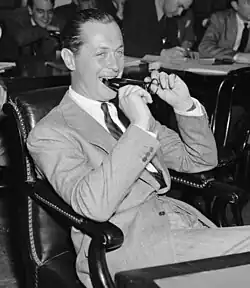 | |
| President of the Screen Actors Guild | |
| In office 1935–1938 | |
| Preceded by | Eddie Cantor |
| Succeeded by | Ralph Morgan |
| In office 1946–1947 | |
| Preceded by | George Murphy |
| Succeeded by | Ronald Reagan |
| Personal details | |
| Born | Henry Montgomery, Jr. May 21, 1904 Fishkill Landing, New York (now Beacon, New York), U.S. |
| Died | September 27, 1981 (aged 77) New York City, U.S. |
| Spouse(s) | Elizabeth Bryan Allen (1928–1950; divorced); 2 children Elizabeth Grant Harkness (1950–1981; his death) |
| Children | Elizabeth Montgomery Robert Montgomery, Jr. |
| Occupation | Actor, director |
Robert Montgomery (May 21, 1904 – September 27, 1981) was an American actor and director. He was born in Beacon, New York. He starred in many movies, including Night Must Fall. During the Second World War, he drove ambulances in France until the Dunkirk evacuation. He was present at the Invasion of Normandy and enlisted in the Navy. He died in New York City from cancer and was cremated.
Early life
Henry Montgomery Jr. was born in Fishkill Landing, New York (now Beacon) to Henry and Mary Weed Montgomery, being of Scottish-Irish heritage. His father was president of the New York Rubber Company and jumped off the Brooklyn Bridge in 1922, ultimately killing him.
Career
Montgomery moved to New York City to attempt writing and acting, establishing his stage career. Sharing a stage with George Cukor, he was able to enter Hollywood and a contract to debut in So This Is College (1929). One writer claimed that he was "agreeable with everyone, eager and willing to take suggestions" and hence it was the source of his establishment. However, he was also regarded as pompous beyond what was shown on cameras.[1]
Montgomery initially played solely in comedy roles, his first dramatic role being in The Big House (1930) - MGM was reluctant to assign him the role until his behaviour won him the role and he acted in the role.
Other websites
 Media related to Robert Montgomery (actor) at Wikimedia Commons
- ↑ Eyman, Scott (1997). The Speed of Sound: Hollywood and the Talkie Revolution 1926-1930. p. 295. ISBN 978-1-4391-0428-6.