Qarmatians
Qarmatians قرامطة | |
|---|---|
| 899–1077 | |
| Capital | Al-Ahsa Oasis |
| Religion | Shia Islam |
| Demonym(s) | Qarmatian |
| Government | Theocracy |
• 894–914 | Abu Sa'id al-Jannabi |
• 914–944 | Abu Tahir al-Jannabi |
• 944–970 | Ahmad Abu Tahir |
• 968–977 | Al-Hasan al-A'sam |
• 970–972 | Abul Kassim Sa'id |
• 972–977 | Abu Yaqub Yousuf |
| Establishment | |
| History | |
• Ismāʿīlī schism | 765 |
• Established | 899 |
• Sack of Mecca | 930 |
• al-Isfahani proclaimed to be the Mahdi | 931 |
• Black Stone returned | 952 |
• Defeated by the Abbasids | 976 |
• Established | 899 |
• Disestablished | 1077 |
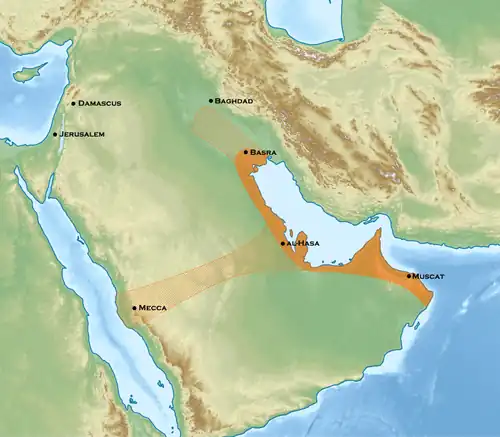
The Qarmatians (Arabic: قرامطة, romanized: Qarāmiṭa; Persian: قرمطیان, romanized: Qarmatiyān or Carmathians in 20th-century historical discourse in English) were a militant Isma'ili Shia movement centred in Al-Ahsa in Eastern Arabia, where they established a religious state in 899 CE.[1][2][3]
References
- ↑ Mumayiz, Ibrahim A. (2006). Arabesques: Selections of Biography and Poetry from Classical Arabic Literature. Garant. ISBN 978-90-441-1888-9.
- ↑ Jr, Everett Jenkins (2010-11-25). The Muslim Diaspora (Volume 1, 570-1500): A Comprehensive Chronology of the Spread of Islam in Asia, Africa, Europe and the Americas. McFarland. ISBN 978-0-7864-4713-8.
- ↑ "Qarmatian | Meaning, Attack, Beliefs, & History | Britannica". www.britannica.com. Retrieved 2025-10-26.