Pyrimidine
| |||
| |||
| Names | |||
|---|---|---|---|
| IUPAC name
Pyrimidine | |||
| Other names
1,3-Diazine, m-Diazine | |||
Except where otherwise noted, data are given for materials in their standard state (at 25 °C [77 °F], 100 kPa). | |||
 verify (what is  ?) | |||
| Infobox references | |||
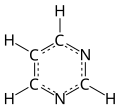
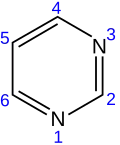
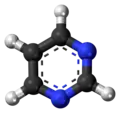
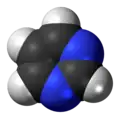
Pyrimidines include three of the bases in DNA and RNA.
A pyrimidine is an aromatic heterocyclic organic compound, similar to purine.[1] It has nitrogens at positions 1 and 3 in the ring.[2][3]
Pyrimidines
The pyrimidine ring system occurs widely in nature.[4]
- Cytosine (C),
- Thymine (T),
- Uracil (U).
- Thiamine (vitamin B1)
It is also found in many synthetic compounds such as barbiturates and the HIV drug, zidovudine. Uric acid is a pyrimidine derivative.
References
- ↑ Gilchrist T.L. (1997). Heterocyclic chemistry. New York: Longman. ISBN 0-582-27843-0.
- ↑ Joule, John A.; Mills, Keith, eds. (2010). Heterocyclic chemistry (5th ed.). Oxford: Wiley. p. 250. ISBN 978-1-405-13300-5.
- ↑ Brown H.C. et al 1955. In Baude, E.A. and Nachod, F.C., Determination of organic structures by physical methods. Academic Press, New York.
- ↑ Lagoja, Irene M. (2007). "Pyrimidine as constituent of natural biologically active compounds" (PDF). Chemistry and Biodiversity. 2 (1): 1–50. doi:10.1002/cbdv.200490173. PMID 17191918. S2CID 9942715. Archived from the original (PDF) on 2017-02-15. Retrieved 2014-10-05.