Prime Minister of Japan
| Prime Minister of Japan 日本国内閣総理大臣 | |
|---|---|
 | |
 The Seal & Standard of the Prime Minister of Japan | |
| Executive Branch of the Japanese Government Office of the Prime Minister | |
| Style | Her Excellency (formal) |
| Status | Head of Government |
| Abbreviation | PMOJ |
| Member of | Cabinet National Security Council National Diet |
| Residence | Kantei |
| Seat | Tokyo, Japan |
| Nominator | National Diet |
| Appointer | The Emperor (Naruhito since 1 May 2019) The monarch invites the designated prime minister confirmed by the Diet to form a government |
| Term length | Four years or fewer, renewable indefinitely.[a] |
| Constituting instrument | Constitution of Japan |
| Precursor | Shogun of Japan |
| Inaugural holder | Itō Hirobumi |
| Formation | 22 December 1885 (140 years, 6 months ago) |
| Deputy | Deputy Prime Minister of Japan |
| Salary | ¥ 40,490,000 ($377,180) annually[1] |
| Website | www.kantei.go.jp |
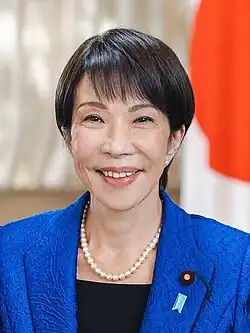
The prime minister of Japan (日本国内閣総理大臣, Naikaku sōri daijin) is the head of the government of Japan as well as the director and chief of the executive branch of the central government. The prime minister appoints the cabinet and wields the power to dismiss any cabinet minister.
The current prime minister is Sanae Takaichi since 21 October 2025.
Background
The longest-serving prime minister was Shinzo Abe, who served over eight years across two non-consecutive terms, and the shortest-serving was Prince Naruhiko Higashikuni, who served fifty-four days. Abe was also the youngest person to become prime minister at aged 52. Kantarō Suzuki is the oldest person to become prime minister at the age of 77. In 2025, Sanae Takaichi became the first female prime minister.
List of prime ministers
Living former prime ministers
| Number | Name | Tenure | Date of birth | Age |
|---|---|---|---|---|
| 1 | Yasuo Fukuda | 2007–2008 | 16 July 1936 | 89 years, 348 days |
| 2 | Yoshirō Mori | 2000–2001 | 14 July 1937 | 88 years, 350 days |
| 3 | Morihiro Hosokawa | 1993–1994 | 14 January 1938 | 88 years, 166 days |
| 4 | Tarō Asō | 2008–2009 | 20 September 1940 | 85 years, 282 days |
| 5 | Junichiro Koizumi | 2001–2006 | 8 January 1942 | 84 years, 172 days |
| 6 | Naoto Kan | 2010–2011 | 10 October 1946 | 79 years, 262 days |
| 7 | Yukio Hatoyama | 2009–2010 | 11 February 1947 | 79 years, 138 days |
| 8 | Yoshihide Suga | 2020–2021 | 6 December 1948 | 77 years, 205 days |
| 9 | Shigeru Ishiba | 2024–2025 | 4 February 1957 | 69 years, 145 days |
| 10 | Yoshihiko Noda | 2011–2012 | 20 May 1957 | 69 years, 40 days |
| 11 | Fumio Kishida | 2021–2024 | 29 July 1957 | 68 years, 335 days |
Travel
References
- ↑ "IG.com Pay Check". IG. Archived from the original on 2018-04-25. Retrieved 2021-08-25.
- ↑ Updated daily according to UTC.
Notes
- ↑ The Cabinet shall resign en masse after a general election of members of the House of Representatives. Their term of office is four years which can be terminated earlier. No limits are imposed on the number of terms or tenures the Prime Minister may hold. The Prime Minister is, by convention, the leader of the victorious party, though some prime ministers have been elected from junior coalition partners or minority parties.
Other websites
- Prime Minister of Japan and His Cabinet Official website