Political interpretations of The Wonderful Wizard of Oz
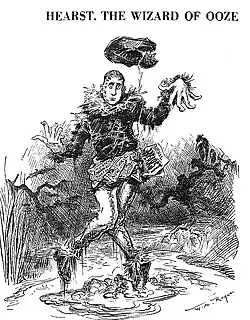
Political interpretations of The Wonderful Wizard of Oz look at the story as a symbol or metaphor for political, economic, and social events in the United States during the 1890s. Scholars have studied four main versions:
- The 1900 book by L. Frank Baum,
- The 1902 Broadway musical,
- The 1939 Hollywood film,
- And many Oz books written later by Baum and others.
The first three versions are most studied for political meaning. Baum was involved in politics in the 1890s, especially about money and silver (bimetallism). The illustrator, William Wallace Denslow, worked as a political cartoonist. In the 1902 musical, Baum even mentioned real politicians like President Theodore Roosevelt.
Monetary policy
In 1964, Henry Littlefield suggested that the book is a story about debates on money in the late 19th century. For example:
- The Yellow Brick Road represents the gold standard.
- The Silver Shoes (Ruby Slippers in the 1939 movie) represent the pro-silver movement.
Hugh Rockoff said the City of Oz is named after "ounces" of gold and silver. Some scholars agree, but others disagree. The 1902 musical had many jokes about real politics. For example, the Tin Woodman asks what would happen if he ran out of oil, and the Scarecrow says John D. Rockefeller would lose $6,000 a minute.
Scholars say Baum used images and characters that reminded people of the 1890s political situation. Dorothy represents the American people. The Emerald City is like paper money that cannot be exchanged for gold or silver. The Wizard is a politician who tricks people into thinking he is powerful. Dorothy’s journey represents the struggles of the public.
Rockoff also said the cyclone that brings Dorothy to Oz represents economic upheaval. The silver shoes are the pro-silver movement. Ruth Kassinger says the Wizard represents bankers supporting the gold standard. Only Dorothy’s silver slippers could take her home, symbolizing a money system for the people.
Social groups
Historian Quentin Taylor suggested other symbols:
- Scarecrow = American farmers and their problems.
- Tin Man = American steel industry and workers.
- Cowardly Lion = the American military in the Spanish–American War.
The cyclone was also used in the 1890s as a symbol for political change. Dorothy represents goodness and innocence. Literary scholar Brian Attebery said Mary Elizabeth Lease may have inspired Dorothy. Others suggest:
- Tin Man = industrial/factory worker,
- Cowardly Lion = William Jennings Bryan or weak politicians.
Other allegories include:
- Wicked Witch of the West = the actual American West,
- Winged Monkeys = dangers from Native Americans.
Baum had controversial views on Native Americans in editorials, but some passages in the book may show more nuanced references. Dorothy and her friends meet “policemen of the forest” and accidentally damage property, which some say refers to historical events like the Grattan massacre and suppression of the Ghost Dance.
Baum was influenced by his mother-in-law, activist Matilda Joslyn Gage, who helped him write the Oz stories. Biographers connect her feminist ideas to Glinda and Dorothy.
Alternative allegory
Other writers have suggested different meanings. For example:
- The “man behind the curtain” may refer to automated store window displays that Baum knew about.
- Some see the story as theosophical or alchemical, with Dorothy’s journey representing stages of alchemy and the Emerald City as the Emerald Tablet.
- The man behind the curtain could also represent Mark Hanna, a political strategist.
In 1993, W. Geoffrey Seeley interpreted the story as political intrigue: Glinda uses Dorothy to defeat her rivals and become ruler of Oz.
Some modern interpretations see the story as feminist: the characters with power are mostly women (Dorothy and the witches). Men are shown as lacking key traits like courage, heart, or brains. Baum supported women’s rights and was influenced by his wife and mother-in-law.
Bibliography
- Barrett, Laura. "From Wonderland to Wasteland: The Wonderful Wizard of Oz, The Great Gatsby, and the New American Fairy Tale." Papers on Language and Literature, March 22, 2006.
- Baum, L. Frank. The Wonderful Wizard of Oz (1900), online version.
- Dighe, Ranjit. The Historian’s Wizard of Oz: Reading L. Frank Baum’s Classic as a Political and Monetary Allegory. 2002.
- Kassinger, Ruth. Gold: From Greek Myth to Computer Chips. 2003.
- Rockoff, Hugh. "The 'Wizard of Oz' as a Monetary Allegory." Journal of Political Economy, 1990.
- Taylor, Quentin P. "Money and politics in the land of Oz." The Independent Review, Winter 2004/05.
Further reading
- The Yellow Brick Road to Utopia – a comparison of the book and film
| |||||||||||||||||||||||||||
| |||||||||||||||||||||||||||
| |||||||||||||||||||||||||||
