Paul Deschanel
Paul Deschanel | |
|---|---|
 | |
| President of France | |
| In office 18 February 1920 – 21 September 1920 | |
| Prime Minister | Alexandre Millerand |
| Preceded by | Raymond Poincaré |
| Succeeded by | Alexandre Millerand |
| Personal details | |
| Born | 13 February 1855 Schaerbeek, Belgium |
| Died | 28 April 1922 (aged 67) Paris, France |
| Political party | Democratic Republican Alliance |
| Alma mater | University of Paris |
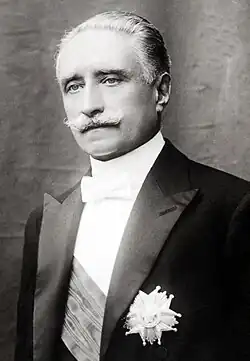
Paul Eugène Louis Deschanel (French pronunciation: [pɔl deʃanɛl]; born 13 February 1855 in Schaerbeek, near Brussels; died 28 April 1922 in Paris) was a French political man and writer.
For thirty-five years he was a deputy, a member of the Chamber of Deputies (the lower house of the French Parliament). His department was Eure-et-Loir. He was twice the president (head) of the Chamber: from 1898 to 1902, and again from 1912 to 1920. From 1899 he was one of the forty members of the Académie française. On 17 January 1920 he was elected the tenth President of the Republic. He won one day after Georges Clemenceau dropped out of the race. Deschanel had beaten him in the test vote of the political groups. But soon his mind became ill. He suffered from fear and deep sadness, made worse by overwork. On 21 September of the same year he resigned (gave up the office). He had been President for only about seven months. Only Jean Casimir-Perier (1894-1895) was President for a shorter time. In January 1921 Deschanel was elected to the Senate (the upper house). He died the next year.
Most people remember him for one strange event. In the night of 23 to 24 May 1920 he fell from the presidential train, wearing only his pajamas. Newspapers and songwriters made fun of him. Later books told false stories about him. Because of this, a long and important political career was almost forgotten. But Deschanel was one of the best public speakers of his time. He was a thinker of a moderate and social Republic, and an expert in foreign policy (relations with other countries). With Raymond Poincaré and Louis Barthou, he was one of the leaders of the moderate republicans, called progressistes. His story shows how the Third Republic worked. It also shows how hard public memory can be on men whose careers end suddenly.
Birth and family
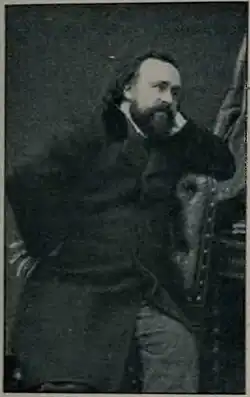
Paul Deschanel's father, Émile Deschanel (1819-1904), was a teacher and writer. His mother was not married. A lawyer, probably his real father, did not give him his name. But he paid for his education. At school Émile was a friend of the young Charles Baudelaire. He became a strong republican. When Louis-Napoléon took power by force on 2 December 1851, Émile had to leave France. He went to Belgium.
So Paul was born in Schaerbeek, near Brussels, in a small house in the rue de Brabant. He was born among French republicans living in exile (sent away from their country). For them, this birth was a sign of hope. Victor Hugo had asked again and again for "the little Deschanel". Edgar Quinet called the baby "the first-born of the exile". Paul spent his first four years among these men. They lived on the memory of France and on the hopes of 1848.
In 1859 Napoleon III let the exiles come back, after his victory in Italy. Émile started teaching and writing again. But he refused to promise loyalty to the Empire. So he could not teach in public schools. Paul grew up knowing that he was born outside France because of the Empire. In his home, politics, writing and the memory of exile were always present. His father's notebooks show a quick, happy and independent boy. When the Republic came, Émile was elected to the Chamber of Deputies (February 1876). So the son grew up among the politicians of the young Republic. Public speaking was his father's gift. It became the main tool of his whole career.
Education and first government work
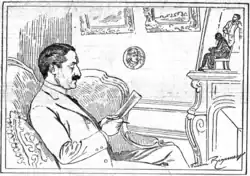
Paul studied literature and law. He spent a year in the army in 1873. He studied at the École libre des sciences politiques. He received his two law degrees in July 1874 and December 1875. Very young, he published serious articles: on Rabelais in the Revue bleue (1875), then on Diderot and Quinet in the Journal des débats (1877). Like his father, he loved both writing and politics. He decided to keep both.
In January 1878, at twenty-two, he became sous-préfet at Dreux. (A sous-préfet represents the government in a small town.) His father's friends had helped him. Dreux is in Eure-et-Loir. This department would later send him to Parliament for thirty-five years. His letters show a young Parisian in a cold, unknown town. There he learned the political trade. He talked to farmers and landowners, and tried to win them over to the Republic. After Dreux he worked at Melun (1879). Then he was sous-préfet at Brest (end of 1879) and Meaux (1881). He did not enjoy this work much. His real wish was a seat in the Chamber.
In August 1881 he left government service. He ran at Dreux against Gatineau, the sitting deputy. His program was moderate: small changes to the basic laws, a return to voting by department lists, and more power for local areas. He lost. In the next years he traveled: Italy in 1880, Germany in 1884-1885. He published books about foreign questions, such as La Question du Tonkin (1883) and La Politique française en Océanie (1884). These books made him known as an expert in foreign policy.
Deputy for Eure-et-Loir (1885-1920)
Two facts gave him his chance: the return of voting by department lists, and the death of Gatineau in July 1885. In October 1885 the republicans of Eure-et-Loir put the young man on their list. He was elected to the Chamber at thirty. In all, the voters elected him nine times, from 1885 to 1919. From 1889 his district was Nogent-le-Rotrou. There his support was almost complete. His opponents got very few votes. Only Dr Poupon, in 1910, gave him a real fight. Even then, Deschanel won more than 71% of the votes.
This safe seat had a strange side. He had no house in the department. He was never a mayor. From 1895 he was only a quiet member of the department council. But this position let him give all his time to national questions. His fame in Paris also helped his district. He looked after its farming interests in the hard years at the end of the 1800s.
One thing makes his story special: he was never a minister. (A minister is the head of one part of the government.) He received offers more than once. His "no" was a clear choice. He said that a failure as a minister would have "broken him at one blow". He was sure of one thing: the road to the presidency meant making no political enemies. So he chose the role of a judge between the parties, not of a man of action. Writers of his time, like Joseph Caillaux, said this. Historians, like Jean-Jacques Becker, say the same: his whole career pointed toward the Élysée (the home of the President).
His political ideas
Deschanel was one of the moderate republicans. They were the strongest group in the Chamber in the 1890s. He was against socialism (a system in which property is owned in common). He was against the program of the Radical party. But his social ideas were very open. The left-wing newspaper La Petite République even called him in 1897 "a socialist of the property-owning classes".
The heart of his social thought was mutual help. He believed in societies where workers put money together. This money supported them in sickness, in old age and in hard times. He led national organizations of this kind. At the end of 1899 he outlined a complete program. It included free offices for finding work. It included mutual societies for schoolchildren, mothers and women. It also included insurance and old-age pensions. On taxes, he accepted a tax on yearly income. But it had to replace older taxes. It had to be measured by outward signs of wealth, such as a man's house and way of living. The smallest incomes had to be free of tax. The number of children had to be counted. Paying taxes, he said, is an act of respect for the nation.
In trade, he wanted taxes on foreign goods when French farming or industry seemed in danger. In 1891 he attacked free trade and the trade agreement of 1860 with England. In April 1897, with Raymond Poincaré, he started a national committee of trade and industry. Before it, he said France had to stop the decline of its foreign trade. It had to renew its education and use its colonies. He was a friend of the small farm. The power of a country, he said, comes from a balance between small and large property.
He also had ideas about government itself. In 1908 he proposed a written list of the rights and duties of the people who work for the government. From his first program in 1881 he wanted more power for local government. He supported proportional voting (a system that gives every party its fair share of seats). A writer said of him in 1898: "He represents almost no group but himself." That fact became his strength when the time came to be a judge over all the parties.
His greatest interest was foreign policy. "It is not power I am looking for: it is foreign policy that attracts me," he said in 1893. He traveled to see things with his own eyes. In 1891 he was in the United States, sent by the government to study its political system. He visited England, Spain, Greece and North Africa. In April 1912 he was in the Balkans. There King Ferdinand of Bulgaria told him his ideas about Constantinople. Even his opponents, like Caillaux, later said he had seen clearly on the questions of the East and of central Europe.
Head of the Chamber of Deputies (1898-1902)
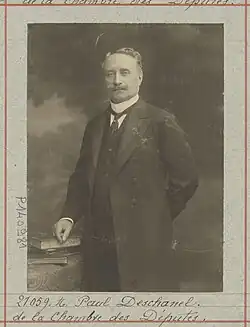
The president of the Chamber held one of the most important offices of the Republic. He organized the work of the house. He played an important part in planning its business. He decided questions of order and doubtful votes. He kept debates regular and gave punishments when needed. At every government crisis, the President of the Republic asked his advice. After the President, he was the second man of the country. He was re-elected every January, so the house always kept him under its eye. Deschanel loved the ceremony of the office. This first made the deputies smile. But it was also a sign of his high idea of the office. In his secret thoughts, the chair was the doorway to the Élysée.
He had been a vice-president of the Chamber for a year and a half. Then the elections of May 1898 made his party the largest in the house. Poincaré and Charles Dupuy said no, so he was put forward. His opponent was Henri Brisson, an old Radical leader and the last president of the Chamber. The vote was one of the strangest ever seen at the Palais-Bourbon. On 1 June he was elected temporary president by one vote. The count was so doubtful that he himself asked for a new vote. He won again the next day. On 9 June 1898 he was elected full president of the Chamber, by 287 votes to 277. He was forty-three. In his first speech from the chair, on 13 June, he gave his rule: "The man called to the role of a judge must silence his own preferences and rise above his very faith."[1]
His first years in the chair came in the middle of the Dreyfus affair. This was the great fight about Alfred Dreyfus, an army officer from a Jewish family. He had been sent to prison for a crime he did not do. The Chamber was split in two. Privately, Deschanel was against a new trial. His reason was fear for the army and for national unity, not hatred of Jews. But he never said this in public. He took no part in the attacks against Jews. He kept the rule of the chair: no opinion.
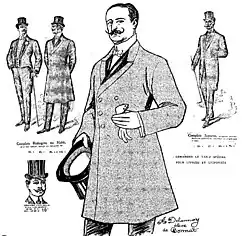
For this, both sides attacked him. Left-wing papers said his way of presiding was "shockingly one-sided". La Libre Parole, Drumont's paper, was full of hatred against Jews. It claimed he had been paid by "the Jewish party". Others made fun of his love of ceremony, his black dress-coat, and his care to be first at every public event. Still, the Chamber re-elected him every January, with bigger and bigger numbers. In 1902 nobody even ran against him. In those years he presided over hard times. President Félix Faure died. Loubet was elected. The Dreyfus case was tried again at Rennes. The Waldeck-Rousseau government came to power. But the elections of 1902 gave power to the left. On 1 June 1902 Léon Bourgeois took the chair from him, by 303 votes to 267. The blow was hard. For him, that chair had been the last step before the Élysée.
Writer, marriage and family
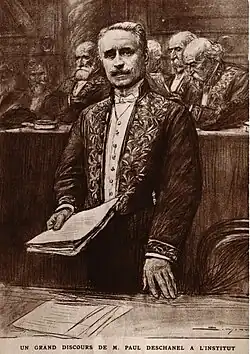
Deschanel was also a man of high society and letters, a famous name of the Paris of the Belle Époque. His elegant clothes caused much humor in the house. His friends included Anna de Noailles, Pierre Loti, Anatole France, Saint-Saëns and Bonnard. In 1899, while head of the Chamber, he was elected to the Académie française. (This society of forty writers is the highest honor for a French writer.) His rivals were Émile Faguet and René Bazin. Unfriendly papers said his books were thinner than his art of pleasing. His father, a greater writer, had never been elected. In 1914 he also joined the Académie des sciences morales et politiques.
In February 1901, at forty-six, he married Germaine Brice, aged twenty-five. She was the daughter of René Brice, a deputy and businessman. The first ceremony was on 13 February, his birthday. The two witnesses were the President of the Republic, Émile Loubet, and the old writer Ernest Legouvé. The church ceremony was on 16 February at Saint-Germain-des-Prés. It was the society event of the year. The marriage was also, as often in his party, a meeting of the moderate Republic and the world of money. It brought him a million francs and a yearly income. Before, he had lived on his pay as a deputy.
They had three children: Renée-Antoinette (1902), Émile-Jean (1904) and Louis-Paul (1909). Deschanel worked hard, getting up at six every day, and watched closely over their education. Émile-Jean became a deputy for Eure-et-Loir in 1932. After 1944 he was banned from public life for voting full powers to Marshal Pétain in 1940. Louis-Paul became a historian. He was one of the first Frenchmen killed at the front, in September 1939.
1913 and the return to the chair
After 1902 came ten quieter years. He gave big speeches on social questions and foreign policy. But the Chamber was now controlled by the left, and it was not much moved. His first real attempt at the presidency came in January 1913, at the end of Fallières's term. At the test meeting of the left groups he received only 83 votes, far behind Poincaré, Pams and Dubost. He withdrew. Poincaré's opponents then made him an offer: to be a second candidate at Versailles. He refused a political game he found shameful. Poincaré was elected President on 17 January 1913. The pain was deep. "Fate has been mean and unfair to me," Deschanel said that summer. Newspaper attacks on both sides made things worse. For a time, they hurt his old friendship with Poincaré.[2]
One comfort had come the year before. In May 1912, after the death of Henri Brisson, the Chamber elected him president again. He kept the chair, re-elected every January, until 1920, through the whole of the Great War.
The Chamber in the Great War

The war changed the office. Deschanel became more than a keeper of order. He defended the rights of the Chamber against a government and an army command that wanted to act alone. He wanted strong control of the war by Parliament. In January 1915 he said: "If Parliament had dared more, if it had known more, France would be better off." This separated him a little from Poincaré, who had more doubts about the houses touching army questions. From June 1916 he presided over the secret meetings of the Chamber. There the deputies learned the truth about the failed attacks. In 1917 they discovered the price in blood of General Nivelle's operations. It was his job to control their anger. He also spoke the words of last respect for the deputies killed at the front, from Driant, killed at Verdun, to Abel Ferry. And he wrote the Chamber's words of respect for the airman Guynemer, who was not a deputy.
He was one of the great public voices of the war. From 1914 to 1918 his speeches and writings spoke of national unity, of Alsace-Lorraine, and of the pain of Belgium. In 1915 he spoke out against the mass killing of the Armenians. After the war these speeches were collected in a book, La France victorieuse. One newspaper called him "the very voice of the fatherland". But his private notes were dark. He saw how unready France had been before 1914. He also kept deep doubts about the Treaty of Versailles. After his presidency he prepared an attack on the way the treaty had been made. Death stopped him from giving it in the Senate.
Elected President (January 1920)
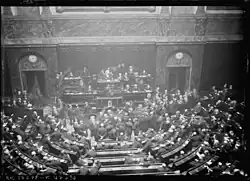
The elections of 16 November 1919 gave France a Chamber of the right and the center. It was called "bleu horizon", after the color of the soldiers' coats. The Senate, one third of which was renewed in January 1920, stayed more to the left. It chose Léon Bourgeois as its head. Poincaré's term was ending. Most people expected Georges Clemenceau to become President. He was the old head of the war government, the "Father of Victory". But many were against him. The Catholic deputies feared this old enemy of the church. A story was quietly going around, kept alive by Aristide Briand: President Clemenceau might one day be buried without a church ceremony. Part of the Radical party could not forgive his attacks on Caillaux and Malvy. The socialists were all against him. And many deputies and senators were tired of his hard ways and sharp words.
Deschanel seemed the right man for houses that wanted, with peace, to go back to the old ways. He was elected temporary head of the new Chamber on 18 December 1919. He was elected full head on 13 January 1920, in a meeting where his friends cried "À Versailles!". He played his cards quietly and well, with Briand's active help. He was kind to everyone. He had never been a "strike-breaker" (he had never sent force against striking workers). He supported fair voting systems. He gave the left of Herriot and Blum soft, unclear words about new relations with the Vatican (the seat of the Pope). At the same time, he let the Catholic deputies believe the opposite. On 16 January 1920, at the test meeting of the republican groups, he came out ahead of Clemenceau. Clemenceau at once withdrew. The next day, at Versailles, the two houses elected Deschanel President of the Republic, with 734 votes. No President had ever received so many. The newspapers saw national unity. Historians, with Jean-Jacques Becker, see something else: the choice of a decorative President, in the line of Fallières. It was the sign, in Becker's words, that the spirit of the Bloc national was "dead at birth". Clemenceau, deeply hurt, resigned at once. Alexandre Millerand formed the new government.[3]
Seven months as President
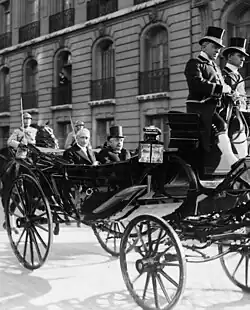
A tired and sad man
Deschanel entered the Élysée in February 1920. He was sixty-five and worn out. Eight years at the head of a Chamber at war had been too much for his nerves. So had the fight for the Élysée, and the writing of his book on Gambetta, which had taken all his free hours. Then came a discovery. The laws of 1875, as used since Grévy, gave the President almost no real power. He had pointed his whole life at this office. Now he saw that he could do almost nothing. Dark thoughts followed: he felt he was betraying the trust of Parliament. Then came physical signs: pressure on the chest, a racing heart, fear. He himself called it "a flame inside my chest".
Still, the first months were full. He presided over the meetings of Millerand's ministers, in a spring of big strikes by railway and coal workers. He went on presidential journeys. Crowds loved his simple, warm and open way. He supported a careful new start of relations with the Vatican, and later said this had been one of his own acts. But the journey to the south, in April 1920, gave a sad picture. People near him saw a man crushed by ceremony and police protection, kind one minute and fearful the next. He was a man of ideas and words. The gap between the dream of a life and the small real power of the office hurt him directly.
The fall from the train near Montargis (night of 23-24 May 1920)
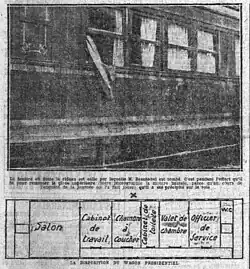
The event that fixed his place in memory came on a journey to Montbrison. He was going there to open a monument to Reymond, a senator and airman killed in the war. Deschanel had influenza and at first refused the journey. On Sunday 23 May, at night, the special train left the Gare de Lyon. The President took a calming medicine and went to bed. The carriage was overheated. The night was stormy. His sleep was broken. About 23:10, half asleep, his mind unclear, he got up for air. With difficulty, he opened the window of his room on the train. It was a window that slides up and down, very low, with nothing to hold on to. At that moment the train slowed to about fifty kilometers per hour, because of works on the line. Deschanel leaned out and fell. He landed on the stones of the track, at kilometer 110.9, before Montargis.
His face was bloody, but he had no deep wound. He walked along the rails. There he met a railway worker, André Radeau, on his night round. "I am the President of the Republic and I have fallen from the train," he said. Radeau thought he was drunk. But he took him to the house of another railwayman, Gustave Dariot. Mme Dariot washed his cuts. She only guessed that the unknown man was "a Monsieur" (a gentleman), "because his feet are clean". The train went on. At the stop of Moulins, the fifty-three people of the President's party were counted. All were there. But nobody dared to wake the fifty-fourth, the President himself. So his absence only became clear in the morning, when telegrams from the local stations caught up with the train. The government examined the facts and said it was an accident. The design of the presidential carriages had made it easier. Poincaré said the same in public, before the Senate.[4]
The damage to his image was great. Some papers truly feared for the President's health. But the satirical papers (papers that make fun of people) had a great time. Le Canard enchaîné printed the song title "Mais n'te promène donc pas en pyjama" ("Do not go walking in your pajamas"). L'Action française suggested a pajama in the national colors. Singers made songs about the railwayman and the President's nightwear. A cruel remark was credited to Clemenceau: "That does not surprise me. M. Deschanel was always in a hurry to arrive." Almost the only public voice on his side was Poincaré. He said the "highest judge" of the nation should be left out of these attacks. Deschanel presided over the ministers' meeting the very next day. But he now knew that he needed complete rest. He offered to resign. Millerand refused, sure that a few months of quiet would be enough.[5]
Rambouillet and the end (September 1920)
The summer brought no improvement. After family days in Normandy, the President rested from July at the castle of Rambouillet. There his sadness grew deeper. He knew that people were saying he was mad. On 10 September 1920, at dawn, he went down into the park, half dressed. He walked into the water of a pond, up to his waist, without knowing what he was doing. A man who saw it said: "You could see he was thinking too much." The story got out at once. Some journalists protested against this hunting of a sick man. But this time, Millerand said yes.
On 21 September 1920 the President's message was read to the Chamber by Raoul Péret, and to the Senate by Léon Bourgeois. Resigning, he said, was the most cruel and the most necessary act of all. The houses sent him their respect and their good wishes. They called him a true servant of the country. On 23 September, the houses met at Versailles and elected Alexandre Millerand in his place. The laws of 1875 had no rule for a President too ill to continue. Deschanel's own free act answered the question. Whatever some books say, he was never removed from office by force.[6]
His illness: true and false stories
For decades, books and papers told wild stories about the sick President. He climbed trees in front of politicians, they said. He received a foreign ambassador wearing only the red band of the Légion d'honneur. He signed government papers with the name "Napoléon". Searches were made in the national archives, under the direction of Jean Favier. They never found any such paper, any witness, or any serious print from the time. The stories are inventions. They were born after the events, and they grew from book to book.[7]
The medical facts point another way. A medical thesis by Gérard Milleret (Dijon, 1981) and the work of Pierre Rentchnick on the illnesses of leaders reach the same answer. Deschanel suffered from severe anxiety and depression, caused by overwork. There was no sign of madness. The events of Montargis and Rambouillet came from short periods of mental confusion. The causes were his worn-out condition and his medicines. A paper written in 1950 by one of his doctors says the same. Deschanel himself told the abbé Mugnier that his illness was anxiety. It was made worse by the fact that "the President of the Republic can do nothing". And he got well. Three months of rest at the sanatorium (rest home) of Rueil-Malmaison put him back on his feet. Georges Feydeau and Maurice Ravel had stayed there before him. He understood very well what the event had cost him. Someone told him that being ill is nothing to be ashamed of. He answered: "For other men, no. But for a President of the Republic, yes!"[8]
Senator and death (1921-1922)
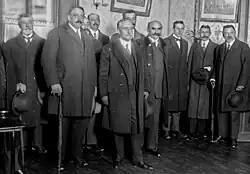
Well again, he refused a quiet old age. He returned to his seats at the two academies. Then he ran for the Senate in Eure-et-Loir. His first public appearance was on 31 December 1920, before the voters. The papers noted the force and clarity of his words: "From the day a cruel illness made me give up the presidency of the Republic, I have lived apart from the world. I wanted my first visit to be for you." On 9 January 1921 the department sent him to Parliament for the tenth time. This time he was a senator.
There he prepared his real comeback: a great public questioning (interpellation) of the government on foreign policy. Poincaré, now head of the government, accepted it at the end of March 1922. The text was published after his death by the Revue des Deux Mondes. It was a hard attack on the way the peace had been made. Four men, he wrote, had taken into their own hands the future "of France, of Europe and of the world". They had shut the door on the smaller allied nations. This went against the very idea of open government by Parliament. The text also answered the British government of Lloyd George, which painted France as a danger to peace. The fear of this speech was great. The Senate's session was closed quickly at the start of April 1922. The speech was put off for months. Deschanel never gave it. He died in Paris on 28 April 1922, of a chest illness that followed an operation. He was sixty-seven.[9]
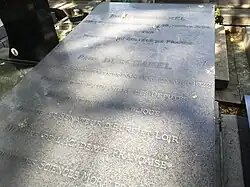
His funeral was on 3 May 1922, with military honors, at the church of Saint-Honoré-d'Eylau. The government was present, with Poincaré, Marshals Foch and Franchet d'Esperey, foreign representatives, and a large, quiet crowd. By his own wish, not one word was spoken over his grave at Montparnasse. One of the great voices of the Republic went to his grave without a single speech.
His voice and his books
His fame came first from his voice. His father, himself a public lecturer, trained him from childhood. His way of speaking was rich and flowery, always carefully prepared. It was at its best on great occasions, and sometimes too much for everyday debates. A paper of 1893 described this child "nursed on eloquence", working in a room watched over by the busts of Chateaubriand and Voltaire. He was a man of letters and a politician in one.
His books follow his two interests. On foreign policy, he published early articles on Talleyrand and Frederick II. Then came La Question du Tonkin (1883), La Politique française en Océanie (1884), and works on French interests in the Pacific. On social questions and government, he published La République nouvelle and La Question sociale, both in 1898, and speeches on local government, mutual help and the reform of government. The war produced La France victorieuse, the collection of his war speeches (1914-1919). The years before his presidency went into his Gambetta. This was the biography of one of the founders of the Republic. In Gambetta he saw a model of eloquence and love of country. The Académie française elected him in 1899 less as a great writer than as the perfect example of the lettered public man of the Third Republic.
His place in history
His place in memory was built backwards. For twenty-five years he was one of the first names of French political life. He led the Chamber in the hardest hours of the Republic. But common memory now keeps another picture. He is the President who fell from a train. He is the man people said was mad. He is the main character of a funny song about a railwayman. At every presidential election, the same stories return, and most of them are false. His whole life is seen through the glass of those seven months of 1920. He had seen the danger himself: the power of ridicule to end a public man. It had ended Mac-Mahon and Félix Faure before him.
Newer work has corrected much of this. Thierry Billard's book calls Deschanel, in its subtitle, a président incompris (a misunderstood president). It took the false stories apart one by one. It gave back the picture of the able man of Parliament, the thinker of a moderate and social Republic, the head of the Chamber in two testing periods (1898-1902 and 1912-1920). The general histories of the Third Republic keep the political meaning of the vote of 1920. By choosing Deschanel instead of Clemenceau, the deputies and senators made a decision. They closed the war years. They returned to the idea of a quiet President. The crisis of September 1920 showed the weak points of that choice. So did the forced resignation of Millerand in 1924. Deschanel stood between two ages: the Republic of men of letters and position, and the democracy of the masses. He is, in the end, a special case: a man who gave his life to winning an office whose weight broke him in a few months. And history keeps, against his wish, the fall more than the long rise.
Important dates
| Date | Event |
|---|---|
| 13 February 1855 | Birth at Schaerbeek (Belgium), among the French republicans sent away after 2 December 1851. |
| 1859 | The family comes back to France. |
| 2 January 1878 | Starts work as sous-préfet of Dreux; then Melun (1879), Brest (1879), Meaux (1881). |
| August 1881 | First attempt at a seat in the Chamber, at Dreux; he does not get it. |
| October 1885 | Gets a seat in the Chamber for Eure-et-Loir; voted in nine times in all, till 1920. |
| 9 June 1898 | Made head of the Chamber of Deputies; keeps the chair till 1902. |
| 1899 | Voted into the Académie française. |
| February 1901 | Marries Germaine Brice; three children will come of the marriage. |
| 1 June 1902 | Léon Bourgeois takes the chair from him. |
| January 1913 | Attempt at the office of President; Raymond Poincaré is made President. |
| 1912-1920 | Head of the Chamber again, through all the Great War. |
| 17 January 1920 | Made President of the Republic with 734 votes, after Georges Clemenceau, who had come second in the test vote the day before, took his name out. |
| Night of 23-24 May 1920 | Fall from the President's train near Montargis, on the way to Montbrison. |
| 10 September 1920 | The event of the basin at Rambouillet. |
| 21 September 1920 | Gives up the office of President. |
| 9 January 1921 | Voted into the Senate by Eure-et-Loir. |
| 28 April 1922 | Death in Paris; last journey on 3 May, resting-place at Montparnasse. |
References
- ↑ The numbers of the votes of 1, 2 and 9 June 1898 come from the newspapers of the time. They are given in Thierry Billard, Paul Deschanel. Le président incompris, Perrin, Tempus, 2022, chapter 7, pages 146-152 (named below: Billard).
- ↑ The numbers of the votes of January 1913 are from Billard. He takes them from the private papers of Alexandre Ribot and of Gheusi.
- ↑ On the vote of January 1920, see Jean-Jacques Becker, Victoire et frustrations, and Billard, chapter 11. The visit of Herriot and Blum is at page 281. The number of 734 votes and the words of Excelsior of 18 January 1920 are given by Billard.
- ↑ The story of the fall comes from Jean Clair-Guyot (Miroir de l'Histoire, March 1953) and Louis Lesueur (Historia, May 1976). It is given again in Billard, chapter 12, together with the government statement read by Millerand.
- ↑ The words given to Clemenceau are not certain: Billard says only that they were put in his mouth, like many others. The newspaper reactions are in the same chapter; the "pajama in the national colors" is at page 308.
- ↑ The statement of 21 September 1920 is printed in Billard, opening pages and chapter 12.
- ↑ The searches in the national archives, under Jean Favier, are given in Billard, chapter 13; see also, by the same writer, "Paul Deschanel : un fou à l'Élysée ?", L'Histoire, April 1988.
- ↑ Gérard Milleret, Une chute peut en cacher une autre, medical thesis, Dijon, 1981; Pierre Rentchnick, Ces malades qui font l'Histoire; the doctor's paper of 10 March 1950; the private diary of the abbé Mugnier, 27 September 1921. All are taken up in Billard.
- ↑ The questioning was accepted by Poincaré in a letter of 30 March 1922. The text was published after his death by the Revue des Deux Mondes, and discussed by Charles Maurras in L'Action française of 14 June 1922. See Billard, chapter 14.
Books used
- Thierry Billard, Paul Deschanel. Le président incompris, Paris, Perrin, Tempus, 2022. The chief book on his life, based on his private papers; it takes the false stories apart.
- Older works named by this book: Jean Mélia, Paul Deschanel, Plon, 1924; Louis Sonolet, La Vie et l'Œuvre de Paul Deschanel, Hachette, 1926; and the paper of Dr Logre on "the Elpenor syndrome" (Le Monde, 1 May 1948), the first medical reading of the fall from the train.
- Jean-Jacques Becker, Victoire et frustrations (1914-1929), Paris, Le Seuil, Points Histoire, 2013. For the vote of January 1920 and the Bloc national.
- Jean-Marie Mayeur, Les Débuts de la IIIe République (1871-1898), Paris, Le Seuil, Points Histoire, 2013; Madeleine Rebérioux, La République radicale ? (1899-1914), Paris, Le Seuil, Points Histoire, 2014. For the political frame of his early years.