Panorpida
| Panorpida | |
|---|---|
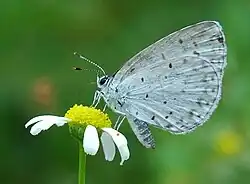 | |
| Celastrina argiolus | |
Scientific classification  | |
| Kingdom: | Animalia |
| Phylum: | Arthropoda |
| Class: | Insecta |
| Clade: | Aparaglossata |
| Superorder: | Panorpida |
| Groups | |
| |
Panorpida (also called Mecopterida) is a group of insects. It is a superorder in the Holometabola.
Scientists think that Panorpida is a natural group (a monophyletic group). This idea was first based on body structure (morphology). For example, many of these insects have a reduced or missing ovipositor. They also share some internal body features and wing structures.[1][2]
More recent studies using DNA (molecular data) also support this idea.[3][4]
Grouping
| Holometabola |
| ||||||||||||||||||||||||||||||||||||||||||||||||
| (Endopterygota) |
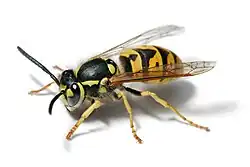
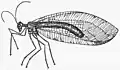

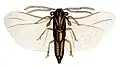

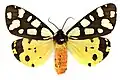
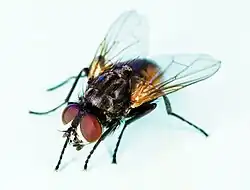
Antliophora
The group Antliophora is not fully understood. Scientists are still studying how its members are related.
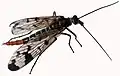
One question is about the group Mecoptera (scorpionflies). It is not clear if this group is complete, or if Siphonaptera (fleas) should be included inside it.[4]
Some earlier studies suggested that fleas are closely related to the group Boreidae (snow scorpionflies).[5][6]
However, newer research suggests they may instead be closer to another group, Nannochoristidae.[7]
Because of this, scientists have suggested different possible evolutionary trees for these insects.
Grouping
(a) Mecoptera is paraphyletic, containing Siphonaptera:
| Antliophora |
| ||||||||||||||||||||||||

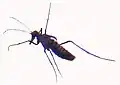
(b) Mecoptera is monophyletic, sister to Siphonaptera:
| Antliophora |
| ||||||||||||||||||||||||
References
- ↑ Kristensen, Niels Peder (1975). "The phylogeny of hexapod "orders". A review". Journal of Zoological Systematics and Evolutionary Research. 13: 1–44. doi:10.1111/j.1439-0469.1975.tb00226.x.
- ↑ Kristensen, Niels Peder (1991). "Phylogeny of extant hexapods". Insects of Australia: 126–140.
- ↑ Grimaldi, David; Engel, Michael S. (2005). Evolution of the Insects. Cambridge University Press. p. 468. ISBN 978-0-521-82149-0.
- 1 2 Kjer, Karl M.; Simon, Chris; Yavorskaya, Margarita; Beutel, Rolf G. (2016). "Progress in insect phylogenetics". Journal of the Royal Society Interface. 13 (121). doi:10.1098/rsif.2016.0363.
- ↑ Whiting, Michael F.; Whiting, Alison S.; Hastriter, Michael W.; Dittmar, Katharina (2008). "A molecular phylogeny of fleas". Cladistics. 24 (5): 677–707. doi:10.1111/j.1096-0031.2008.00211.x.
- ↑ Whiting, Michael F. (2002). "Mecoptera is paraphyletic". Zoologica Scripta. 31 (1): 93–104. doi:10.1046/j.0300-3256.2001.00095.x.
- ↑ Meusemann, Karen; Trautwein, Michelle (2020). "Are Fleas Highly Modified Mecoptera?". bioRxiv. doi:10.1101/2020.11.19.390666.
Other websites

- Minet, J.; Huang, D-T.; Wu, H.; Nel, A. (2010). "Early Mecopterida". Annales de la Société entomologique de France. 46 (1–2): 262–270. doi:10.1080/00379271.2010.10697667.