Palace of Castel Gandolfo
| Palace of Castel Gandolfo | |
|---|---|
| Native name Italian: Palazzo Apostolico di Castel Gandolfo | |
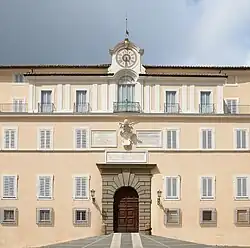 The facade of the Apostolic Palace of Castel Gandolfo in 2015 | |
| Coordinates | 41°44′49.56″N 12°39′1.08″E / 41.7471000°N 12.6503000°E |
| Area | 135-acre |
| Governing body | Holy See |
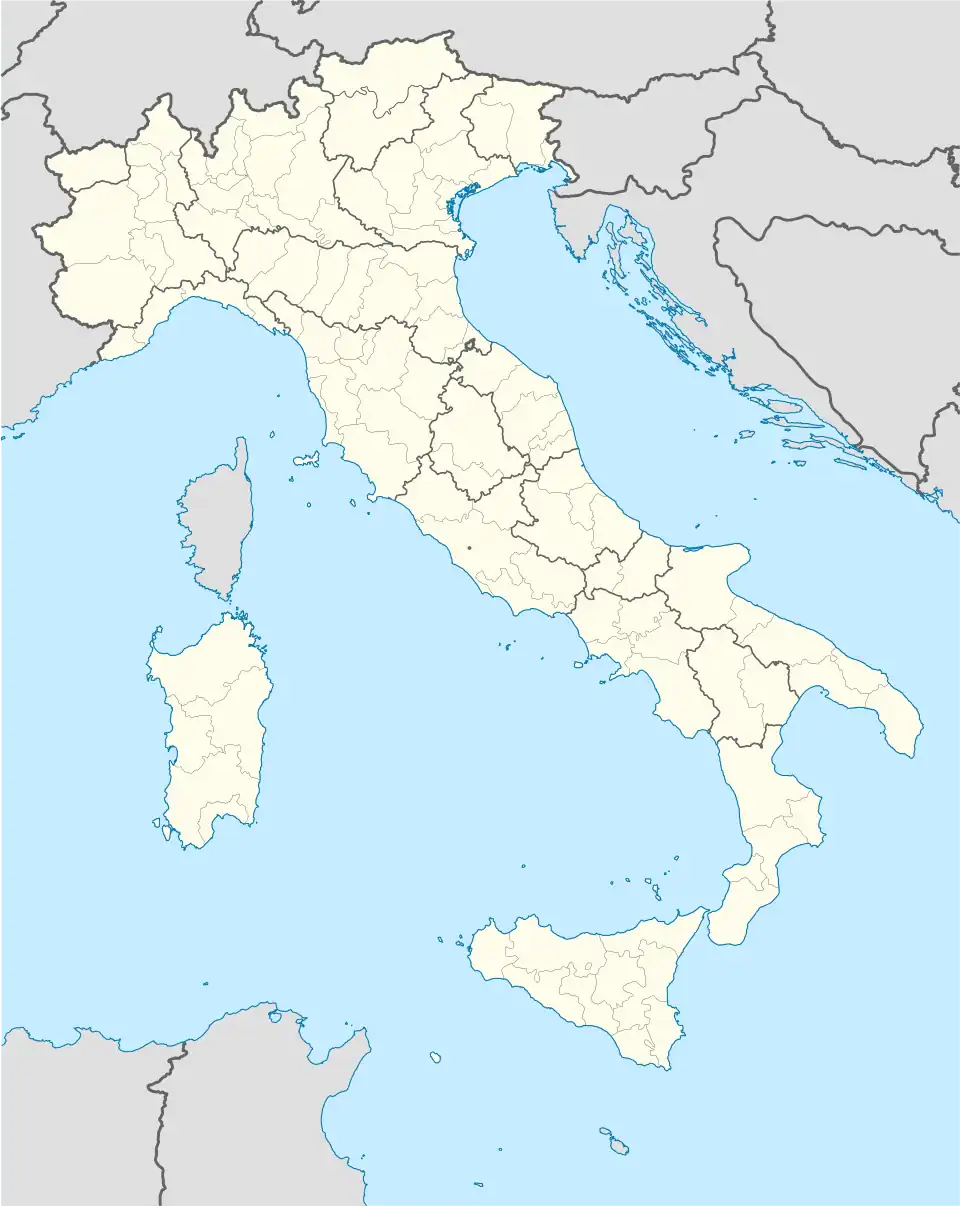  Location of Palace of Castel Gandolfo in Italy | |
The Palace of Castel Gandolfo (Italian: Palazzo Pontificio di Castel Gandolfo) is a historic building belonging to the Catholic Church, a former suburban papal residence and current museum.
It is located inside the extraterritorial zone of the papal villas of Castel Gandolfo, in the Alban Mountains, about twenty kilometers south of Rome. The pontiffs used to travel to Castel Gandolfo at least once a year, in summer.
History
Purchased by the Apostolic Camera in July 1596 and incorporated as an inalienable patrimony of the Holy See on May 27, 1604, the territory of Castel Gandolfo was chosen as a place to spend vacations by many popes starting with Pope Urban VIII, who, shortly after his election as pontiff (1623), undertook the construction of a building on the plot of the Roman villa of Emperor Domitian, probably built in turn on the acropolis of ancient Alba Longa.[1]
Although he was the promoter of its construction, Urban VIII never lived in this palace, preferring to reside in the nearby Villa Barberini, which belonged to his nephew Taddeo Barberini. The first pontiff to vacation there was Pope Alexander VII, who completed the main façade and the western wing of the palace, works on which Gian Lorenzo Bernini worked.
However, starting in 1870, after the end of the Papal States, it was abandoned by the popes, like all the other residences they had outside of Rome, to be "locked up" in the Vatican as a sign of protest against the Italian State.
In 1929, after the creation of Vatican City State, the papal villas of Castel Gandolfo (to which the nearby Villa Barberini was added) were declared a papal extraterritorial domain and with Pius XI the palace of Castel Gandolfo once again became the summer residence of the popes.
Pope Pius XII died at the palace in 1958,[2] as did Pope Paul VI in 1978.[3] Pope John Paul II had a swimming pool built at the palace, which was criticized by some. Paparazzi used the opportunity to take photos of him.[4]
From February 28 to May 2, 2013, Pope Benedict XVI temporarily resided here after resigning from the Petrine ministry.[5] Since April 2014, along with eleven other properties, it obtained the privilege of extraterritoriality and exemption from expropriations and taxes.
On October 21, 2016, by decision of Pope Francis, the palace ceased to be a papal summer residence and became a museum. However, after his death and the beginning of the pontificate of Pope Leo XIV, the palace was once again used as a summer residence.[6][7][8]
References
- ↑ Squires, Nick (23 February 2013). "A rare glimpse inside the remote retreat Pope Benedict XVI is soon to call home". The Telegraph.
- ↑ Cortesi, Arnaldo (9 October 1958). "Pontiff 19 Years" (PDF). New York Times. Retrieved 3 March 2014.
- ↑ Tanner, Henry (7 August 1978). "Election to be Held" (PDF). New York Times. Retrieved 3 March 2014.
- ↑ "Castel Gandolfo: The Colorful History of the Pope's Summer Home". Spiegel.de. Retrieved 19 January 2017.
- ↑ Donadio, Rachel (28 February 2013). "Discord Remains at Vatican as Pope Benedict Departs". New York Times. Retrieved 3 March 2014.
- ↑ "Comunicato della Prefettura della Casa Pontificia". Holy See Press Office. Retrieved 2025-06-17.
- ↑ "Pope Leo XIV to spend summer holidays in Castel Gandolfo - Vatican News". Vatican News. 2025-06-17. Retrieved 2025-06-17.
- ↑ "Press Release from the Prefecture of the Pontifical Household". Holy See Press Office. Retrieved 2025-06-18.