Paca
| Paca[1] | |
|---|---|
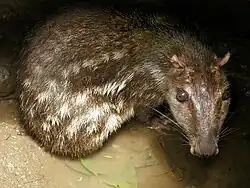 | |
| Lowland paca | |
Scientific classification  | |
| Kingdom: | Animalia |
| Phylum: | Chordata |
| Class: | Mammalia |
| Order: | Rodentia |
| Infraorder: | Hystricognathi |
| Parvorder: | Caviomorpha |
| Superfamily: | Cavioidea |
| Family: | Cuniculidae Miller & Gidley, 1918[2] |
| Genus: | Cuniculus Brisson, 1762[3] |
| Type species | |
| Mus paca Linnaeus, 1766 | |
| Species | |
|
Cuniculus paca | |
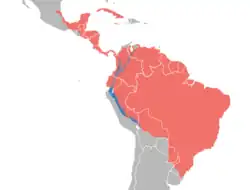 | |
| Cuniculidae distribution. Cuniculus paca in red, Cuniculus taczanowskii in blue (brighter where range does not overlap C. paca). | |
| Synonyms | |
|
For Cuniculidae:
For Cuniculus:
| |
A paca (from Tupí paka[4]) is part of the genus Cuniculus.
There are four species:
- Lowland paca, Cuniculus paca (Agouti paca)
- Mountain paca, Cuniculus taczanowskii
- Dry zone paca, Cuniculus shakilee
- Cuniculus hernandezi[5] (a recent and disputed nomen nudum)[6]
Pacas are found from southern Mexico to northern Argentina. They are a source of meat in many places.
Both species of paca eat mainly fruit. Other foods include roots, seeds, leaves, buds, and flowers. In the wild, pacas are herbivores, meaning they eat only plants. In captivity, they are omnivores, meaning they eat both plants and flesh. Pacas in zoos eat fruits, vegetables, raw meat, lizards, and insects.
References
- ↑ Woods & Kilpatrick 2005
- ↑ Miller & Gidley 1918
- ↑ Brisson 1762
- ↑ Simpson, George Gaylord (February 1941). "Vernacular Names of South American Mammals". Journal of Mammalogy. 22 (1): 6. doi:10.2307/1374677. JSTOR 1374677.
- ↑ Castro, López & Becerra 2010
- ↑ Ramírez–Chaves, Héctor E.; Solari, Sergio (2014). "Sobre la disponibilidad del nombre Cuniculus hernandezi Castro, López y Becerra, 2010 (Rodentia: Cuniculidae)" [On the availability of the name Cuniculus hernandezi Castro, López, and Becerra, 2010 (Rodentia: Cuniculidae)]. Actualidades Biológicas (in Spanish). 36 (100): 59–62. doi:10.17533/udea.acbi.329110. S2CID 128367062.
Sources
- Brisson, Mathurin Jacques (1762). Regnum Animale in classes IX distributum, sive synopsis methodica. Retrieved 3 March 2013.
- Castro, José J; López, Juan Bautista; Becerra, Francisco (2010). "Una nueva especie de Cuniculus (Rodentia: Cuniculidae) de la Cordillera Central de Colombia". Rev. Asoc. Col. Cienc.(Col.). 22: 122–131. Retrieved 3 March 2013.
- Grzimek, Bernhard (2003). Hutchins, Michael; Kleiman, Devra G; Geist, Valerius; et al. (eds.). Grzimek's Animal Life Encyclopedia, Vol 16, Mammals V (2nd ed.). Farmington Hills, MI: Gale Group. ISBN 0-7876-5362-4.
- Miller, G.S. Jr.; Gidley, J.W. (1918). "Synopsis of the supergeneric groups of rodents". Journal of the Washington Academy of Sciences. 8: 431–48. doi:10.5962/bhl.part.6490.
- Ríos-Uzeda, Boris; Wallace, Robert B; Vargas, Julieta (2004). "La Jayupa de la altura (Cuniculus taczanowskii, Rodentia, Cuniculidae), un nuevo registro de mamífero para la fauna de Bolivia". Mastozoología Neotropical. 11 (1). ISSN 1666-0536. Retrieved 3 March 2013.
- Woods, C. A.; Kilpatrick, C. W. (2005). "Infraorder Hystricognathi". In Wilson, D. E.; Reeder, D. M. (eds.). Mammal Species of the World (3rd ed.). Johns Hopkins University Press. pp. 1538–1600. ISBN 978-0-8018-8221-0. OCLC 62265494. Retrieved 3 March 2013.
Other websites
- Gibnuts at Crooked Tree Wildlife Sanctuary