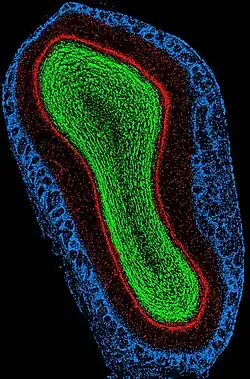
The olfactory bulb has one source of sensory input (axons from olfactory receptor neurons, and one output (mitral cell axons). It is thought that it functions as a filter. However, the olfactory bulb also gets "top-down" information from brain areas like the amygdala, neocortex, hippocampus, locus coeruleus, and substantia nigra.[1][2]
Its range of functions probably include:
discriminating between odors
enhancing sensitivity of odor detection
filtering out background odors
permitting higher brain areas involved in arousal and attention to modify the detection or discrimination of odors.
References
↑Scott, J. W.; Wellis, D. P.; Riggott, M. J.; Buonviso, N. (1993). "Functional organization of the main olfactory bulb". Microscopy Research and Technique. 24 (2): 142–156. doi:10.1002/jemt.1070240206. PMID8457726.
↑Linster, Christiane; Cleland, Thomas A. (2013). "Spatiotemporal Coding in the Olfactory System". 20 Years of Computational Neuroscience. pp.229–242. doi:10.1007/978-1-4614-1424-7_11. ISBN978-1-4614-1423-0.