Oakland Alameda Coliseum
The Coliseum, Oakland Coliseum | |
 | |
  | |
| Former names | Oakland–Alameda County Coliseum (1966–1998, 2008–2011, 2016–present) Network Associates Coliseum (1998–2004) McAfee Coliseum (2004–2008) Overstock.com Coliseum (May 2011) O.co Coliseum (2011–2016) |
|---|---|
| Location | 7000 Coliseum Way Oakland, California 94621 |
| Coordinates | 37°45′6″N 122°12′2″W / 37.75167°N 122.20056°W |
| Capacity | 46,837 (standing room to 56,782) |
| Field size | Left Field – 330 feet (101 m) Left-Center – 367 feet (112 m) Center Field – 400 feet (122 m) Right-Center – 367 feet (112 m) Right Field – 330 feet (101 m) Backstop – 60 feet (18 m) |
| Surface | Bluegrass |
| Construction | |
| Started | April 15, 1964[1] |
| Opened | September 18, 1966 |
| Renovated | 1995-1996 |
| Construction cost | $25.5 million ($213 million in 2026 dollars[2]) $200 million (1995-1996 renovation) ($346 million in 2026 dollars[2]) |
| Architect | Skidmore, Owings and Merrill HNTB (1995-1996 renovation) |
| Structural engineer | Ammann & Whitney[3] |
| Services engineer | Syska & Hennessy, Inc.[4] |
| Tenants | |
| Oakland Athletics (MLB) (1968–present) Oakland Raiders (AFL / NFL) (1966–1981, 1995–2019) Oakland Invaders (USFL) (1983–1985) Oakland Clippers (NPSL/NASL) (1967–68) Oakland Stompers (NASL) (1978) San Jose Earthquakes (MLS) (2008–2009)[5] | |
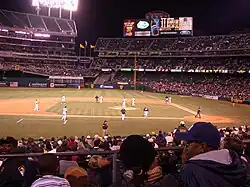
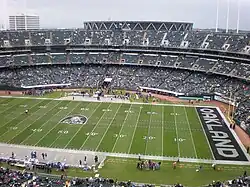
Oakland–Alameda County Coliseum (commonly called Oakland Coliseum) is a stadium in Oakland, California. The stadium is a multi purpose stadium.This means it can be used to play different sports. The stadium was used as the home field for the Oakland Raiders of the National Football League[6] before they moved to Las Vegas. The stadium was used by the Oakland Athletics of Major League Baseball until the 2025 season.[6]
On December 15, 2019, the Raiders played their final game at Oakland Coliseum. They would lose to the Jacksonville Jaguars 20–16.[7] The team would move to Las Vegas the next season.[8]
The Athletics will also relocate to Las Vegas in 2028 when their 33,000 seat domed ballpark is finished being built.[9][10]
The stadium first opened in 1966.[11] It can seat more than 55,000 people for football games. It seats 45,000 when it is used for baseball.[12]
References
- ↑ "Oakland Raiders Fan Guide". Raiders.com. Archived from the original on 2018-05-11. Retrieved 2013-07-16.
- 1 2 1634–1699: McCusker, J. J. (1997). How Much Is That in Real Money? A Historical Price Index for Use as a Deflator of Money Values in the Economy of the United States: Addenda et Corrigenda (PDF). American Antiquarian Society. 1700–1799: McCusker, J. J. (1992). How Much Is That in Real Money? A Historical Price Index for Use as a Deflator of Money Values in the Economy of the United States (PDF). American Antiquarian Society. 1800–present: Federal Reserve Bank of Minneapolis. "Consumer Price Index (estimate) 1800–". Retrieved April 16, 2022.
- ↑ "Oakland-Alameda County Coliseum Complex". Engineering News-Record. 179 (2). McGraw-Hill: 13. 1967. Retrieved February 8, 2013.
- ↑ "Sports" (PDF). Syska Hennessy Group. Archived from the original (PDF) on May 20, 2011. Retrieved February 8, 2013.
- ↑ "Official statements concerning the cancellation of gr and prix arizona". Archived from the original on September 27, 2007. Retrieved September 15, 2007.
- 1 2 Cheryl Crabtree; Daniel Magnin; et al. Fodor's 2013 California (New York: Fodor's, 2013), p. 501
- ↑ "Jaguars spoil final Oakland game with 20-16 win over Raiders". ESPN. Retrieved January 10, 2024.
- ↑ "NFL owners approve Raiders' move to Las Vegas". National Football League. Retrieved January 10, 2024.
- ↑ "Where will A's play before Las Vegas move? Five options as team plans 'revolving group' of home stadiums". CBS Sports. Retrieved November 27, 2023.
- ↑ "Owners' vote approves A's relocation to Las Vegas for 2028". Major League Baseball. Retrieved November 16, 2023.
- ↑ James T. Bennett, They Play, You Pay: Why Taxpayers Build Ballparks, Stadiums, and Arenas for Billionaire Owners and Millionaire Players (New York, NY: Copernicus Books, 2012), p. 102
- ↑ Lyle Spatz, Historical Dictionary of Baseball (Lanham, MD: Scarecrow Press, Inc., 2013), p. 252
Other websites

- Stadium site on oaklandathletics.com Archived 2014-11-29 at the Wayback Machine
- Official Site