Neo-Mu'tazilites
Neo-Mu'tazilites (Arabic: المعتزلة الجدد), also called Neo-Mu'tazila, are modern Muslims inspired by the principles of the classical Mu'tazila school of theology, which flourished under the Abbasid caliphs al-Ma'mun, al-Mu'tasim, and al-Wathiq.[1] Neo-Mu'tazilism stands in relation to the "renaissance" (Nahda) of the Arab world and to modern Islamic reformism, which opposes Islamic conservatism, taqlid of the earlier generations, and fatalism.[2] Neo-Mu'tazilites emphasise the possibility of freedom in the face of divine omnipotence and rational notions of good and evil.[3]
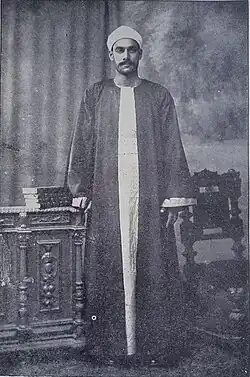
Like their classical predecessors, Neo-Mu'tazilites emphasize the use of reason ('aql) in interpreting Islamic scripture. Their understanding of Islamic scripture has included de-emphasising the authoritative value of Islamic tradition, such as hadith and the idea of ijma (consensus), and widening the use of ijtihad (independent reasoning).[5][6][7][8][9] They also uphold the core historical Mu'tazilite tenet that the Qur'an is God's "created" word and not uncreated or co-eternal with God, in contrast to Sunni theology.[10][11][12]
Around the world
In the modern period, Neo-Mu'tazilism has developed in various regions, such as in the Maghreb, Turkey, Iran, France, India, and Indonesia.[7][13][14][15][16][17]
Neo-Mu'tazilites form the main composites of the Indo-Pakistan Muslim society today, alongside Barelvis, Deobandis, and Ahl al-Hadith.[18]
Notable individuals
Notable neo-Mu'tazilites:
- Syed Ahmad Khan (d. 1898 CE).[7] Syed's reformist program included a rationalist, neo-Mu'tazilite understanding of Islamic scripture, questioning much of the corpus of Hadith as either apocryphal or relevant only to prophet Muhammad's day and age, rejecting the validity of ijma, broadening the horizon of ijtihad, and interpreting Biblical scripture from a sympathetic Muslim point of view (see Muslim Hebraism).[7]
- Ahmad Amin (d. 1954 CE), a chief proponent of neo-Mu'tazilism in Egypt.[19] He described the main principles of Mu'tazilism and was critical of hadith. He was known for his rationalist approach to the Qur'an and Sunnah, and he proposed Mu'tazilism in his famous trilogy: Fajr al-Islam (The Dawn of Islam), Duha al-Islam (The Morning of Islam), and Zuhr al-Islam (The Noon of Islam).[20]
- Dr. Taj Hargey, a British imam who founded the Open Mosque in Cape Town, South Africa. He identifies as a freethinker and promotes a "new Mu'tazilism". He supports a liberal form of Islam and rejects hadith.[21][22]
See also
References
- ↑ https://namibian-studies.com/index.php/JNS/article/download/1524/1133/3156
- ↑ Neuwirth, Angelika; Pflitsch, Andreas (1998). Crisis and Memory in Islamic Societies: Proceedings of the Third Summer Academy of the Working Group Modernity and Islam Held at the Orient Institute of the German Oriental Society in Beirut. Ergon Verlag in Kommission. ISBN 978-3-515-07510-7.
- ↑ Research in African Literatures. African and Afro-American Studies and Research Center, University of Texas [at Austin]. 1992.
- ↑ Islamic Studies. Islamic Research Institute. 1976.
- ↑ Moussa, Mohammed (2015-06-29). "The Neo-Modernity of Soroush – Mohammed Moussa". Critical Muslim. Retrieved 2026-01-26.
- ↑ https://www.mdpi.com/2077-1444/13/3/234
- 1 2 3 4 "Sayyid Ahmad Khan". mrmo.org.
- ↑ "The new Shi'i thinkers | Cairn.info". shs.cairn.info.
- ↑ "Le néo mutazilisme". France Culture (in French). 2019-10-13. Retrieved 2026-01-26.
- ↑ http://www.drsoroush.com/English/Interviews/E-INT-Neo-Mutazilite_July2008.html
- ↑ Abdullah Saeed. The Qur'an: an introduction. 2008, page 203
- ↑ Kadri, Sadakat (2012). Heaven on Earth: A Journey Through Shari'a Law from the Deserts of Ancient Arabia to the Streets of the Modern Muslim World. macmillan. p. 77. ISBN 9780099523277. Archived from the original on 2021-02-25. Retrieved 2015-09-16.
- ↑ Byrd, Anthony Robert (27 November 2007). A Euro-American 'Ulama? Mu 'tazilism, (Post)Modernity, and Minority Islam. Archived from the original on 8 March 2021. Retrieved 4 June 2020.
- ↑ Van Ess, Joseph (2005). Jones, Lindsay (ed.). Encyclopedia of Religion. Vol. 9 (2nd ed.). Detroit: Macmillian Reference USA. p. 6322.
- ↑ https://shs.cairn.info/journal-etudes-2023-5-page-83?lang=en
- ↑ "Mutazilisme". mutazilisme.fr (in French). Archived from the original on 22 December 2017. Retrieved 23 July 2018.
- ↑ Harun Nasution, "The Mu'tazila and Rational Philosophy' translated in Defenders of Reason in Islam by Martin et al., pp.191-92.
- ↑ Muztar, A. D. (1979). Shah Wali Allah: A Saint-scholar of Muslim India. National Commission on Historical and Cultural Research.
- ↑ Islamic Studies. Islamic Research Institute. 1976.
- ↑ https://www.mdpi.com/2077-1444/13/3/234
- ↑ https://books.google.co.uk/books?id=8eSKDwAAQBAJ&pg=PT204&dq=Dr.+Hargey+rejects+the+Hadith&hl=en&newbks=1&newbks_redir=0&source=gb_mobile_search&sa=X&ved=2ahUKEwiNwr6SwJSTAxXiQEEAHRxjPS4Q6AF6BAgPEAM#v=onepage&q&f=false
- ↑ https://freethinker.co.uk/2023/11/britains-liberal-imam-interview-with-taj-hargey/