Muslim Hebraists
Muslim Hebraists (Arabic: المُسْتَعْبِرونَ المُسْلِمُونَ, romanized: al-mustaʿbirūn al-muslimūn) are Muslims who use the Tawrat and the Injil to interpret the Qur'an. They study what many Jews and Christians call the Bible, and sometimes early non-canonical writings. This is because the Qur'an says the Tawrat, the Zabur, and the Injil were revealed by Allah.[1][2] Some Bible scholars call these Muslims "Biblical Muslims," but they call themselves simply Muslim.[3]
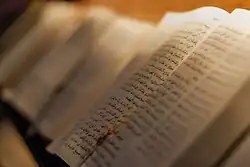
Muslim Hebraists use stories and ideas from the Bible when they write Qur'anic commentary (tafsir).[4][5][6] They often look at places where the Qur'an mentions a story from the Bible but does not give many details.[7] This is different from orthodox scholarly practice, which only uses the Bible for polemic or apologetic purposes. Orthodox scholars believe earlier scriptures were changed.[8][9][10] Biblical Muslims may also engage in group Bible study.[11]
Muslim Hebraists such as al-Biruni and al-Biqa'i made use of Arabic translations of the Hebrew Bible, the Old Testament, and the New Testament, while Syed Ahmad Khan made use of Urdu translations of the Bible. The Islamic method known as tafsir al-Qur'an bi-l-Kitab (Arabic: تفسير القرآن بالكتاب) refers to interpreting the Qur'an through the Bible.[2] This method uses canonical Arabic versions of the Bible to give more meaning and background to Qur'anic verses.[12]
Name
Aside from Muslim Hebraists, Muslims who use the Bible to gain insights for their faith and to help interpret the Qur'an are sometimes called "Biblical Muslims" by Bible scholars. They are also called "Sub-biblical Muslims" or "Messianic Muslims", but they call themselves simply Muslim.[13][14]
History
In the early centuries of Islam, Muslims often used the Bible to support Islamic ideas.[16] Al-Biqa'i argued that using the Torah and the Gospels is an old and respected Islamic practice, and that the Qur'an, the Islamic prophet Muhammad, the early generation of Muslims, and leading scholars in every age referred to these scriptures.[17]
Ubayy ibn Ka'b, a companion of Muhammad, was praised by Muhammad. He was known for his strong knowledge of the Torah, the Gospel, and the Qur'an.[18]
Ka'b al-Ahbar, a Jewish man from Yemen who became a Muslim, also taught Jewish traditions. He explained verses of the Qur'an by linking them to the Torah. He even taught the Torah in the mosque of Medina.[19] Many companions of Muhammad asked Ka'b about the meaning of Qur'anic verses. These companions included Umar ibn al-Khattab, Ali ibn Abi Talib, Abu Hurayra, Mu'awiya I, and Ibn Abbas.[20] Ka'b was sometimes called "the owner of the two books" because he used both the Qur'an and the Bible. He was also paid as a preacher during the rule of Caliph Uthman.[21]
Early Muslim transmitters of Islamo-Biblica included Wahb ibn Munabbih and Mujahid ibn Jabr al-Makki. Mujahid collected Abrahamic materials to help explain the Qur'an.[22]
One of the earliest Muslim authors to use Biblical material in Arabic translation was al-Jahiz. He was a Mu'tazilite thinker. In his work Al-Radd 'alā al-Naṣārā, he said that the Hebrew Bible was trustworthy and more reliable than the Christian Gospels. He also rejected Jewish translations of the Old Testament when Christians used them to argue that Jesus was the literal Son of God. Al-Jahiz said that the parts of these translations that made God seem human came from poor translation, not from the original text. He accepted the Old Testament as valid in principle, and for him the Tawrat referred to the entire Tanakh/Old Testament, not only the five books of Moses.[23]
The Fatimids who were Shia Ismailis used the Bible not to reach out to Jews or Christians but to affirm the legitimacy of their beliefs. They used Biblical testaments to show other believers that they possessed secret knowledge unknown to other Muslims. Some Ismaili scholars referred to the Bible in order to refute Twelver Shias and non-Ismaili jurists.[24]
In the 11th century CE, Muslim writers began to focus much more on the idea that the Bible had been changed. This view became well-known mainly because of Ibn Hazm. Even so, some Muslims continued to use the Bible and still saw value in it.[25] At the same time, the famous Muslim philosopher and doctor Ibn Sina disagreed with Ibn Hazm. He wrote that it was impossible for the Bible to have been changed in the way some people claimed.[26] By the 14th century CE, the belief that the Bible had been textually corrupted had become the majority view among Muslims.[27]
Al-Biqa'i was a Muslim Hebraist in the Mamluk period.[28] He made use of Arabic translations of the Hebrew Bible and the Gospels.[29][30][31] He believed that Muslims were allowed to use the Torah and the Gospel to help explain the Qur'an, and he said that quoting earlier scriptures was permitted in Islamic law. Al-Biqa'i used the Hebrew Bible and the New Testament to make some Qur'anic verses clearer.[6][32][33][2] He often pointed to the Ten Commandments and quoted the parables of Jesus to show Jesus' wisdom and his role as a prophet.[6] He also made his version of a Diatessaron, which is a single story created by combining the four Gospels. His version mostly followed the Gospel of Matthew.[34][35] He especially praised the Book of Jeremiah.[36]
Al-Biqa'i believed that Muslims could quote earlier revelations only when talking about stories from the past.[5] He taught that the Torah and the Gospel should be used only for this purpose. When he explained the Qur'an, he relied mainly on logic and clear reasoning.[5][32][33]
Al-Biqa'i criticized those who believed that most or all of the Bible was corrupted, calling their view extreme and arrogant. He himself believed that only a small part of the Bible had been changed. For him, the unchanged parts of the Bible were equal in value to the Qur'an, while the corrupted parts were like weak or unreliable hadith.[6] Al-Biqa'i used Bible passages that he believed agreed with the Qur'an to explain Qur'anic stories, such as the story of Noah's flood. But he rejected parts of the Bible that he believed disagreed with the Qur'an, such as the Torah's version of Abraham's sacrifice.[37]
Important thinkers who influenced al-Biqa'i's work included al-Haralli and al-Asbahani.[38] Al-Biqa'i also defended the use of the Gospels and the Torah by saying that the Muslim community had silently accepted this practice. He explained that quoting earlier scriptures had become common in the Muslim world, and that this silent acceptance was a form of ijma' sukuti (silent agreement). He pointed to many Qur'an commentaries that used quotations from earlier scriptures. These included Tafsir al-Kashshaf by al-Zamakhshari and Tafsir al-Kabir by Fakhr al-Din al-Razi.[5]
The Brethren of Purity (Ikhwan al-Safa) were a secret society active in Basra and Baghdad in the late 10th century CE. In their Epistles, they used not only the Qur'an but also the Torah and the Gospels. They treated these earlier scriptures as almost the same as the Qur'an. They quoted the Hebrew Bible, used Rabbinic stories, and also had some knowledge of the New Testament. They recommended reading the Abrahamic scriptures and the Injil, because they said these books came from angelic and divine inspiration. Because of their textual legacy, many scholars hold the Brethren to be freethinkers who transcended sectarian divisions among Muslims (see: non-denominational Muslims).[39][40][41]
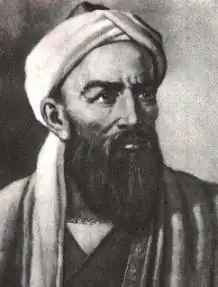
Al-Biruni has been called the "greatest Muslim Hebraist" by historian Walter J. Fischel.[15] He made use of Arabic translations of the Old Testament and the New Testament, as well as other Jewish and Christian writings.[15][42] He believed the Hebrew Bible was comparatively free from confusion whereas the Greek Septuagint is garbled to a greater extent.[43]
Al-Biruni spoke of three versions of the Torah: the original Hebrew Torah used by Jews, the Greek Septuagint used by Christians, and the Torah of the Samaritans.[44] In his book "Chronology of Ancient Nations", he quoted from books like Exodus, Leviticus, and Deuteronomy, saying they contained God’s commands and words.[45] At the same time, he criticized some Christian readings of the Bible, such as their interpretation of Daniel 9:24–27. He rejected both Jewish and Christian interpretations about messianic prophecies.[46]
Al-Biruni said that translating the Jewish scriptures from Hebrew into Syriac, such as in the Peshitta, changed the meaning of some words. He believed these changes were intentional.[47] He noted the differences between the four Gospels and described how Christians tried to explain the different family lines of Jesus in the Gospel of Matthew and the Gospel of Luke. He also mentioned other Gospels used by groups like the Marcionites, Bardesanites, and Manicheans. He said that the contradictions in these texts made them unreliable.[48]
Because of these issues, al-Biruni trusted the Torah more than Christian sources, since the Christian texts had gone through more translation.[49] Even so, he believed the existing Gospels still contained real parts of the original Injeel and could be used as historical sources. He quoted and paraphrased Gospel passages, including from Matthew and the Gospel of John. One example he gave was a saying attributed to Jesus: "Do not mind the anger of kings when you speak the truth to them. They control only your body, not your soul."[50]
Al-Biruni rejected beliefs that he saw as unacceptable to Muslims, but he also criticised unfair attacks on other religions, including Christianity. Although he disagreed with the Trinity, he believed that the Torah and the Gospel used the words "father" and "son" in both a metaphorical and a literal way.[51]
According to Yasir Qadhi, al-Biruni was "not pro-Hadith" and was "sceptical of Hadith". His analysis of the famous hadith about the 10th of Muharram (Ashura) is a clear example: using calendrical calculations and scientific examination, he argued that the 10th of Muharram could not have coincided with the Jewish Day of Atonement (Yom Kippur) at the time of Muhammad's migration to Medina, and therefore deemed the hadith unauthentic despite its presence in Sahih al-Bukhari.[52][53]
Stories from the Hebrew Bible were popular among the Iberian Peninsula's Jews, Christians, and Muslims. Beginning in the 14 century CE, Muslims and Moriscos retold these stories in Aljamiado texts in Spanish or Aragonese written in Arabic characters. These retellings exalted Islamic beliefs, traditions, rituals, and doctrines.[54]
One important example is the Aljamiado adaptation of Muhammad al-Qaysi. This Aljamiado version expresses a distinctly Islamic view of revelation when it states that "the Torah and the Gospels do not oppose each other because the book of God is all one and true." According to the Aljamiado adaptation, Christians read the books sent by God, but they do not understand them. The misunderstanding of the Scriptures lies at the basis of the Christians' heresy, which is most heinous to Muslims.[55][56]
Modern period
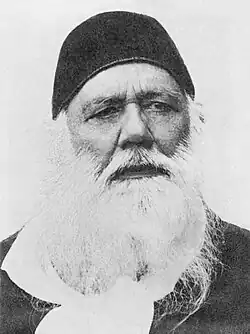
Modern Muslim Hebraists, such as Syed Ahmad Khan, explicitly reject the wholesale concept of tahrif by upholding the divine origin and considerable integrity of the Tawrat and the Injil. They interpret these scriptures sympathetically alongside the Qur'an, a stance that counters narratives of total corruption.[58]
Syed wrote a Muslim commentary on the Tawrat and the Injil called Tabyin al-Kalam in Urdu. In this work, he taught that the Tawrat, the Injil, and the Qur'an all come from God. He also used Kalam (Islamic rational theology) to discuss and explain perceived contradictions between the Qur'an and earlier scriptures, especially the Book of Genesis and the Gospel of Matthew. Although the work had an important influence on Muslim–Christian relations, its impact was mostly limited to educated and elite groups.[59][60][61]
Syed's reformist program included a rationalist, neo-Mu'tazilite understanding of Islamic scripture, questioning much of the corpus of hadith as either apocryphal or relevant only to prophet Muhammad's day and age, rejecting the validity of ijma (consensus), broadening the horizon of ijtihad (independent reasoning), and interpreting Biblical scripture from a sympathetic Muslim point of view.[62]
The Zumratul Jamiu Mumin (ZJM) is a society in Nigeria that regards only the Qur'an and the Bible as sacred books of Allah for determining religious matters. To them, the use of hadith is an aberration. The group numbers in the thousands and occupies a specific "Islamic City" settlement in the Ogun State.[63][64]
A similar group in Nigeria is the Isawa, who reject hadith and all established Muslim traditions and instead preach that the Qur'an alone and the Christian scriptures should be the foundations of a Muslim's faith.[65][66][67]
In the 21st century CE, many scholars have studied how the Qur'an and the Bible are connected. More Muslim scholars who study the Bible, such as Abdullah Saeed, Jerusha Lamptey, Farid Esack, and Abdulla Galadari, say that the main ideas of Islam can also be found in earlier holy books. Because of this, they accept the Tawrat, the Injil, the Zabur, and the Scrolls of Abraham as true, important, and still meaningful today.[68][69]
Galadari's method of understanding the Qur'an looks at intertextual polysemy, which means that one Arabic word can have several related meanings in different places. By studying these meanings, he shows how the Qur'an refers to itself and also to the Bible. For example, his method helps explain how the Qur'anic verses about the Qibla (the direction of prayer) are directly connected to the Shema passages in the Book of Deuteronomy and to later Talmudic commentary.[70][71]
Some modern Muslims who believe in the harmony of the Injil and the Qur'an say that the Gospel of Thomas, unearthed in Egypt in 1945 CE, is the Injil mentioned in the Qur'an. They do not believe that the gospels written by the New Testament apostles are the Injil. They point out similarities in ideas, wording, and style between the Gospel of Thomas and the Qur'an. They also highlight important connections between key words in both texts. The Gospel of Thomas was once seen as a "lost holy book." It is one of the early non-canonical writings that were not included in the later Christian Bible.[72][73]
Influence
Although Muslim Hebraism was never very widespread, it played an important and often overlooked role in early Islamic thought, especially in the 7th and 8th centuries CE.[74]
According to some writers, Muslim Hebraism contributed to major heterodox developments within both Islamic and Jewish scholarly traditions in early Islam, particularly in Khorasan.[75]
Notable individuals
Notable Muslim mufassirun (commentators) or philosophers of the Bible and Qur'an who have weaved biblical texts together with Qur'anic ones:
- Ubayy ibn Ka'b (d. 649 CE), a companion of the Islamic prophet Muhammad[76]
- Ka'b al-Ahbar (d. 652/656 CE), a Yemenite Jew who converted to Islam and lived during the Rashidun Caliphate[77]
- al-Biruni (d. 1052 CE), an Iranic polymath[15]
- Ibrahim ibn Umar al-Biqa'i (d. 1480 CE), a scholar during the Mamluk Sultanate[78]
- al-Jahiz (d. 868 CE), a polymath and Mu'tazilite theologian who lived during the Abbasid Caliphate[79]
- Hamid al-Din al-Kirmani (d. 1021 CE), an Isma'ili Shia scholar who lived during the Fatimid Caliphate[80][81]
- Abu al-Jald al-Jauni (d. 718 CE), a Judaeo-Muslim preacher and Shia Akhbari from Basra[82]
- Abu al-Hakam Abd al-Salam bin al-Isbili of al-Andalus (d. 1141 CE)[83][84][85]
- Shams al-Din al-Daylami (d. 1197 CE)[86]
- the Brethren of Purity[87][88]
- Yusuf bin Hilal al-Safadi (d. 1296 CE)[89]
- Ibn Qutaybah (d. 889 CE), a Persian scholar who served as a judge during the Abbasid Caliphate[90]
- Abdülvasi Çelebi (d. 1415 CE), a scholar during the Ottoman Caliphate[91]
- Syed Ahmad Khan (d. 1898 CE), a Muslim modernist and Neo-Mu'tazilite from India[92][93][94]
- Abdulla Galadari, an Emirati scholar who focuses on Qur'anic hermeneutics[95]
See also
External links
References
- ↑ Saleh, Walid A. (2008). "A Fifteenth-Century Muslim Hebraist: Al-Biqāʿī and His Defense of Using the Bible to Interpret the Qurʾān". Speculum. 83 (3): 629–654. doi:10.1017/S0038713400014615.
- 1 2 3 McCoy, R. Michael (2021-09-08). Interpreting the Qurʾān with the Bible (Tafsīr al-Qurʾān bi-l-Kitāb). Brill. ISBN 978-90-04-46682-1.
- ↑ https://www.scribd.com/document/870899596/Biblical-Muslims
- ↑ Christian W. Troll. "Bible and Qur'an in Dialogue" (PDF). www.sankt-georgen.de.
- 1 2 3 4 Umar Albiqa’i, Ibrahim (June 1, 2023). "Embrassing previous traditions through intertextual interpretation". Universitas Islam Negeri Sunan Ampel Surabaya. 13 – via NOMOR.
- 1 2 3 4 "A Fifteenth-Century Muslim Hebraist: Al-Biqā'ī and His Defense of Using the Bible to Interpret the Qur'ān". ResearchGate.
- ↑ https://www.researchgate.net/publication/290776048_The_Qur'an_and_its_Biblical_Subtext
- ↑ Dayeh, Islam (2008). "In Defense of the Bible: A Critical Edition and an Introduction to al-Biqāʿī's Bible Treatise. by Walid Saleh. Brill: Leiden & Boston, 2008. Pp. 224 + viii. € 99.00 / US$ 147.00". Journal of Qur'anic Studies. 10 (2): 101–106. doi:10.3366/E146535910900045X.
- ↑ "Early Muslims and the Bible | Bible Interp".
- ↑ https://www.scribd.com/document/870899596/Biblical-Muslims
- ↑ https://www.scribd.com/document/870899596/Biblical-Muslims
- ↑ "Preface". Interpreting the Qurʾān with the Bible (Tafsīr al-Qurʾān bi-l-Kitāb). Brill. 8 September 2021. ISBN 978-90-04-46682-1.
- ↑ Saleh, Walid A. (2008). "A Fifteenth-Century Muslim Hebraist: Al-Biqāʿī and His Defense of Using the Bible to Interpret the Qurʾān". Speculum. 83 (3): 629–654. doi:10.1017/S0038713400014615.
- ↑ https://www.scribd.com/document/870899596/Biblical-Muslims
- 1 2 3 4 Khanbaghi, Aptin (22 February 2006). The Fire, the Star and the Cross: Minority Religions in Medieval and Early Modern Iran. Bloomsbury. ISBN 978-0-85771-266-0.
- ↑ "Early Muslims and the Bible | Bible Interp".
- ↑ Dayeh, Islam (2008). "In Defense of the Bible: A Critical Edition and an Introduction to al-Biqāʿī's Bible Treatise. by Walid Saleh. Brill: Leiden & Boston, 2008. Pp. 224 + viii. € 99.00 / US$ 147.00". Journal of Qur'anic Studies. 10 (2): 101–106. doi:10.3366/E146535910900045X.
- ↑ "Ubayy bin Ka'b (R.a.) » Questions on Islam".
- ↑ Porter, Stanley E. (24 January 2007). Dictionary of Biblical Criticism and Interpretation. Routledge. ISBN 978-1-134-63557-3.
- ↑ Kusuma, Hamdan Hadi; Ahmad, Nur; Zaki, Nasrul Fahmi; Rahim, Robbi (14 October 2020). ICON-ISHIC 2020: Proceedings of the First International Conference on Islamic History and Civilization, ICON-ISHIC 2020, 14 October, Semarang, Indonesia. European Alliance for Innovation. ISBN 978-1-63190-289-5.
- ↑ https://www.encyclopedia.com/religion/encyclopedias-almanacs-transcripts-and-maps/kab-al-ahbar
- ↑ https://hurqalya.ucmerced.edu/node/704
- ↑ Gibson, Nathan P. (2017). "A Mid-Ninth-Century Arabic Translation of Isaiah? Glimpses from al-Jāḥiẓ". Senses of Scripture, Treasures of Tradition. pp. 325–369. doi:10.1163/9789004347403_015. ISBN 978-90-04-34740-3.
- ↑ https://books.google.co.uk/books?id=lhMrEAAAQBAJ&pg=PA107&dq=Fatimids+used+the+Bible+to+affirm+the+legitimacy+of+their+beliefs.&hl=en&newbks=1&newbks_redir=0&source=gb_mobile_search&sa=X&ved=2ahUKEwjWuZKf4KuTAxVM3AIHHY13EKoQ6AF6BAgHEAM#v=onepage&q&f=false
- ↑ "Handling Muslim Objections, Part 1: "The Bible Has Been Corrupted"". 3 January 2024.
- ↑ "Handling Muslim Objections, Part 1: "The Bible Has Been Corrupted"". 3 January 2024.
- ↑ "Early Muslims and the Bible | Bible Interp".
- ↑ https://www.researchgate.net/publication/231937216_A_Fifteenth-Century_Muslim_Hebraist_Al-Biqa'i_and_His_Defense_of_Using_the_Bible_to_Interpret_the_Qur'an
- ↑ https://www.sblcentral.org/home/conferencePaperDetails/41933
- ↑ https://www.researchgate.net/publication/328957943_An_Islamic_Diatessaron_Al-Biqai's_Harmony_of_the_Four_Gospels
- ↑ Dayeh, Islam (2008). "In Defense of the Bible: A Critical Edition and an Introduction to al-Biqāʿī's Bible Treatise. by Walid Saleh. Brill: Leiden & Boston, 2008. Pp. 224 + viii. € 99.00 / US$ 147.00". Journal of Qur'anic Studies. 10 (2): 101–106. doi:10.3366/E146535910900045X.
- 1 2 Saleh, Walid (30 September 2008). In Defense of the Bible: A Critical Edition and an Introduction to al-Biqāʿī's Bible Treatise. BRILL. ISBN 978-90-474-3378-1.
- 1 2 al-Biqa'i (2006). Ghalib al-Mahdi, A.R. (ed.). Nazm al-Durar fi Tanasub al-Ayat wa-al-Suwar. Beirut, Lebanon: Dar Al Kutub Al Ilmiyah. ISBN 9782745151339.
- ↑ Saleh, Walid. "An Islamic Diatessaron: Al-Biqa'i's Harmony of the Four Gospels".
- ↑ Dayeh, Islam (2008). "In Defense of the Bible: A Critical Edition and an Introduction to al-Biqāʿī's Bible Treatise. by Walid Saleh. Brill: Leiden & Boston, 2008. Pp. 224 + viii. € 99.00 / US$ 147.00". Journal of Qur'anic Studies. 10 (2): 101–106. doi:10.3366/E146535910900045X.
- ↑ https://www.academia.edu/29597880/Sublime_in_its_Style_Exquisite_in_its_Tenderness_The_Hebrew_Bible_Quotations_in_al_Biqais_Quran_commentary
- ↑ Halil, Hüseyin (2024). "Exegesis of the Qurʾān with the biblical and post-biblical literature". HTS Teologiese Studies / Theological Studies. 80. doi:10.4102/hts.v80i1.10144.
- ↑ Saleh, Walid A. (2008). In Defense of the Bible: A Critical Edition and an Introduction to al-Biqa'i's Bible Treatise. Leiden, Netherlands: Koninklijke Brill NV.
- ↑ https://books.google.co.uk/books?id=lhMrEAAAQBAJ&pg=PA108&dq=The+Brethren+of+Purity+Bible&hl=en&newbks=1&newbks_redir=0&source=gb_mobile_search&sa=X&ved=2ahUKEwjG3Ya_36uTAxXJ3AIHHUudMhEQ6AF6BAgIEAM#v=onepage&q&f=false
- ↑ https://hurqalya.ucmerced.edu/node/3981
- ↑ https://www.iis.ac.uk/scholarly-contributions/brethren-of-purity/
- ↑ https://www.iranicaonline.org/articles/biruni-abu-rayhan-vii/
- ↑ "The Four Kingdom Schema and the Seventy Weeks in the Arabic Reception of Daniel". brill.com.
- ↑ "The chronology of ancient nations; an english version of the Arabic text of the Athâr-ul-Bâkiya of Albîrûnî, or "Vestiges of the past"". 1879.
- ↑ "The chronology of ancient nations; an english version of the Arabic text of the Athâr-ul-Bâkiya of Albîrûnî, or "Vestiges of the past"". 1879.
- ↑ "The Four Kingdom Schema and the Seventy Weeks in the Arabic Reception of Daniel". brill.com.
- ↑ "The chronology of ancient nations; an english version of the Arabic text of the Athâr-ul-Bâkiya of Albîrûnî, or "Vestiges of the past"". 1879.
- ↑ "Muslim Evangelism | Discussion of Islam, Muhammad & the Quran / The Injil in Islamic thinking". www.message4muslims.org.uk.
- ↑ Bjørnbekk, Vibeke Moe (June 17, 2024). Narratives about Jews among Muslims in Norway: A qualitative interview study. Walter de Gruyter GmbH & Co KG. ISBN 978-3-11-132941-3 – via Google Books.
- ↑ Starr, S. Frederick (December 5, 2009). "Rediscovering Central Asia". The Wilson Quarterly: 33–43.
- ↑ "BĪRŪNĪ, ABŪ RAYḤĀN vii. History of Religions".
- ↑ https://muslimcentral.com/yasir-qadhi-library-chat-12-al-biruni-d-1048-ce-and-the-making-of-muslim-civilization/
- ↑ https://www.duas.org/falsefast.htm
- ↑ https://link.springer.com/article/10.1057/s41280-022-00251-1
- ↑ https://link.springer.com/article/10.1057/s41280-022-00251-1
- ↑ https://er.ceres.rub.de/index.php/ER/article/view/8693/8303
- ↑ "The Muslim World Review".
- ↑ https://countercurrents.org/2026/01/how-the-quran-affirms-the-gospels-and-ends-the-lost-book-delusion/
- ↑ "Imtezaaj, Urdu Research Journal, UOK - Welcome". imtezaaj.uok.edu.pk. Retrieved 2022-09-21.
- ↑ Howard, Damian (2011-03-08). Being Human in Islam: The Impact of the Evolutionary Worldview. Routledge. ISBN 978-1-136-82026-7.
- ↑ Guenther, Alan M. (2011). "Christian Responses to Ahmad Khan's Commentary on the Bible". Comparative Islamic Studies. 6 (1–2): 67–100. doi:10.1558/CIS.V6I1-2.67.
- ↑ "Sayyid Ahmad Khan".
- ↑ https://samphina.com.ng/dawah-activities-zumratul-jamiu-mumin-society-nigeria/
- ↑ https://www.muricnigeria.com/muric-to-fg-dont-eject-muslims-from-islamic-city/
- ↑ https://b.mou.ir/tglanceu/35WH756007/wselecte/96WH172/ijma__dan__qiyas.pdf
- ↑ https://africanstudies.northwestern.edu/docs/publications-research/working-papers/HASSAN%202015%20PAS-ISITA%20WP%20NO%201.pdf
- ↑ https://books.google.co.uk/books?id=ZtWDEQAAQBAJ&pg=PA86&dq=Who+were+the+Isawa,+and+what+were+their+beliefs?&hl=en&newbks=1&newbks_redir=0&source=gb_mobile_search&sa=X&ved=2ahUKEwiH4Ye2ivuSAxVKV0EAHajnL7wQ6AF6BAgOEAM#v=onepage&q&f=false
- ↑ https://muse.jhu.edu/article/963980
- ↑ "Re-examining the Accusation of Corruption in Previous Scriptures: Contextual and Comparative Approaches by Contemporary Islamic Scholars | V.A. Mohamad Ashrof, New Age Islam".
- ↑ Galadari, Abdulla (2018-08-09). Qur'anic hermeneutics : between science, history, and the Bible. London, England. ISBN 9781350070035. OCLC 1042329197.
{{cite book}}: CS1 maint: location missing publisher (link) - ↑ Galadari, Abdulla (2016). "The Qibla: An Allusion to the Shema?". Comparative Islamic Studies. 9 (2): 165–194. doi:10.1558/cis.v9i2.20101. ISSN 1743-1638.
- ↑ https://gospel.neocities.org/injelquran
- ↑ https://www.biblicalarchaeology.org/daily/biblical-topics/bible-versions-and-translations/the-sayings-of-jesus-in-the-gospel-of-thomas/
- ↑ https://books.google.co.uk/books?id=I0oABAAAQBAJ&pg=PA148&dq=The+phenomenon+of%C2%A0Muslim+Hebraism&hl=en&newbks=1&newbks_redir=0&source=gb_mobile_search&sa=X&ved=2ahUKEwiBk9y-w62TAxVBUkEAHU0LIZgQ6AF6BAgJEAM#v=onepage&q&f=false
- ↑ https://almuslih.org/wp-content/uploads/2024/12/Wasserstrom-S-Between-Muslim-and-Jew.pdf
- ↑ "Ubayy bin Ka'b (R.a.) » Questions on Islam".
- ↑ Kusuma, Hamdan Hadi; Ahmad, Nur; Zaki, Nasrul Fahmi; Rahim, Robbi (14 October 2020). ICON-ISHIC 2020: Proceedings of the First International Conference on Islamic History and Civilization, ICON-ISHIC 2020, 14 October, Semarang, Indonesia. European Alliance for Innovation. ISBN 978-1-63190-289-5.
- ↑ https://www.researchgate.net/publication/231937216_A_Fifteenth-Century_Muslim_Hebraist_Al-Biqa'i_and_His_Defense_of_Using_the_Bible_to_Interpret_the_Qur'an
- ↑ Gibson, Nathan P. (2017). "A Mid-Ninth-Century Arabic Translation of Isaiah? Glimpses from al-Jāḥiẓ". Senses of Scripture, Treasures of Tradition. pp. 325–369. doi:10.1163/9789004347403_015. ISBN 978-90-04-34740-3.
- ↑ Mc Laughlin, Fiona (2018). "Fallou Ngom, Muslims beyond the Arab World: The Odyssey of ʿAjamī and the Murīdiyya, AAR Religion, Culture, and History (New York: American Academy of Religion and Oxford University Press, 2016). Pp. 336. $105.00 cloth. ISBN: 9780190279868". International Journal of Middle East Studies. 50 (4): 826–828. doi:10.1017/S0020743818001083.
- ↑ Casewit, Yousef (27 April 2017). The Mystics of al-Andalus. Cambridge University Press. ISBN 978-1-107-18467-1.
- ↑ https://www.researchgate.net/publication/378871774_Torah_and_Quran_in_the_practice_of_Abu_l-Jald_a_Judaeo-Muslim_preacher_and_akhbari_from_Basra_d_ca_100718
- ↑ Casewit, Yousef (2016). "A Muslim Scholar of the Bible: Prooftexts from Genesis and Matthew in the Qur'an Commentary of Ibn Barrajān of Seville (D. 536/1141)". Journal of Qur'anic Studies. 18: 1–48. doi:10.3366/jqs.2016.0221.
- ↑ Casewit, Yousef (27 April 2017). The Mystics of al-Andalus. Cambridge University Press. ISBN 978-1-107-18467-1.
- ↑ Mc Laughlin, Fiona (2018). "Fallou Ngom, Muslims beyond the Arab World: The Odyssey of ʿAjamī and the Murīdiyya, AAR Religion, Culture, and History (New York: American Academy of Religion and Oxford University Press, 2016). Pp. 336. $105.00 cloth. ISBN: 9780190279868". International Journal of Middle East Studies. 50 (4): 826–828. doi:10.1017/S0020743818001083.
- ↑ Casewit, Yousef (27 April 2017). The Mystics of al-Andalus. Cambridge University Press. ISBN 978-1-107-18467-1.
- ↑ https://www.mdpi.com/2077-1444/16/6/662
- ↑ Adang, Camilla; Schmidtke, Sabine (24 July 2019). Muslim Perceptions and Receptions of the Bible: Texts and Studies. Lockwood Press. ISBN 978-1-948488-21-1.
- ↑ https://read.dukeupress.edu/english-language-notes/article-abstract/56/1/83/134500/Jewish-Mystical-Influences-on-a-Medieval-Ottoman
- ↑ "Imtezaaj, Urdu Research Journal, UOK - Welcome". imtezaaj.uok.edu.pk. Retrieved 2022-09-21.
- ↑ Howard, Damian (2011-03-08). Being Human in Islam: The Impact of the Evolutionary Worldview. Routledge. ISBN 978-1-136-82026-7.
- ↑ "Sayyid Ahmad Khan".
- ↑ Galadari, Abdulla (2016). Qurʾanic Hermeneutics. doi:10.5040/9781350070059. ISBN 978-1-350-07005-9.