Mousterian
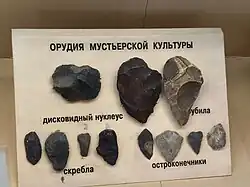
The Mousterian (or Mode III) is a type of stone tool used by early hominids during the Middle Paleolithic period of the Stone Age. This tool culture lasted from around 160,000 BC to 40,000 BC.[1][2]
Mousterian tools were made by Neanderthals in Europe, as well as early modern humans in North Africa, the Middle East, and West Asia. They used flint stones and created specialized tools like hand axes, points, and spearheads.[3]
The Mousterian culture was named after the type site of Le Moustier, three rock shelters in the Dordogne region of France.[4]
Characteristics
Europe
Neanderthals in Europe made a style of tools that scientists call the European Mousterian. It existed from around 160,000 BC to 40,000 BC.[5]
Some European Mousterian artifacts have very small points. Some were created with a process called the Levallois technique. Others used a different type of method where a flint stone core was prepared for use. Some researchers think this means Neanderthals had greater grip strength than earlier hominids.[6]
North Africa & Near East
In North Africa and the Near East, early modern humans made Mousterian tools.[7] The Mousterian industry in North Africa is estimated to be 315,000 years old.[1]
Locations

Mousterian tools have been found in the following locations.
North Africa
Middle East
- Syria (found in a cave with a Neanderthal skeleton)[8]
- The Zagros region of Iran and Central Iran
- Israel[9]
Israel is one of the places where remains of both Neanderthals and Homo sapiens sapiens have been found with Mousterian artifacts.[10]
Asia
- The Haibak Valley in Afghanistan[8]
In Azerbaijan, Mousterian artifacts were found with the lower jaw of a hominid named Azykhantrop. Scientists think this was an earlier species that existed before Neanderthals.[11][12]
Europe
Photo gallery
 Stone scrapers for cleaning and working leather (Israel, 250,000-50,000 BC)

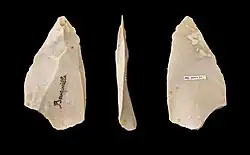 Points created using the Levallois technique
 Mousterian notch for sharpening wood, and denticulate for sawing wood and bone (Israel, 250,000-22,000 BC)
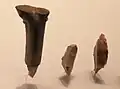 Mousterian and Aurignacian stone burins for cutting stone and wood (250,000–22,000 BC). Israel Museum
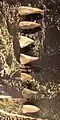 Mousterian stone spearheads (250,000–50,000 BC). Israel Museum.
Related pages
References
- 1 2 Richter, Daniel; Grün, Rainer; Joannes-Boyau, Renaud; Steele, Teresa E.; Amani, Fethi; Rué, Mathieu; Fernandes, Paul; Raynal, Jean-Paul; Geraads, Denis (2017-06-07). "The age of the hominin fossils from Jebel Irhoud, Morocco, and the origins of the Middle Stone Age". Nature. 546 (7657): 293–296. Bibcode:2017Natur.546..293R. doi:10.1038/nature22335. ISSN 0028-0836. PMID 28593967. S2CID 205255853.
- ↑ Shaw, Ian; Jameson, Robert, eds. (1999). A Dictionary of Archaeology. Blackwell. p. 408. ISBN 0-631-17423-0.
- ↑ Aldenderfer, Mark; Andrea, Alfred J.; McGeough, Kevin; Mierse, William E.; Neel, Carolyn (29 April 2010). World History Encyclopedia. ABC-CLIO. p. 330. ISBN 978-1-85109-929-0. Retrieved 23 November 2011.
- ↑ Haviland, William A.; Prins, Harald E. L.; Walrath, Dana; McBride, Bunny (24 February 2009). The Essence of Anthropology. Cengage Learning. p. 87. ISBN 978-0-495-59981-4. Retrieved 23 November 2011.
- ↑ Shaw, Ian; Jameson, Robert, eds. (1999). A Dictionary of Archaeology. Blackwell. p. 408. ISBN 0-631-17423-0. Retrieved 1 August 2016. "the classic Mousterian can be identified after perhaps 160,000 BP and lasts until c. 40,000 BP in Europe."
- ↑ Dibble, Harold L.; McPherron, Shannon P. (October 2006). "The Missing Mousterian". Current Anthropology. 47 (5): 777–803. doi:10.1086/506282. S2CID 145362900.
- ↑ Shea, J. J. (2003). "Neandertals [sic], competition and the origin of modern human behaviour in the Levant". Evolutionary Anthropology. 12: 173–187. doi:10.1002/evan.10101. S2CID 86608040.
- 1 2 3 4 5 6 Langer, William L., ed. (1972). An Encyclopedia of World History (5th ed.). Boston: Houghton Mifflin Company. pp. 9. ISBN 0-395-13592-3.
- ↑ Condemi, Silvana (1999-10-15). "The Mousterian Populations of the Near East". Bulletin du Centre de recherche français à Jérusalem (5): 60–70. ISSN 2075-5287.
- ↑ Levy, T., ed. (2001). The Archaeology of Society in the Holy Land. London: Leicester University Press.
- ↑ Lan Shaw, Robert Jameson, ed. (2008). A Dictionary of Archaeology. John Wiley & Sons. ISBN 9780470751961.
- ↑ Dolukhanov, Pavel (2004). The Early Slavs: Eastern Europe from the Initial Settlement to the Kievan Rus. Routledge. ISBN 9781317892229.
- ↑ Karavanić, Ivor; Vukosavljević, Nikola; Janković, Ivor; Ahern, James C.M.; Smith, Fred H. (November 2018). "Paleolithic hominins and settlement in Croatia from MIS 6 to MIS 3: Research history and current interpretations". Quaternary International. 494: 152–166. Bibcode:2018QuInt.494..152K. doi:10.1016/j.quaint.2017.09.034. S2CID 134269685.
- ↑ "Paleolithic hominins and settlement in Croatia from MIS 6 to MIS 3: Research history and current interpretations". ResearchGate.
- ↑ Simek, Jan F.; Smith, Fred H. (1997-06-01). "Chronological changes in stone tool assemblages from Krapina (Croatia)". Journal of Human Evolution. 32 (6): 561–575. doi:10.1006/jhev.1996.0129. ISSN 0047-2484. PMID 9210018.
- ↑ Ahern, James C. M; Karavanić, Ivor; Paunović, Maja; Janković, Ivor; Smith, Fred H (2004-01-01). "New discoveries and interpretations of hominid fossils and artifacts from Vindija Cave, Croatia". Journal of Human Evolution. 46 (1): 27–67. doi:10.1016/j.jhevol.2003.09.010. ISSN 0047-2484. PMID 14698684.
- ↑ "The Mousterian industry of Veternica Cave". ResearchGate.
- ↑ Harvati, Katerina; Roksandic, Mirjana (2017-01-18). Paleoanthropology of the Balkans and Anatolia: Human Evolution and its Context. Springer. ISBN 978-94-024-0874-4.
- ↑ Bekker, Henk (23 October 2017). "Neues Museum in Berlin 1175".