Moons of Saturn
The planet Saturn has 274 moons with confirmed and stable orbits. Sixty-three of these have officially been named, after Titans, Giants, or minor Greek or Roman gods.[1] Most of these moons are very small: 248 of the above total are less than 10 km (6 mi) in diameter.[2] Saturn also has many moonlets, extremely tiny particles within Saturn's rings that orbit the planet.
Confirmed moons
The moons of Saturn that were announced by 2018 are listed here by orbital period (or semi-major axis), from shortest to longest. Moons massive enough for their surfaces to have collapsed into a spheroid are highlighted in bold, while the irregular moons are listed in red, orange and gray background.
| Key | ||||
|---|---|---|---|---|
| † Major icy moons |
♠ Titan |
‡ Inuit group |
♦ Gallic group |
♣ Norse group |
| Order | Label [a] |
Name | Pronunciation | Image | Diameter (km)[b] | Mass (×1015 kg) [c] |
Semi-major axis (km) [d] | Orbital period (d)[d][e] | Inclination [d][f] | Eccentricity | Position | Discovery year |
Discoverer |
|---|---|---|---|---|---|---|---|---|---|---|---|---|---|
| 1 | S/2009 S 1 | — |  | ≈ 0.3 | < 0.0001 | ≈ 117000 | ≈ 0.47 | ≈ 0° | ≈ 0 | outer B Ring | 2009 | Cassini | |
| (moonlets) | — |  | 0.04 to 0.4 (Earhart) | < 0.0001 | ≈ 130000 | ≈ 0.55 | ≈ 0° | ≈ 0 | Three 1000 km bands within A Ring | 2006 | Cassini | ||
| 2 | XVIII | Pan | /ˈpæn/ |  | 28.2±2.6 (34 × 31 × 20) | 4.95±0.75 | 133584 | +0.57505 | 0.001° | 0.000035 | in Encke Division | 1990 | M. Showalter |
| 3 | XXXV | Daphnis | /ˈdæfnɪs/ |  | 7.6±1.6 (9 × 8 × 6) | 0.084±0.012 | 136505 | +0.59408 | ≈ 0° | ≈ 0 | in Keeler Gap | 2005 | Cassini |
| 4 | XV | Atlas | /ˈætləs/ |  | 30.2±1.8 (41 × 35 × 19) | 6.6±0.045 | 137670 | +0.60169 | 0.003° | 0.0012 | outer A Ring shepherd | 1980 | Voyager 2 |
| 5 | XVI | Prometheus | /proʊˈmiːθiəs/ | 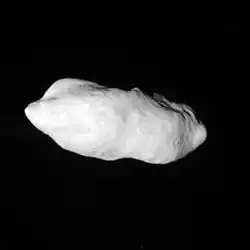 | 86.2±5.4 (136 × 79 × 59) | 159.5±1.5 | 139380 | +0.61299 | 0.008° | 0.0022 | inner F Ring shepherd | 1980 | Voyager 2 |
| 6 | XVII | Pandora | /pænˈdɔːrə/ | 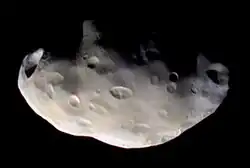 | 81.4±3.0 (104 × 81 × 64) | 137.1±1.9 | 141720 | +0.62850 | 0.050° | 0.0042 | outer F Ring Shepherd | 1980 | Voyager 2 |
| 7a | XI | Epimetheus | /ɛpɪˈmiːθiəs/ | 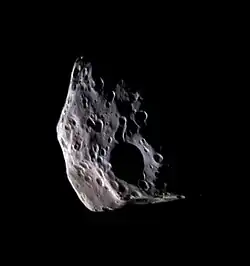 | 116.2±3.6 (130 × 114 × 106) | 526.6±0.6 | 151422 | +0.69433 | 0.335° | 0.0098 | co-orbital with Janus | 1977 | J. Fountain, and S. Larson |
| 7b | X | Janus | /ˈdʒeɪnəs/ |  | 179.0±2.8 (203 × 185 × 153) | 1897.5±0.6 | 151472 | +0.69466 | 0.165° | 0.0068 | co-orbital with Epimetheus | 1966 | A. Dollfus |
| 9 | LIII | Aegaeon | /iːˈdʒiːən/ |  | ≈ 0.5 | ≈ 0.0001 | 167500 | +0.80812 | 0.001° | 0.0002 | G Ring moonlet | 2008 | Cassini |
| 10 | I | †Mimas | /ˈmaɪməs/ | 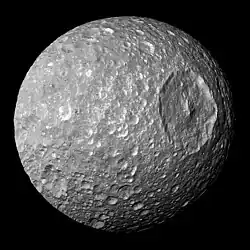 | 396.4±0.8 (416 × 393 × 381) | 37493±31 | 185404 | +0.942422 | 1.566° | 0.0202 | 1789 | W. Herschel | |
| 11 | XXXII | Methone | /mɪˈθoʊniː/ |  | 3.2±1.2 | ≈ 0.02 | 194440 | +1.00957 | 0.007° | 0.0001 | Alkyonides | 2004 | Cassini |
| 12 | XLIX | Anthe | /ˈænθiː/ |  | 1.8 | ≈ 0.0015 | 197700 | +1.05089 | 0.1° | 0.0011 | Alkyonides | 2007 | Cassini |
| 13 | XXXIII | Pallene | /pəˈliːniː/ |  | 5.0±1.2 (6 × 6 × 4) | ≈ 0.05 | 212280 | +1.15375 | 0.181° | 0.0040 | Alkyonides | 2004 | Cassini |
| 14 | II | †Enceladus | /ɛnˈsɛlədəs/ |  | 504.2±0.4 (513 × 503 × 497) | 108022±101 | 237950 | +1.370218 | 0.010° | 0.0047 | Generates the E ring | 1789 | W. Herschel |
| 15 | III | †Tethys | /ˈtiːθɪs/ |  | 1062±1.2 (1077 × 1057 × 1053) | 617449±132 | 294619 | +1.887802 | 0.168° | 0.0001 | 1684 | G. Cassini | |
| 15a | XIII | Telesto | /tɪˈlɛstoʊ/ | 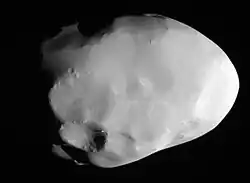 | 24.8±0.8 (33 × 24 × 20) | ≈ 9.41 | 294619 | +1.887802 | 1.158° | 0.000 | leading Tethys trojan | 1980 | B. Smith, H. Reitsema, S. Larson, and J. Fountain |
| 15b | XIV | Calypso | /kəˈlɪpsoʊ/ | 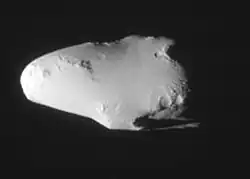 | 21.4±1.4 (30 × 23 × 14) | ≈ 6.3 | 294619 | +1.887802 | 1.473° | 0.000 | trailing Tethys trojan | 1980 | D. Pascu, P. Seidelmann, W. Baum, and D. Currie |
| 18 | IV | †Dione | /daɪˈoʊniː/ |  | 1122.8±0.8 (1128 × 1123 × 1119) | 1095452±168 | 377396 | +2.736915 | 0.002° | 0.0022 | 1684 | G. Cassini | |
| 18a | XII | Helene | /ˈhɛlɪniː/ |  | 35.2±0.8 (43 × 38 × 26) | ≈ 24.46 | 377396 | +2.736915 | 0.212° | 0.0022 | leading Dione trojan | 1980 | P. Laques and J. Lecacheux |
| 18b | XXXIV | Polydeuces | /pɒliˈdjuːsiːz/ |  | 2.6±0.8 (3 × 2 × 1) | ≈ 0.03 | 377396 | +2.736915 | 0.177° | 0.0192 | trailing Dione trojan | 2004 | Cassini |
| 21 | V | †Rhea | /ˈriːə/ | 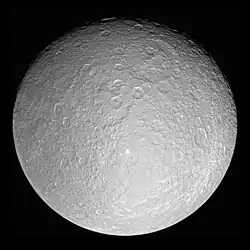 | 1527.0±1.2 (1530 × 1526 × 1525) | 2306518±353 | 527108 | +4.518212 | 0.327° | 0.001258 | 1672 | G. Cassini | |
| 22 | VI | ♠Titan | /ˈtaɪtən/ | 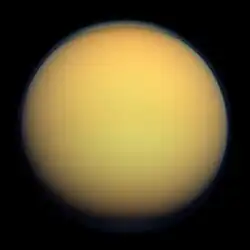 | 5149.46±0.18 (5149 × 5149 × 5150) | 134520000±20000 | 1221930 | +15.94542 | 0.3485° | 0.0288 | 1655 | C. Huygens | |
| 23 | VII | †Hyperion | /haɪˈpɪəriən/ |  | 270±8 (360 × 266 × 205) | 5620±50 | 1481010 | +21.27661 | 0.568° | 0.123006 | in 4:3 resonance with Titan | 1848 | W. Bond G. Bond W. Lassell |
| 24 | VIII | †Iapetus | /aɪˈæpɪtəs/ | 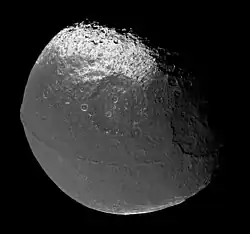 | 1468.6±5.6 (1491 × 1491 × 1424) | 1805635±375 | 3560820 | +79.3215 | 15.47° | 0.028613 | 1671 | G. Cassini | |
| 25 | XXIV | ‡Kiviuq | /ˈkɪviək/ | ≈ 16 | ≈ 2.79 | 11294800 | +448.16 | 49.087° | 0.3288 | Inuit group | 2000 | B. Gladman, J. Kavelaars, et al. | |
| 26 | XXII | ‡Ijiraq | /ˈiːɪrɒk/ |  | ≈ 12 | ≈ 1.18 | 11355316 | +451.77 | 50.212° | 0.3161 | Inuit group | 2000 | B. Gladman, J. Kavelaars, et al. |
| 27 | IX | ♣†Phoebe | /ˈfiːbiː/ | 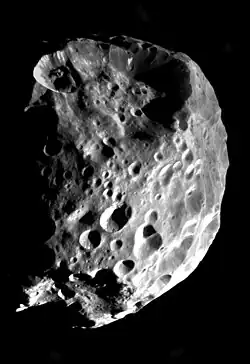 | 213.0±1.4 (219 × 217 × 204) | 8292±10 | 12869700 | −545.09 | 173.047° | 0.156242 | Norse group | 1899 | W. Pickering |
| 28 | XX | ‡Paaliaq | /ˈpɑːliɒk/ |  | ≈ 22 | ≈ 7.25 | 15103400 | +692.98 | 46.151° | 0.3631 | Inuit group | 2000 | B. Gladman, J. Kavelaars, et al. |
| 29 | XXVII | ♣Skathi | /ˈskɒði/ | ≈ 8 | ≈ 0.35 | 15672500 | −732.52 | 149.084° | 0.246 | Norse (Skathi) Group | 2000 | B. Gladman, J. Kavelaars, et al. | |
| 30 | XXVI | ♦Albiorix | /ˌælbiˈɒrɪks/ | ≈ 32 | ≈ 22.3 | 16266700 | +774.58 | 38.042° | 0.477 | Gallic group | 2000 | M. Holman | |
| 31 | ♣S/2007 S 2 | — | ≈ 6 | ≈ 0.15 | 16560000 | −792.96 | 176.68° | 0.2418 | Norse group | 2007 | S. Sheppard, D. Jewitt, J. Kleyna, B. Marsden | ||
| 32 | XXXVII | ♦Bebhionn | /bɛˈviːn/ | ≈ 6 | ≈ 0.15 | 17153520 | +838.77 | 40.484° | 0.333 | Gallic group | 2004 | S. Sheppard, D. Jewitt, J. Kleyna | |
| 33 | XXVIII | ♦Erriapus | /ɛriˈæpəs/ | ≈ 10 | ≈ 0.68 | 17236900 | +844.89 | 38.109° | 0.4724 | Gallic group | 2000 | B. Gladman, J. Kavelaars, et al. | |
| 34 | XLVII | ♣Skoll | /ˈskɒl/ | ≈ 6 | ≈ 0.15 | 17473800 | −862.37 | 155.624° | 0.418 | Norse (Skathi) group | 2006 | S. Sheppard, D. Jewitt, J. Kleyna | |
| 35 | XXIX | ‡Siarnaq | /ˈsiːɑːrnək/ | ≈ 40 | ≈ 43.5 | 17776600 | +884.88 | 45.798° | 0.24961 | Inuit group | 2000 | B. Gladman, J. Kavelaars, et al. | |
| 36 | LII | ‡Tarqeq | /ˈtɑːrkeɪk/ | ≈ 7 | ≈ 0.23 | 17910600 | +894.86 | 49.904° | 0.1081 | Inuit group | 2007 | S. Sheppard, D. Jewitt, J. Kleyna | |
| 37 | ♣S/2004 S 13 | — | ≈ 6 | ≈ 0.15 | 18056300 | −905.85 | 167.379° | 0.261 | Norse group | 2004 | S. Sheppard, D. Jewitt, J. Kleyna | ||
| 38 | LI | ♣Greip | /ˈɡreɪp/ | ≈ 6 | ≈ 0.15 | 18065700 | −906.56 | 172.666° | 0.3735 | Norse group | 2006 | S. Sheppard, D. Jewitt, J. Kleyna | |
| 39 | XLIV | ♣Hyrrokkin | /hɪˈrɒkɪn/ | ≈ 8 | ≈ 0.35 | 18168300 | −914.29 | 153.272° | 0.3604 | Norse (Skathi) group | 2006 | S. Sheppard, D. Jewitt, J. Kleyna | |
| 40 | L | ♣Jarnsaxa | /jɑːrnˈsæksə/ | ≈ 6 | ≈ 0.15 | 18556900 | −943.78 | 162.861° | 0.1918 | Norse group | 2006 | S. Sheppard, D. Jewitt, J. Kleyna | |
| 41 | XXI | ♦Tarvos | /ˈtɑːrvəs/ | ≈ 15 | ≈ 2.3 | 18562800 | +944.23 | 34.679° | 0.5305 | Gallic group | 2000 | B. Gladman, J. Kavelaars, et al. | |
| 42 | XXV | ♣Mundilfari | /mʊndəlˈværi/ | ≈ 7 | ≈ 0.23 | 18725800 | −956.70 | 169.378° | 0.198 | Norse group | 2000 | B. Gladman, J. Kavelaars, et al. | |
| 43 | ♣S/2006 S 1 | — | ≈ 6 | ≈ 0.15 | 18930200 | −972.41 | 154.232° | 0.1303 | Norse (Skathi) group | 2006 | S. Sheppard, D.C. Jewitt, J. Kleyna | ||
| 44 | ♣S/2004 S 17 | — | ≈ 4 | ≈ 0.05 | 19099200 | −985.45 | 166.881° | 0.226 | Norse group | 2004 | S. Sheppard, D. Jewitt, J. Kleyna | ||
| 45 | XXXVIII | ♣Bergelmir | /bɛərˈjɛlmɪər/ | ≈ 6 | ≈ 0.15 | 19104000 | −985.83 | 157.384° | 0.152 | Norse (Skathi) group | 2004 | S. Sheppard, D. Jewitt, J. Kleyna | |
| 46 | XXXI | ♣Narvi | /ˈnɑːrvi/ |  | ≈ 7 | ≈ 0.23 | 19395200 | −1008.45 | 137.292° | 0.320 | Norse (Narvi) group | 2003 | S. Sheppard, D. Jewitt, J. Kleyna |
| 47 | XXIII | ♣Suttungr | /ˈsʊtʊŋɡər/ | ≈ 7 | ≈ 0.23 | 19579000 | −1022.82 | 174.321° | 0.131 | Norse group | 2000 | B. Gladman, J. Kavelaars, et al. | |
| 48 | XLIII | ♣Hati | /ˈhɑːti/ | ≈ 6 | ≈ 0.15 | 19709300 | −1033.05 | 163.131° | 0.291 | Norse group | 2004 | S. Sheppard, D. Jewitt, J. Kleyna | |
| 49 | ♣S/2004 S 12 | — | ≈ 5 | ≈ 0.09 | 19905900 | −1048.54 | 164.042° | 0.396 | Norse group | 2004 | S. Sheppard, D. Jewitt, J. Kleyna | ||
| 50 | XL | ♣Farbauti | /fɑːrˈbaʊti/ | ≈ 5 | ≈ 0.09 | 19984800 | −1054.78 | 158.361° | 0.209 | Norse (Skathi) group | 2004 | S. Sheppard, D. Jewitt, J. Kleyna | |
| 51 | XXX | ♣Thrymr | /ˈθrɪmər/ | ≈ 7 | ≈ 0.23 | 20278100 | −1078.09 | 174.524° | 0.453 | Norse group | 2000 | B. Gladman, J. Kavelaars, et al. | |
| 52 | XXXVI | ♣Aegir | /ˈaɪ.ɪər/ | ≈ 6 | ≈ 0.15 | 20482900 | −1094.46 | 167.425° | 0.237 | Norse group | 2004 | S. Sheppard, D. Jewitt, J. Kleyna | |
| 53 | ♣S/2007 S 3 | — | ≈ 5 | ≈ 0.09 | 20518500 | ≈ −1100 | 177.22° | 0.130 | Norse group | 2007 | S. Sheppard, D. Jewitt, J. Kleyna | ||
| 54 | XXXIX | ♣Bestla | /ˈbɛstlə/ | ≈ 7 | ≈ 0.23 | 20570000 | −1101.45 | 147.395° | 0.5145 | Norse (Narvi) group | 2004 | S. Sheppard, D. Jewitt, J. Kleyna | |
| 55 | ♣S/2004 S 7 | — | ≈ 6 | ≈ 0.15 | 20576700 | −1101.99 | 165.596° | 0.5299 | Norse group | 2004 | S. Sheppard, D. Jewitt, J. Kleyna | ||
| 56 | ♣S/2006 S 3 | — | ≈ 6 | ≈ 0.15 | 21076300 | −1142.37 | 150.817° | 0.4710 | Norse (Skathi) group | 2006 | S. Sheppard, D. Jewitt, J. Kleyna | ||
| 57 | XLI | ♣Fenrir | /ˈfɛnrɪər/ | ≈ 4 | ≈ 0.05 | 21930644 | −1212.53 | 162.832° | 0.131 | Norse group | 2004 | S. Sheppard, D. Jewitt, J. Kleyna | |
| 58 | XLVIII | ♣Surtur | /ˈsɜːrtər/ | ≈ 6 | ≈ 0.15 | 22288916 | −1242.36 | 166.918° | 0.3680 | Norse group | 2006 | S. Sheppard, D. Jewitt, J. Kleyna | |
| 59 | XLV | ♣Kari | /ˈkɑːri/ | ≈ 7 | ≈ 0.23 | 22321200 | −1245.06 | 148.384° | 0.3405 | Norse (Skathi) group | 2006 | S. Sheppard, D. Jewitt, J. Kleyna | |
| 60 | XIX | ♣Ymir | /ˈɪmɪər/ | ≈ 18 | ≈ 3.97 | 22429673 | −1254.15 | 172.143° | 0.3349 | Norse group | 2000 | B. Gladman, J. Kavelaars, et al. | |
| 61 | XLVI | ♣Loge | /ˈlɔɪ.eɪ/ | ≈ 6 | ≈ 0.15 | 22984322 | −1300.95 | 166.539° | 0.1390 | Norse group | 2006 | S. Sheppard, D. Jewitt, J. Kleyna | |
| 62 | XLII | ♣Fornjot | /ˈfɔːrnjɒt/ | ≈ 6 | ≈ 0.15 | 24504879 | −1432.16 | 167.886° | 0.186 | Norse group | 2004 | S. Sheppard, D. Jewitt, J. Kleyna |
Unconfirmed moons
The following objects (observed by Cassini) have not been confirmed as solid bodies. It is not yet clear if these are real satellites or merely persistent clumps within the F Ring.
| Name | Image | Diameter (km) | Semi-major axis (km) |
Orbital period (d) |
Position | Discovery year |
|---|---|---|---|---|---|---|
| S/2004 S 6 | 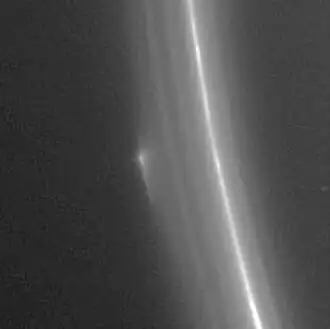 | ≈ 3–5 | ≈ 140130 | +0.61801 | uncertain objects around the F Ring | 2004 |
| S/2004 S 3/S 4[g] | 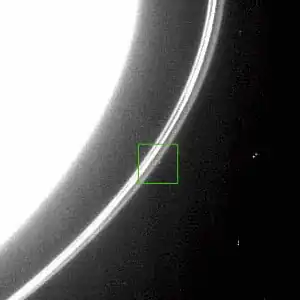 | ≈ 3–5 | ≈ 140300 | ≈ +0.619 | 2004 |
Hypothetical moons
Two moons were claimed to be discovered by different astronomers but never seen again. Both moons were said to orbit between Titan and Hyperion.
See Also
List Of Natural Satellites
References
Citations
- ↑ "Saturn: Moons". Solar System Exploration: Planets. National Aeronautics and Space Administration. 2011. Archived from the original on 2011-03-16. Retrieved 2011-04-21.
- ↑ "About Saturn & Its Moons". Cassini Solstice Mission. National Aeronautics and Space Administration. 2011. Retrieved 2011-06-25.
Notes
- ↑ A confirmed moon is given a permanent designation by the IAU consisting of a name and a Roman numeral. The nine moons that were known before 1900 (of which Phoebe is the only irregular) are numbered in order of their distance from Saturn; the rest are numbered in the order by which they received their permanent designations. Nine small moons of the Norse group and S/2009 S 1 have not yet received a permanent designation.
- ↑ The diameters and dimensions of the inner moons from Pan through Janus, Methone, Pallene, Telepso, Calypso, Helene, Hyperion and Phoebe were taken from Thomas 2010, Table 3. Diameters and dimensions of Mimas, Enceladus, Tethys, Dione, Rhea and Iapetus are from Thomas 2010, Table 1. The approximate sizes of other satellites are from the website of Scott Sheppard.
- ↑ Masses of the large moons were taken from Jacobson, 2006. Masses of Pan, Daphnis, Atlas, Prometheus, Pandora, Epimetheus, Janus, Hyperion and Phoebe were taken from Thomas, 2010, Table 3. Masses of other small moons were calculated assuming a density of 1.3 g/cm3.
- 1 2 3 The orbital parameters were taken from Spitale, et al. 2006, IAU-MPC Natural Satellites Ephemeris Service, and NASA/NSSDC.
- ↑ Negative orbital periods indicate a retrograde orbit around Saturn (opposite to the planet's rotation).
- ↑ To Saturn's equator for the regular satellites, and to the ecliptic for the irregular satellites
- ↑ S/2004 S 4 was most likely a transient clump—it has not been recovered since the first sighting.
| |||||||||||||||||||||
