Mikumari-no-Kami
| Mikumari-no-Kami | |
|---|---|
 | |
| Japanese | 水分神 |
| Temples | Kono Shrine Uda Mikumari Shrine |
| Personal information | |
| Parents |
|
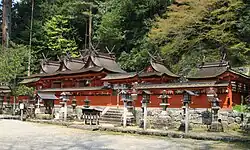
Mikumari-no-kami (水分神) is a Japanese goddess. She is worshipped at Uda Mikumari Shrine and Yoshino Mikumari Shrine.[1] Due to a pun she is associated with pregnancy and childbirth, because komori (子守) means childcare, and because of Amniotic fluid.[2][3]
The most famous shrine for her is Yoshino Mikumari Shrine.[4] Such shrines are frequently found in mountains and linked to Buddhism through Shinbutsu-shūgō.[4] The word mikumari (水分) means water distribution.[4]
Because she is a goddess of water distribution, people pray to her for help with irrigation. The god Suijin helps with other water things like Sewage treatment, avoiding drowning, and help with fishing.[5]
She has two versions Ame-no-Mikumari-no-Kami, for collecting water from rain, and Kuni-no-Mikumari-no-Kam, for collecting water from springs. In some traditions both are seen as children of Hayaakitsuhiko and Hayaakitsuhime .[1]
In other versions there is a Mikumari for every river or spring.
Related pages
- Suijin
Referemces
- 1 2 "Mikumarinokami | 國學院大學デジタルミュージアム". 2023-06-02. Archived from the original on 2023-06-02. Retrieved 2024-05-24.
{{cite web}}: CS1 maint: bot: original URL status unknown (link) - ↑ "Yoshino Mikumari Shrine - Nara". JapanTravel. 2015-09-03. Retrieved 2023-10-17.
- ↑ "Mikumari Shrine | Things to Do in Yoshino | All Japan Tours". alljapantours.com. Retrieved 2024-03-25.
- 1 2 3 Grapard, Allan G. (1982). "Flying Mountains and Walkers of Emptiness: Toward a Definition of Sacred Space in Japanese Religions". History of Religions. 21 (3): 195–221. ISSN 0018-2710. JSTOR 1062158.
- ↑ "Suijin, Water Divinity of Japan, Shinto Origin, Patron of Fishermen, Fertility, Motherhood". www.onmarkproductions.com. Retrieved 2024-04-02.