Maroi Bori Thongba
| Meitei cuisine |
|---|
 |
| Vegetarian |
| Non vegetarian |
| Miscellaneous |
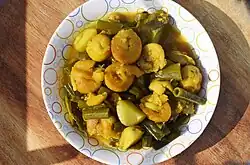
Maroi Bori Thongba (ꯃꯔꯣꯏ ꯕꯣꯔꯤ ꯊꯣꯡꯕ), also known as Maroi Thongba (ꯃꯔꯣꯏ ꯊꯣꯡꯕ), or Bori Thongba (ꯕꯣꯔꯤ ꯊꯣꯡꯕ), is a traditional dish from Meitei cuisine of Manipur. It is a curry made with bori (badi), which are small sun-dried lentil nuggets, along with Maroi herbs, vegetables and spices.[1][2] The dish is also known as Manipuri Aloo Badi. It is usually prepared with traditionally used ingredients such as chives, potatoes, urad dal badi, and heiribob, which is the peel of Manipuri citrus.[3][4][5]
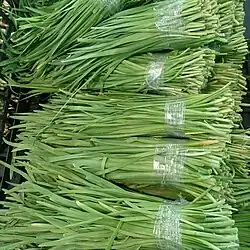
In Meitei language and cuisine, Maroi can be either Maroi Nakuppi/Nakupi (Allium tuberosum; Chinese Chive, Garlic Chives,[6] or even Allium ramosum,[7] or Allium odorum[8]) or Maroi Napakpi (Allium hookeri).[7][9][10][11]
Use of chives
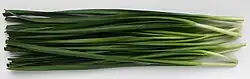
Traditionally, this dish is prepared with a large quantity of maroi nakuppi, which are chives used in Meitei traditional cooking as a substitute for onion and garlic. If fresh chives are not available, spring onions can be used instead of chives.[3][4][5]
Bori
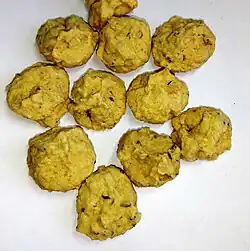

Bori, known as Badi in other places in India, are small nuggets made from sun-dried ground lentils mixed with spices. They are commonly used across India and are known by different names such as bori, bari, or wadi. In this dish, urad dal badi, which are made from soaked and ground black gram lentils, are used.[3][4][5]
Changes could be made to the traditional recipe because of the unavailability of certain ingredients. Spring onions could be used in place of chives, and plain lemon peel could be used instead of heiribob or Khasi papeda. Other than these changes, the ingredients and proportions should be kept close to the original recipe.[3][4][5]
Variations
Maroi Bori Thongba is traditionally prepared with a large amount of chopped chives. The dish can vary in its ingredients. It may include maroi and bori, maroi with peanuts, maroi with potatoes and thangjing, which is also known as makhana, lotus seed, or foxnut, or only maroi with thangjing. Another common variation is maroi aloo badi. The dish can also be made using different combinations of these ingredients.[3][4][5]
Ingredients
For frying the bori, the ingredients include small pieces of urad dal badi, mustard oil, and whole dried red chillies.[3][4][5]
For preparing the aloo badi, mustard oil is used along with a pinch of asafoetida powder, fresh bay leaves if available, cumin seeds, chives or spring onions, sliced onion, ginger garlic paste, diced tomatoes, diced potatoes, citrus peel such as heiribob or lemon peel, garam masala, and salt.[3][4][5]
Preparation
The onions are sliced finely. The potatoes are peeled and cut into small cubes of about one centimetre and kept in water to prevent discoloration. The tomatoes are diced into small pieces. The chives or spring onions are cut into one-inch lengths. The citrus peel is minced into small pieces.[3][4][5]
Frying the bori
A pan is heated and mustard oil is added. The oil is heated without allowing it to smoke. The bori are added and fried on low heat until they turn light brown, which takes about two minutes. Whole dried red chillies are then added and fried until they begin to turn black. The badi and chillies are then removed and kept aside in a dry bowl.[3][4][5]
Cooking the curry
In the same pan, the aloo badi is prepared. If there is not enough oil left, additional mustard oil is added. Cumin seeds are added and allowed to crackle. Asafoetida, bay leaves, and sliced chives are then added and sauteed on low heat until the chives begin to blacken. The heat is increased and sliced onions are added and cooked until they turn golden brown. Ginger garlic paste is then added and sauteed until its aroma develops. Tomatoes are added and stirred on high heat until they blend into the gravy.[3][4][5]
The potatoes are drained and added to the pan and mixed well with the masala. The fried badi and red chillies are added along with any remaining oil. The citrus peel, garam masala, and salt are added and mixed well. Water is poured in until the curry is fully covered. The mixture is brought to a boil and then reduced to a simmer for about twenty minutes. The badi become soft and spongy and the potatoes are cooked through. The dish is then removed to a serving bowl and served hot with steamed rice.[3][4][5]
Related pages
References
- ↑ Meitei, Sanjenbam Yaiphaba; Chaudhuri, Sarit K.; Arunkumar, M. C. (2020-11-25). The Cultural Heritage of Manipur. Routledge. p. 243. ISBN 978-1-000-29629-7.
- ↑ Borthakur, Anwesha; Singh, Pardeep (2025-05-02). People and Mountain Environments: Interconnectedness for Sustainable Development in the Himalayas. Springer Nature. p. 58. ISBN 978-3-031-83553-7.
- 1 2 3 4 5 6 7 8 9 10 11 Shridhar, Purabi, and Sanghita Singh. The Seven Sisters: Kitchen Tales from the North East.
- 1 2 3 4 5 6 7 8 9 10 11 Shukla, Sujata (2019-01-30). "Aloo Badi Manipuri/ Bori Thongba/ Potato Lentil Nuggets". PepperOnPizza. Retrieved 2026-02-17.
- 1 2 3 4 5 6 7 8 9 10 11 "Why Nakuppi is the Definitive Flavour of Meitei Cuisine". GOYA. 2024-05-09. Retrieved 2026-02-17.
- ↑ Ravindran, P. N.; Sivaraman, K.; Devasahayam, S.; Babu, K. Nirmal (2024-06-24). Handbook of Spices in India: 75 Years of Research and Development. Springer Nature. p. 3583. ISBN 978-981-19-3728-6.
- 1 2 Jain, V.; Jain, S. K. (2017-07-01). Dictionary of Local-Botanical Names in Indian Folk Life. Scientific Publishers. p. 193. ISBN 978-93-87869-57-8.
- ↑ Tamang, Jyoti Prakash (2020-03-02). Ethnic Fermented Foods and Beverages of India: Science History and Culture. Springer Nature. p. 353. ISBN 978-981-15-1486-9.
- ↑ Gantait, Saikat; Majumder, Jayoti; Sharangi, Amit Baran (2024-05-30). Biotechnology of Medicinal Plants with Antiallergy Properties: Research Trends and Prospects. Springer Nature. p. 50. ISBN 978-981-97-1467-4.
- ↑ Samanta, Suman Kumar; Talukdar, Narayan Chandra (2025-08-19). Innovations in Bioactive Compound Discovery. Cambridge Scholars Publishing. p. 84. ISBN 978-1-0364-5516-3.
- ↑ Kumar, Ajay; Singh, Pardeep; Singh, Suruchi; Singh, Bhupinder (2023-04-03). Wild Food Plants for Zero Hunger and Resilient Agriculture. Springer Nature. p. 138. ISBN 978-981-19-6502-9.